Competitor Guest Post Checker: How to Find Rival Backlinks and Turn Them into Link Building Wins
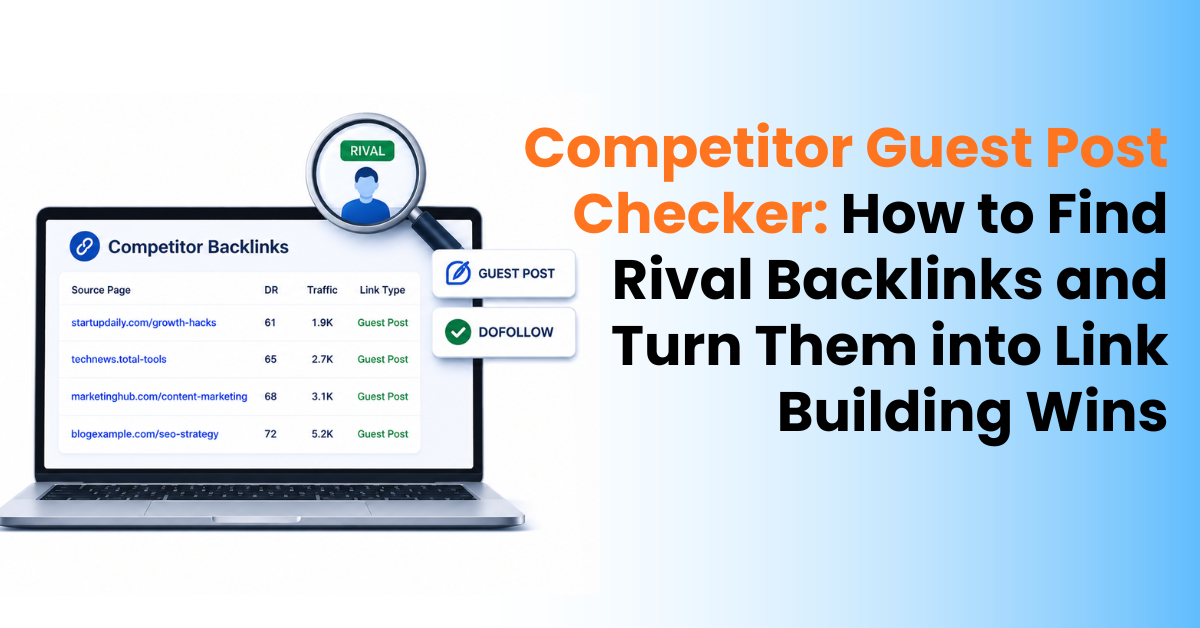
Every link your competitor has earned came from somewhere. A blog that accepted their guest post is a blog that will probably accept yours. A site that linked to their resource page will likely link to a better one. The hard part finding those sites has already been done for you. You just need the right tool and a clear process to act on it.
This guide walks you through exactly how to use a competitor guest post checker, filter the noise from 500 raw backlinks down to 30 golden opportunities, and convert them into live, dofollow links for your own domain.
Quick Win: Vefogix offers a free Competitor Guest Post Checker, run your top competitor right now before reading further.
What Is a Competitor Guest Post Checker — And Why Does It Matter?
A competitor guest post checker is a backlink analysis tool with one specific job: it filters a rival site's entire backlink profile and surfaces only the links that came from guest posts or contributed articles. Instead of scrolling through thousands of directory listings, forum profiles, and press releases, you see only the sites that published editorial content from your competitor and linked back to them.
The logic is powerful. If a site published your competitor's article, it accepts contributed content. That site is not a cold lead it's a proven opportunity. You're not guessing whether they accept guest posts. You already know they do.
According to a 2023 Ahrefs study, pages ranking in position one carry an average of 3.8× more backlinks than pages in position five for the same keyword. Those links did not come from random outreach. They came from a specific set of sites already open to linking in that niche and a competitor guest post checker gives you that list directly.
Why this beats cold prospecting: Cold outreach to unknown sites has a 3–5% response rate. Reaching out to sites you know have already published in your space typically returns 15–30%. The difference is proof of intent.
Step 1: Pick the Right Competitors to Analyze
Start with competitors who are already winning the keywords you want to rank for specifically those on page one. Targeting a DR 90 enterprise site when you're a DR 30 blog will produce a list of links you cannot realistically earn. Focus on sites in your range.
Three criteria for choosing the right competitors to study:
- Ranking positions 1–5 for your primary target keyword right now
- Domain Rating (DR) within 20 points of your own site their links are reachable
- Content topic overlap of 40%+ with your site (check via Ahrefs Content Gap or Semrush Topic Research)
Three to five competitors are the right number. Fewer means you miss opportunities. More means you spend hours deduplicating a list that converges on the same 30–50 sites anyway.
Step 2: Pull the Backlink Profile with a Guest Post Checker Tool
Every major SEO platform Ahrefs, SEMrush, Moz lets you export a competitor's full backlink profile. The key is knowing which filters to apply so you surface guest posts, not noise. Below are the exact filter sequences for each major tool.
|
Tool |
Filter Sequence |
Export Tip |
|
Ahrefs |
Site Explorer → Backlinks → Filter: Dofollow | One link per domain ON | Anchor: Branded/URL | Sort by DR desc |
Export CSV. Sort by DR column. Delete rows under DR 35. |
|
SEMrush |
Backlink Analytics → Filter: Follow | Status: Active | Sort by Authority Score desc |
Export as CSV. Cross-reference traffic column — ignore sites under 1K/mo. |
|
Vefogix Guest Post Checker (free) |
Enter competitor URL → tool auto-classifies links as Guest Post / Directory / Editorial |
Fastest shortcut. Classifications are 80%+ accurate. Spot-check top 20 before pitching. |
Step 3: Filter Down to Genuine Guest Post Opportunities
A raw export of 500 backlinks contains hundreds of useless links. Apply the five filters below in sequence. Most lists drop to 40–80 real opportunities worth your time.
|
Filter |
Keep If You See… |
Remove If You See… |
|
Page title |
"Written by", "Guest post by", "Contributor", "About the author" |
Homepage links, product/category pages, sitemaps |
|
Anchor text |
Competitor's brand name or a target keyword |
"Click here", "this site", "read more" (generic anchors) |
|
Linking page type |
Blog articles, opinion pieces, how-to guides |
Forum threads, web directories, press syndication sites |
|
DR range |
DR 40–80 (reachable and genuinely valuable) |
Under DR 20 (almost zero value), over DR 85 (near-impossible to earn) |
|
Organic traffic |
Site receives 1,000+ monthly organic visitors |
Traffic-less sites regardless of how high their DR looks |
Pro Tip: A DR 55 site with 400 monthly visitors is almost certainly a link farm. Always verify organic traffic in Ahrefs or Semrush before adding any site to your pitch list.
Step 4: Score and Prioritise the List
Not all filtered sites are equal. Before you spend a minute drafting an email, score each site against three variables. This prevents you from burning your best pitches on sites that will not move your rankings.
1. Topical Relevance (Most Important)
A DR 55 site in your exact niche outperforms a DR 70 site that's only tangentially related. Google's 2024 Helpful Content updates reinforced topical authority as a primary ranking signal. A link from an off-topic blog even a high-authority one contributes far less to your rankings than an on-topic link from a smaller, focused site.
2. Real Traffic (Not Just Metrics)
Use the "Traffic value" metric in Ahrefs or the "Authority Score traffic" estimate in Semrush. A site with DR 45 and 15,000 monthly organic visitors is more valuable than a DR 60 site with 200 visitors. The former sends actual humans to your site and signals editorial relevance to Google.
3. Editorial Standards
Browse five recent articles on the site before pitching. Sites that publish anything submitted to them inconsistent quality, no named authors, no editorial voice are regularly devalued by Google's quality systems. Target sites with real editors, consistent formatting, and author bios.
Spend 80% of your outreach budget on your top 20 scored sites. A focused effort on 20 quality targets consistently outperforms spray-and-pray across 200.
Step 5: Find Contacts and Send the Pitch
Finding the right person to email is half the battle. Pitching a generic info@ address drops your response rate by roughly 60% compared to reaching a named editor or content manager.
How to Find the Right Contact
- Check the "Write for Us" or "Contribute" page first many lists a direct email address.
- Search LinkedIn: "[site name] editor" or "[site name] content manager".
- Use Hunter.io or Apollo.io to find verified email formats for the domain.
- Find the author of their most recent article that person often manages submissions.
The Pitch Template That Gets Responses
A pitch that converts does exactly three things: names a specific topic the site hasn't covered, proves you understand their audience, and fits inside 150 words. Editors receive dozens of submissions per week. Anything longer signals you haven't done your homework.
Subject: Guest post idea for [Site Name] — [Specific Topic Title]
Hi [Name],
I noticed [Site Name] hasn't covered [specific gap] yet, even though your audience regularly asks about [related pain point] — it gets 2,400 monthly searches.
I'd like to write "[Proposed Title]" for you. I've covered similar ground at [Publication 1] and [Publication 2].
Happy to send an outline first. Would this fit your editorial calendar?
Follow-up Rule: Follow up once after 7 days. A single follow-up increases response rates by 28% (Backlinko, 2023). Two or more follow-ups starts to damage your sender reputation with that editor.
Step 6: Track Live Placements and Measure What Actually Moves Rankings
Every confirmed guest post placement needs to be tracked in two places: your outreach CRM (even a simple Google Sheet works) and your backlink monitoring tool.
Set up an Ahrefs or SEMrush alert on your domain so you're notified the moment a new link goes live. Once it does, log the DR, anchor text, linking URL, and the page on your site it points to. Check rankings on that target page after 60 and 90 days.
A realistic benchmark: a campaign targeting DR 40–70 guest post sites produces measurable ranking movement on target pages within 60–90 days, assuming the content on those pages is already competitive. Links alone won't rank a thin page — but links on a strong page move fast.
5 Mistakes That Kill Guest Post Campaigns (And How to Avoid Them)
Mistake 1: Only Targeting High-DR Sites
Sites with DR above 85 receive hundreds of pitches weekly. Acceptance rates for unknown brands fall under 5%. DR 40–65 sites have real audiences, real editorial standards, and acceptance rates of 15–30% for well-targeted pitches. Start there.
Mistake 2: Ignoring Niche Edits as an Alternative
A niche edit placing your link into an existing published article is often faster and more valuable than a full guest post. Many sites that won't accept new content will add a relevant link to an existing post. This option is underused by 90% of link builders. Also known as link insertion services or authority link insertions.
Mistake 3: Writing a Generic Pitch
An editor knows within three sentences whether you've read their site. Referencing a specific article, they published and explaining how your topic builds on it separates your pitch from everything else in the inbox.
Mistake 4: Not Verifying Traffic Before Pitching
A DR 55 site with 150 monthly organic visitors is almost certainly a private blog network (PBN) or a link farm that has never ranked for anything real. Google identifies and devalues these regularly. Always check traffic before adding any site to your outreach list.
Mistake 5: Treating Link Building as a One-Time Activity
Link building compounds. Sites that link to you once are more likely to link again. Editors who published your guest post are the warmest leads for your next pitch. Build the relationship, not just the link.
White Hat Link Building: What's Safe, What's Not
The entire process described in this guide is white hat link building. Finding sites through competitor research, pitching an original article, and earning a link because your content earns its place this is exactly how Google expects links to work.
What crosses the line:
- Paying a site owner for a link without disclosure (violates Google's link scheme guidelines)
- Using private blog networks (PBNs) Google actively detects and penalizes these
- Link exchanges ("I'll link to you if you link to me") reciprocal link schemes
- Submitting the same article to dozens of sites simultaneously (mass syndication)
Guest post outreach services and guest posting marketplaces like Vefogix operate within white hat boundaries when the link is earned by editorial contribution, not purchased placement. The distinction matters and Google's quality team understands it.
The Fastest Link Building Shortcut Is Already in Your Competitor's Profile
Your competitors have already done the prospecting. Every guest post they earned came from a site that was willing to publish in your niche, at your quality level, for your audience. A competitor guest post checker turns that track record into a list. That list filtered by relevance, DR, and real traffic becomes a repeatable outreach pipeline you can run every quarter.
Start with five competitors. Pull their guest post backlinks. Filter to your top 20 targets. Send your first batch of pitches this week. That single action puts you ahead of every competitor who is still building their prospect list from scratch.
Ready to Find Your Competitor's Guest Post Links?
Stop guessing which sites accept guest posts in your niche. The free Competitor Guest Post Checker at Vefogix gives you a filtered, actionable list of proven guest post opportunities pulled directly from your rival's backlink profile in minutes, no signup required.
Run Your Free Competitor Analysis →
Already have your target list? Browse Vefogix's Guest Post Marketplace to place links on 92,000+ verified sites across 80+ niches starting from $6. Filter by DR, traffic, niche, and price before you commit to a single placement.
Your competitors are building links this week. The question is whether you are.
Frequently Asked Questions
A competitor guest post checker analyses a rival website's backlink profile and identifies which links came from guest posts or contributed articles. It filters thousands of raw backlinks down to proven editorial placements — the sites most likely to accept your pitch too.
Copying the strategy is safe and standard. Earning your own link from the same site — by writing a legitimate article — is white hat link building. What violates Google's guidelines is acquiring a link artificially: paying without disclosure, using PBNs, or link exchanges.
Three to five competitors ranking on page one for your primary keyword. Beyond five, the unique opportunities thin out and you spend more time deduplicating than prospecting.
Target sites with DR 40 or above and at least 1,000 monthly organic visitors. Links from lower-authority, traffic-less sites deliver minimal ranking benefit regardless of how easy they are to get.
From first contact to a live link: expect 3–8 weeks. Following up once after seven days doubles response rates without harming the relationship.
A guest post is new content you write and publish on another site. A niche edit (also called link insertion) adds your link to an existing published article. Both are white hat. Niche edits are faster — the page already has traffic and link equity.