How to Optimize Your Website for GEO

Generative Engine Optimization (GEO) is the practice of structuring your content so that AI-powered search platforms — including ChatGPT, Perplexity, Google AI Overviews, and Microsoft Copilot — cite it as a source when generating answers to user queries.
Unlike traditional SEO, which focuses on ranking in a list of links, GEO focuses on a different outcome: being included in the synthesized response the AI assembles from across the web. The distinction matters because those two goals require different content decisions, different structural choices, and different ways of measuring success.
Why GEO Has Become Necessary in 2026
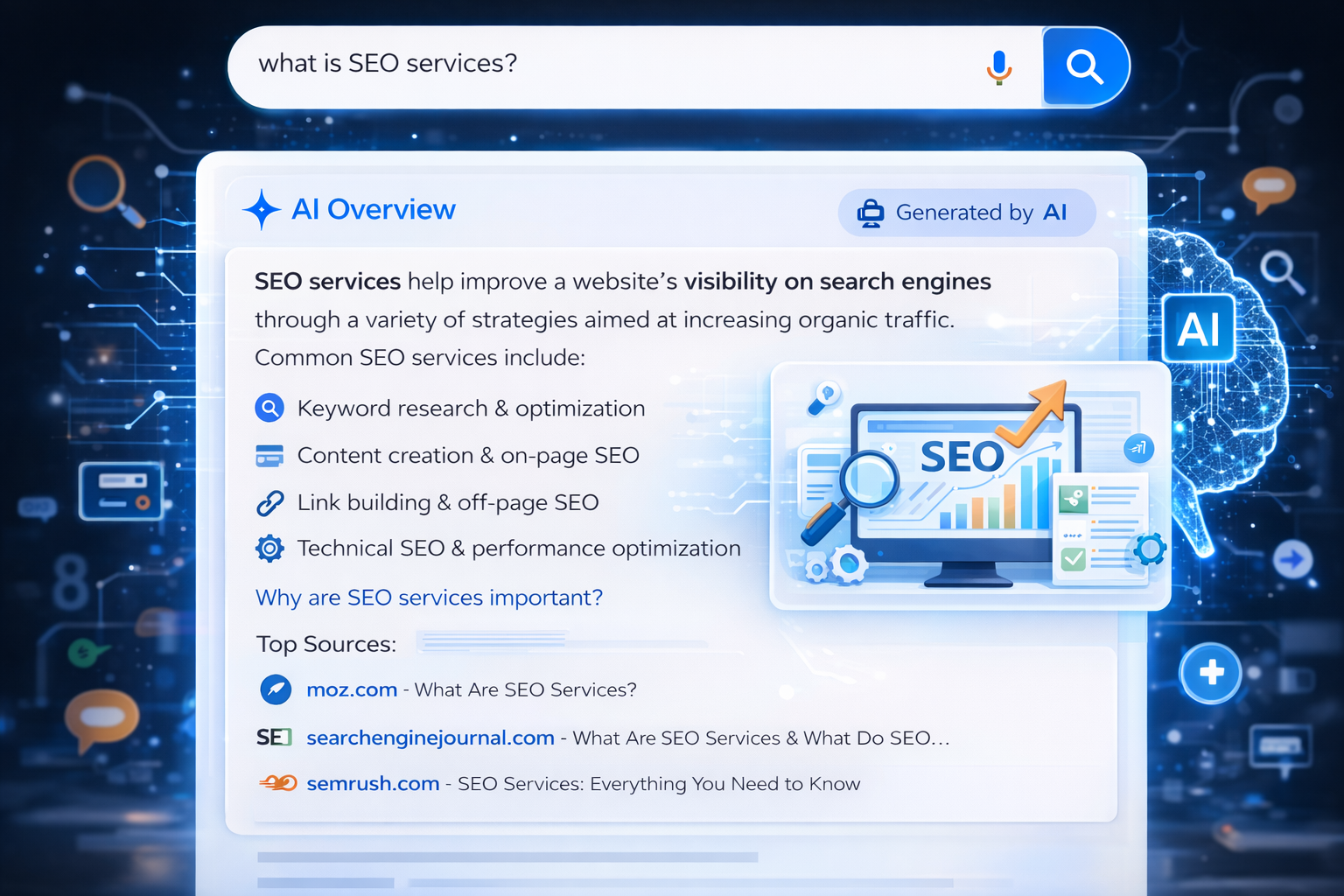
The traffic pattern that alerted most marketers to GEO was a specific one: rankings stayed stable, impressions held steady in Search Console, but clicks started dropping. The cause, in most cases, was that an AI-generated summary was answering the query before a user ever reached the organic results.
The scale of this shift is significant. ChatGPT now handles over 700 million weekly queries. Perplexity processes over 780 million monthly. Google AI Overviews appear in an estimated 60% of searches. Research from GEO firm Brandlight found that the overlap between pages ranking in Google's top results and pages cited by AI systems has dropped from 70% to below 20% — meaning a high traditional ranking no longer reliably predicts AI citation.
This is the core problem GEO addresses: your content can rank well and still be invisible in AI-generated answers if it isn't structured in ways AI retrieval systems understand and prefer.
How AI Engines Actually Select Sources
Understanding what drives citation selection is the foundation of any GEO strategy. AI systems don't read pages the way a human does — they retrieve and process content through a mechanism called retrieval-augmented generation (RAG), which works roughly like this:
When a user asks a question, the AI breaks it into multiple sub-queries, retrieves relevant content from its index for each, evaluates which sources are most authoritative and structurally useful, then synthesizes those sources into a response. Pages that get cited are the ones that emerged from retrieval as the clearest, most authoritative, most structurally accessible answers to those sub-queries.
Several factors influence whether your page makes it through that process:
Structural clarity. AI models extract passages, not whole pages. Content organized with clear headings, concise answer blocks, and logical section hierarchy is easier to parse and more likely to produce extractable passages that fit cleanly into a synthesized response.
Factual density. AI engines prefer content that makes specific, verifiable claims over content that makes general observations. Citing statistics, naming specific tools or studies, and including dates and data points all increase what researchers call "factual density" — a measurable quality signal in AI retrieval.
Authority signals. High authority backlinks, brand mentions across the web, and citations from other trusted sources still influence which domains AI engines treat as credible. A site with strong traditional SEO authority has a head start in GEO for this reason — though it isn't sufficient on its own.
Content freshness. Research on citation decay shows that pages not updated within approximately 13 weeks lose citation priority at a measurable rate. AI systems weight recency when selecting sources, particularly for topics where information changes over time.
Crawl accessibility. This is the most overlooked barrier. If AI crawlers can't access your content, nothing else matters. Several common configurations block AI bots without the site owner realizing it: Cloudflare changed its default settings in 2024 in a way that blocks AI crawlers for many sites, and robots.txt files sometimes restrict AI user agents that weren't relevant when the file was last updated.
The Technical Foundation: Making Your Site Accessible to AI
Before any content optimization will help, confirm that AI systems can actually reach your pages.
Check robots.txt. Review whether your robots.txt blocks any of the major AI crawler user agents: ChatGPT-User, GPTBot, PerplexityBot, Google-Extended, Anthropic-ai, ClaudeBot. If any of these are disallowed, those platforms cannot index your content.
Check your Cloudflare settings. If you use Cloudflare, verify whether their AI bot blocking is enabled. It may have been turned on by default during a settings update. Check this in your Cloudflare security settings under Bot Fight Mode.
Ensure content is server-side rendered. Content that loads through JavaScript after page render may not be visible to AI crawlers. If key content on your pages only appears after user interaction or JS execution, AI systems may be indexing blank or incomplete versions of those pages.
Consider creating an llms.txt file. This is an emerging convention (analogous to robots.txt but for AI systems) that provides a structured summary of your site's content, purpose, and key pages to help AI crawlers understand your site architecture efficiently.
Add schema markup. JSON-LD structured data helps AI systems understand entities and relationships on your pages. For GEO specifically, the About and Mentions schema properties are particularly useful — they explicitly declare what your page is about and which entities it discusses, reducing the interpretive work AI systems have to do. FAQ schema also performs well because it maps directly to the question-answer format AI retrieval prioritizes.
Content Structure for AI Citation
Once your site is accessible, the content itself needs to be structured for extraction rather than for reading flow.
Lead each section with a direct answer. AI retrieval systems give disproportionate weight to the first 150–200 tokens of a passage. Research from Princeton's GEO study (Aggarwal et al., 2024, published at KDD 2024) found that content beginning with a definitional or direct-answer structure receives measurably higher "impression scores" in LLM retrieval pipelines. In practice, this means opening sections with the answer, then providing supporting detail — not building to an answer through a long introduction.
Match how users actually phrase questions. AI engines mirror natural language queries. Content that uses the same phrasing patterns as real user questions — drawn from tools like AlsoAsked, Google Search Console query data, Reddit discussions, and community forums — aligns more closely with the sub-queries AI systems generate during retrieval.
Use specific data points, not general claims. The Princeton GEO research identified "statistics addition" and "cite sources" as two of the highest-impact optimization techniques, capable of boosting AI visibility by up to 40%. A sentence like "organic traffic from AI-referred sessions grew 527% year-over-year in the first half of 2025, according to Previsible's AI Traffic Report" performs better in AI retrieval than "AI search traffic is growing significantly."
Cite external authoritative sources inline. Linking to the original research or data at the point where you reference it signals credibility to AI systems and makes your content easier to verify. Use specific article URLs, not domain homepages.
Build topical depth across a content cluster, not just individual pages. AI systems prefer sources that demonstrate comprehensive coverage of a topic. A single well-written page helps, but a cluster of pages that collectively cover a topic from multiple angles — including subtopics, specific use cases, related questions, and updated data — builds the kind of topical authority that makes a domain more likely to be cited consistently across queries in that space.
The Platforms Are Not All the Same
GEO is not a single-target discipline. ChatGPT, Perplexity, Google AI Overviews, and Microsoft Copilot each have different retrieval behaviors, different preferences for content format, and different citation patterns.
Google AI Overviews build heavily on Google's existing index and E-E-A-T signals. If your site already performs well in traditional Google search, you have a foundation to work from. Structured data, clear author attribution, and content that demonstrates first-hand experience all strengthen your position here.
Perplexity tends to cite recent, specific, factually dense sources. It updates its index frequently and weights recency strongly. Content that includes current data, specific statistics, and clear sourcing performs well.
ChatGPT Search (launched late 2024) synthesizes from web sources and cites them inline. Research shows it has a strong preference for Wikipedia, established news sources, and educational domains — meaning newer sites face a higher bar for citation. Building brand mentions and citations from established publications raises your credibility signal in this context.
Microsoft Copilot draws heavily from Bing's index and shows strong preference for structured, authoritative sources. Technical accuracy and clear source attribution matter here.
A strategy that only optimizes for one platform will miss citation opportunities on the others.
Measuring GEO Performance
Traditional SEO metrics don't capture AI visibility, which creates a significant measurement gap for most marketing teams. Clicks and impressions in Google Search Console tell you about traditional search performance, not whether your content is being cited in AI-generated answers.
The metrics that matter for GEO are:
Citation rate — what percentage of AI-generated answers to your target queries include a link to your domain. This is measured by systematically testing a set of 15–25 representative prompts across the AI platforms you're targeting.
Mention rate — how often your brand name appears in AI answers, even without a clickable link. Brand mentions influence trust signals even when they don't drive direct clicks.
Citation position — when you are cited, whether your source appears as the primary reference or buried further in the response. Earlier citation positions correlate with stronger authority signals.
AI-referred traffic — sessions in your analytics that originate from ChatGPT, Perplexity, or other AI platforms. This is increasingly trackable through referral source data and UTM parameters on links AI systems cite.
Tracking these consistently — rather than only monitoring organic traffic — gives you a complete picture of your content's visibility across both traditional and AI-powered search.
The Relationship Between GEO and Traditional SEO
GEO doesn't replace SEO. It extends it.
Traditional SEO still drives discoverability, builds domain authority, and signals credibility to AI systems — many of which factor conventional search signals into their source selection. A site with no SEO foundation will have a harder time earning AI citations than a site with established authority in its niche.
But SEO alone is no longer sufficient. A page can rank in position one on Google and still not appear in the AI overview above it, because AI extraction selects for structure, factual density, and direct-answer clarity in ways that traditional ranking signals don't fully account for.
The most effective approach in 2026 builds both disciplines together: traditional SEO handles rankings, discoverability, and domain authority; GEO-specific structuring — direct answer blocks, entity schema, factual density, citation sourcing, and content freshness — handles AI extraction. Neither replaces the other, and neither is sufficient alone.
A Practical Starting Point
If you're looking GEO services, prioritize your highest-traffic pages and most commercially important topics first. For each, work through this sequence:
Confirm AI crawlers can access the page. Restructure the opening of each main section to lead with a direct answer. Add specific data points with inline citations to authoritative sources. Implement or update JSON-LD schema with About and Mentions properties. Add or expand an FAQ section matching real user question phrasings. Add a clearly visible "last updated" date and refresh the content with current data at least quarterly.
Then test. Query your target topics across ChatGPT, Perplexity, and Google AI Overviews and record whether your content is cited. Track the results over time. Adjust based on what gets cited and what doesn't.
GEO is iterative, not a one-time implementation. Citation patterns shift as AI systems update their models and preferences. The sites that build a consistent process for monitoring, updating, and improving their content for AI retrieval will accumulate compounding advantages over those that treat it as a one-time project.
Frequently Asked Questions
These terms are used interchangeably across the industry and describe the same goal: getting your content cited in AI-generated answers. GEO (Generative Engine Optimization) is the most widely used term, but you'll also see Answer Engine Optimization (AEO), Large Language Model Optimization (LLMO), and Generative Search Optimization (GSO). The underlying practices are the same regardless of which label a source uses.
Both. Existing high-authority pages that already rank well are your best starting point — restructuring them for AI extraction is typically faster than building new content and waiting for authority to accumulate. New content is valuable for covering topic gaps that your existing library doesn't address, particularly where those gaps represent questions AI systems are frequently asked.
Data from citation monitoring services suggests new or updated content can enter AI citation pools within three to five days on some platforms. Meaningful, consistent citation on competitive queries typically takes longer — it depends on the authority of your domain, how well your content is structured, and how competitive the topic is across other sources. Unlike traditional SEO, citation decay is also a factor: pages not refreshed within roughly 13 weeks show measurable citation loss on some platforms, so maintenance is ongoing.
Not necessarily. The structural elements that help AI extraction — clear headings, direct-answer openings, factual density, specific data points — don't conflict with what traditional SEO requires. The main adjustment is to content structure and writing style, not to create a separate content library. Some formats work better for one than the other (long-form comprehensive guides favor traditional SEO; concise, structured answer blocks favor AI extraction), but a single well-built page can serve both goals simultaneously.