AI Search Link Building: How Digital PR, Backlinks and Brand Mentions Work Together
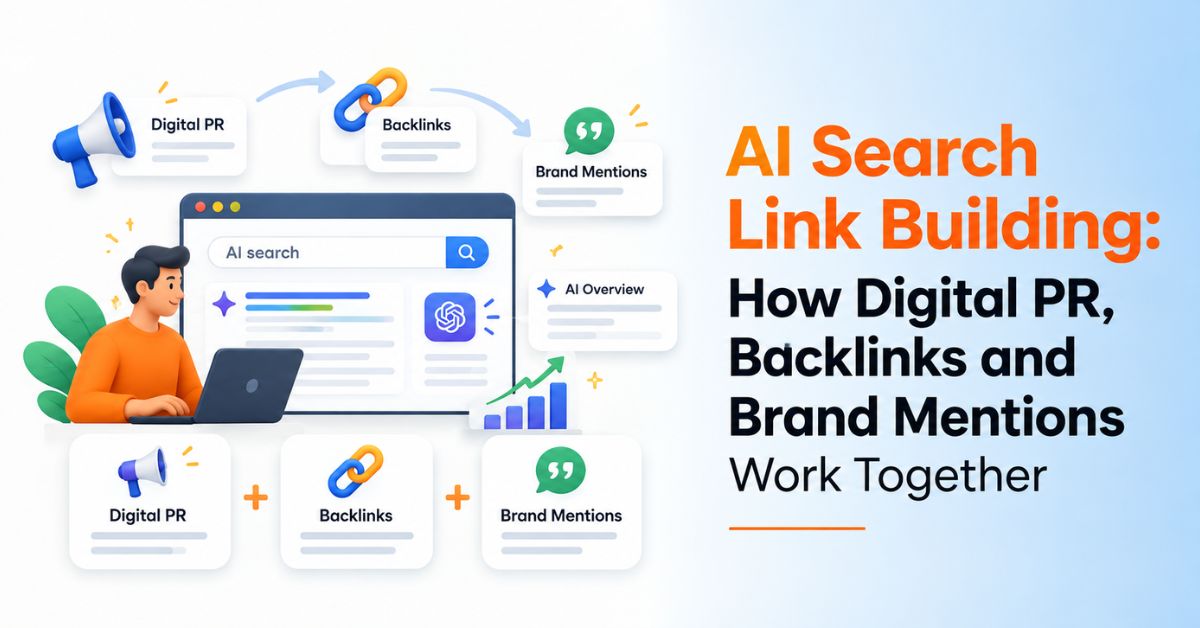
AI search is changing what it means to build online authority — and the reason behind link building matters more than ever.
Quick answer: AI search link building is the process of earning relevant backlinks, editorial mentions, and brand references that strengthen a website’s authority and topical relevance across traditional and AI-powered search. Backlinks are not a direct guarantee of AI citations — but they contribute to a broader authority ecosystem that includes content, digital PR, and brand consistency.
In traditional SEO, the goal of link building is usually straightforward: earn relevant backlinks that help important pages gain authority and improve their search rankings.
AI-powered search adds another layer. Search experiences such as Google AI Overviews, ChatGPT, and Perplexity may use information from multiple sources to generate an answer. For a brand to appear in those answers, it needs more than a page targeting the right keyword. Its information needs to be useful, credible, and supported by signals across the web.
That is where AI search link building becomes relevant. It does not mean building a special type of backlink that is guaranteed to make an AI system cite your website. Instead, it means approaching link building with a broader goal: build the authority, relevance, and brand presence that can support visibility in both traditional and AI-powered search.
What Is AI Search Link Building?
AI search link building is the process of earning relevant backlinks, editorial mentions, and brand references that strengthen a website’s authority and topical relevance across search.
The basic principles of good link building have not disappeared. Relevant websites, useful content, editorial context, and genuine authority still matter. What changes is the objective.
Instead of asking only: “How can I get a backlink to this page?” — a stronger question is: “What information, research, or expertise can make this brand worth mentioning in the first place?”
This shift is important because AI search systems often need to identify reliable sources before using their information in generated answers. A backlink can contribute to a site’s authority, but the surrounding context matters too. A brand that consistently appears in relevant publications, industry discussions, expert articles, and useful resources can build a stronger overall presence than a site relying on large numbers of unrelated links.
Why Traditional Link Building Needs a Broader Approach
Traditional link building often focuses on metrics such as:
- Domain Rating (DR)
- Domain Authority (DA)
- Organic traffic
- Referring domains
- Anchor text
- Page authority
These metrics can still be useful when evaluating link opportunities. However, they should not be the only criteria.
Imagine two websites: Website A receives hundreds of backlinks from unrelated websites. Website B receives fewer links, but those links come from publications that regularly cover its industry, products, research, or subject matter. The second website may have a stronger contextual relationship with its topic.
This is particularly important when building visibility beyond standard search rankings. AI search requires systems to understand what a brand is known for and whether it is a credible source on a particular subject. That makes topical relevance, editorial context, and brand mentions increasingly important parts of an authority-building strategy.
The Link Is Not Always the Story
One of the most useful ideas from modern digital PR is that campaigns should not start with the backlink. They should start with a story.
A business selling SEO software, for example, could pitch journalists with: “Our company has launched a new SEO tool.” That is primarily a product announcement. A stronger PR angle could be: “The SEO tasks marketers spend the most time doing manually.” The second idea addresses a broader problem that marketers may already care about. The company’s research, data, or expertise can then become part of that story.
This approach can lead to editorial coverage, expert references, brand mentions, and backlinks at the same time.
Search Engine Journal highlights this shift in its discussion of digital PR for AI search: successful campaigns begin with a narrative, trend, tension, misconception, or problem that already matters to an audience rather than starting with a request for a link.
How Digital PR Supports AI Search Visibility
Digital PR and link building are often treated as separate activities. They do not have to be. A strong digital PR campaign can generate several useful signals at once:
- Editorial backlinks — A publication may link to your research, study, tool, or original resource. These links can contribute to your site’s overall authority.
- Brand mentions — A publication may mention your company without linking to it. That does not make the mention worthless. It can still contribute to your broader online presence and help establish associations between your brand and a particular topic.
- Expert references — Journalists and publishers may quote an expert from your company when covering an industry issue. This can help establish your brand as a source of information rather than simply another business selling a service.
- Topical associations — Repeated appearances in relevant publications can strengthen the connection between your brand and the subjects you want to be known for.
- Referral traffic — Good media coverage can also introduce your brand to people who have never encountered it through search.
The result is a more complete authority-building strategy rather than a campaign measured only by the number of backlinks acquired.
What Makes a Link More Valuable for AI Search?
There is no publicly documented formula that says an AI search engine will cite a page because it has a particular DA, DR, or number of backlinks. So it is better to avoid treating any individual SEO metric as an “AI citation score.” Instead, evaluate link opportunities using several factors.
Topical relevance
A backlink from a website that regularly covers your industry can provide more useful context than a link from an unrelated site. For example, a cybersecurity company should generally prioritize relevant technology, security, business, and industry publications over random high-metric websites.
Editorial context
The link should make sense within the content. A contextual reference inside a useful article is generally more meaningful than a link placed simply because someone paid for a slot.
Website quality
Look beyond DA or DR. You can use Vefogix’s DA PA Checker Tool to quickly check the Domain Authority and Page Authority of multiple websites before evaluating potential link opportunities. Check:
- Organic traffic
- Ranking keywords
- Content quality
- Publishing frequency
- Topical focus
- Outbound link patterns
- Indexation
- Overall website reputation
Relevance of the referring page
The domain may be relevant while the individual page is not. A link from an article directly related to your subject can provide much stronger context than a link buried on an unrelated page of the same website.
Brand consistency
Your company should be represented consistently across the sources where it appears. If one publication describes your company as an SEO marketplace, another as a link building platform, and another associates it with a completely unrelated topic, the resulting signals are less useful.
Original Research Can Earn Both Links and Citations
One of the strongest ways to build authority is to publish something other websites genuinely need. That could include:
- Original industry research
- Surveys
- Pricing studies
- First-party data
- Trend reports
- Statistical analysis
- Industry benchmarks
- Expert commentary
- Unique datasets
For example, instead of publishing another article titled “What Is Link Building?”, a link building marketplace could analyze pricing across thousands of publisher websites and publish the findings. That creates an asset journalists, bloggers, and marketers can reference.
Vefogix has already used this type of approach through its research-oriented content, including its analysis of link building pricing across a large publisher dataset. The important distinction is that the data becomes the reason for the story. The backlink becomes secondary.
Guest Posting Still Has a Role
The rise of AI search does not make guest posting irrelevant. But the purpose of guest posting should be broader than collecting links. A good guest post can help a brand:
- Demonstrate expertise
- Reach a relevant audience
- Build topical associations
- Earn a contextual backlink
- Introduce the brand to new readers
- Support a wider digital PR strategy
The publication matters. A guest post on a relevant industry publication can make more sense than publishing the same article across dozens of unrelated websites. Businesses looking for relevant publishers can use the Vefogix Guest Post Marketplace to evaluate opportunities based on factors such as niche, traffic, authority, and location.
The goal should not be to maximize the number of placements. It should be to build a relevant network of references around the topics that matter to your business.
Press Releases Can Support the Same Strategy
Press releases are another piece of the puzzle, particularly when a business has something genuinely newsworthy to announce. Examples include:
- New research
- Product launches
- Company milestones
- Industry reports
- Partnerships
- New market expansion
- Original survey results
- Major platform updates
A press release should not be treated simply as a way to generate a large number of links. The stronger objective is to create a newsworthy asset that can lead to coverage, references, discussion, and additional editorial links. Businesses can also combine press release distribution with content and link building when they have a story worth distributing.
A Better AI Search Link Building Framework
A practical campaign can be organized into five steps.
|
1
|
Identify the topics you want to own — Start with the subjects your business should be associated with. For example: link building, guest posting, digital PR, SEO, AI search visibility. Do not try to build authority around every possible keyword. Choose the topics that are commercially and strategically important. |
|
2
|
Find the questions people are asking — AI search is heavily driven by questions and conversational queries. Look for questions such as: How does link building work? Are backlinks still important for SEO? How can businesses improve AI search visibility? What makes a good guest post? How does digital PR help SEO? These questions can guide both your content and your outreach strategy. For more opportunities, Vefogix’s AI Search Tool can help identify relevant guest posting opportunities based on niche, authority, traffic, location, and other criteria. |
|
3
|
Create something worth referencing — Before outreach begins, create a useful asset. It could be: a detailed guide, a research report, an original study, a dataset, a calculator, a useful tool, an expert analysis, or a strong visual resource. Ask a simple question: “Why would another publisher want to reference this?” If the answer is unclear, the asset probably needs more work. |
|
4
|
Build relevant third-party visibility — Now promote the asset. Depending on the campaign, that could include: guest posts, expert contributions, digital PR, press releases, editorial outreach, industry roundups, resource pages, relevant partnerships. The objective is to create multiple credible references rather than repeatedly forcing the same keyword and URL into unrelated articles. |
|
5
|
Measure visibility beyond rankings — Traditional SEO reporting often focuses on: rankings, organic traffic, impressions, clicks, referring domains. Continue tracking those metrics. But for AI search, add: brand mentions in AI answers, citation frequency, which pages are cited, which competitors appear alongside your brand, which questions trigger your brand, which third-party sources are associated with your brand. AI visibility is harder to measure consistently than Google rankings, so treat these observations as an additional layer of analysis rather than a replacement for standard SEO reporting. |
What AI Search Link Building Should Not Become
AI search should not become an excuse for low-quality link building. Be cautious of services promising:
🚨 Guaranteed ChatGPT citations
No legitimate provider can guarantee how an independent AI system will select sources.
🚨 Guaranteed Perplexity rankings
AI search results are dynamic and based on multiple signals — not a fixed ranking.
🚨 A fixed number of AI mentions
Mentions depend on editorial decisions and algorithmic interpretation.
🚨 “AI-approved” backlinks
There is no such thing as a backlink officially approved by an AI system.
🚨 Thousands of backlinks specifically for AI
Volume alone does not build credibility — relevance and context matter more.
🚨 Guaranteed inclusion in Google AI Overviews
No one can guarantee inclusion in AI-generated overviews.
No legitimate link building provider can guarantee how an independent search or AI system will select sources. The better approach is to build assets and authority that make your website more useful and more credible across search environments.
AI Search Does Not Replace SEO
It is tempting to treat AI search as a completely separate marketing channel. That can lead to unnecessary complexity. Many of the fundamentals still overlap:
Useful content + technical accessibility + topical relevance + credible references + strong brand presence = a stronger foundation for search visibility.
The difference is that AI search can make the importance of context and entity-level authority more visible. A page does not exist in isolation. Its reputation is influenced by the wider ecosystem of websites, publications, authors, organizations, and discussions surrounding the topic. That is why modern SEO link building services should focus on relevance and quality rather than simply increasing backlink volume.
Final Takeaway
AI search has not made link building obsolete. It has made the reason behind link building more important. A backlink should ideally be part of a broader authority strategy that includes useful content, relevant publishers, original research, digital PR, expert contributions, and consistent brand mentions.
Instead of asking: “How many backlinks can we build?” — Start asking: “How can we become a source that other people want to reference?” That shift produces a better link building strategy for Google today and creates a stronger foundation for AI-powered search as well.
💡 Tip: Before investing in any AI search link building campaign, verify that your content, research, and brand mentions are consistent across the web. AI systems rely on contextual signals — and consistency strengthens those signals.
Frequently Asked Questions
Yes, but backlinks should not be viewed as a direct guarantee of AI citations. Relevant editorial links can contribute to website authority, while brand mentions, useful content, and third-party references can help build a broader online presence.
AI search link building is a broader approach to earning relevant backlinks, editorial mentions, and brand references with the goal of strengthening authority and visibility across traditional and AI-powered search.
No. AI search systems use multiple sources and signals, and there is no known backlink threshold that guarantees inclusion. Strong content, relevance, credibility, and third-party references can all contribute to a stronger foundation.
Yes. Relevant guest posts can help demonstrate expertise, build topical associations, earn contextual backlinks, and increase brand visibility. Quality and relevance are more important than publishing on as many websites as possible.
Digital PR can generate editorial coverage, expert references, brand mentions, and backlinks. A strong campaign starts with a topic or story that matters to the audience rather than simply asking publications to link to a commercial page.
Both can have a role. Backlinks can contribute to SEO authority, while unlinked brand mentions can contribute to broader brand visibility and topical recognition. The best strategy builds a natural mix of relevant references rather than focusing on one signal alone.