How to Measure AI Search Visibility: The Metrics SEO Teams Should Track Beyond Traffic
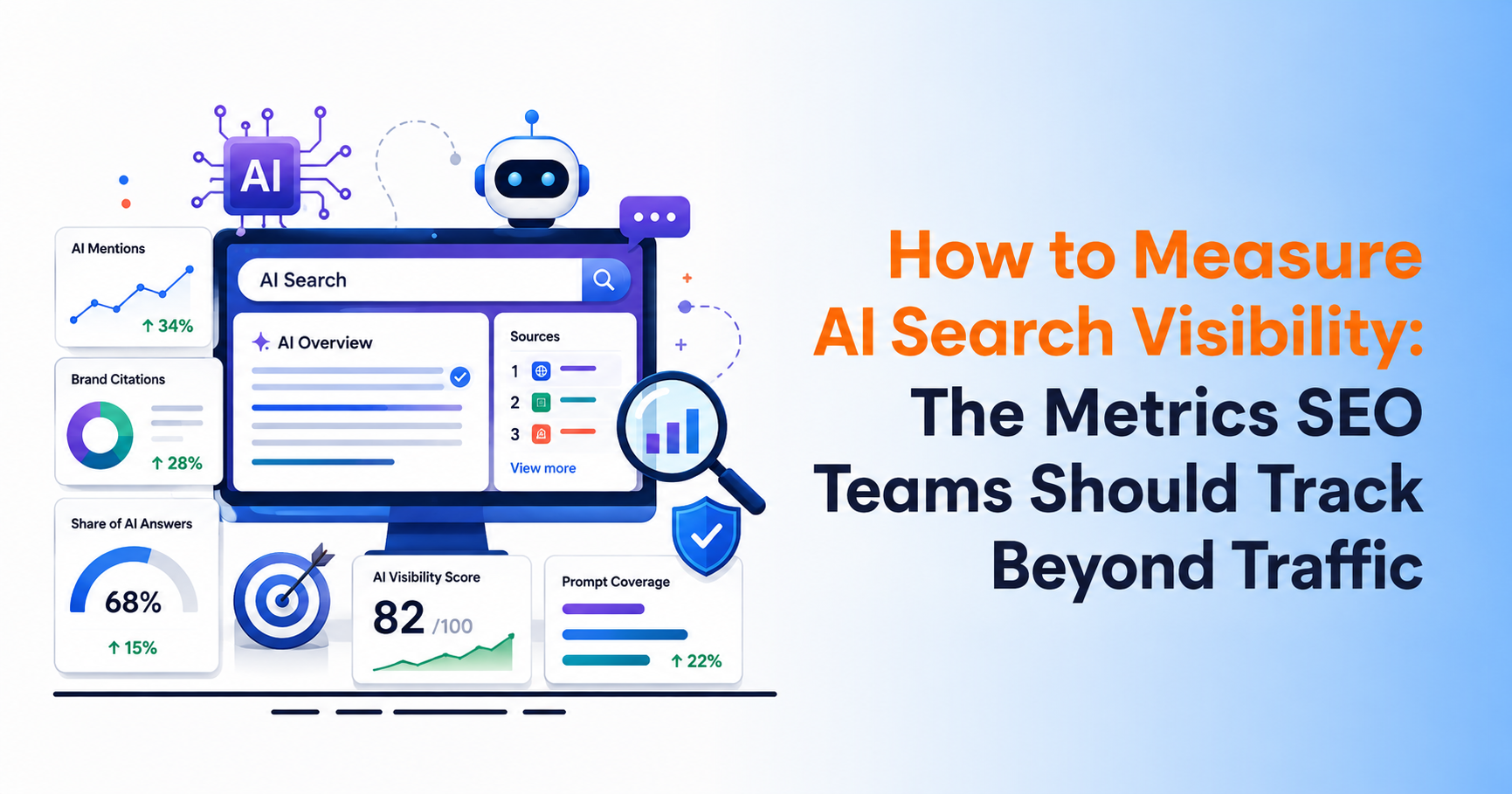
Search Console still shows clicks. Rankings trackers still show positions. But when a buyer asks ChatGPT, Gemini, or Google's AI Overviews for a recommendation and the model answers without a link, none of those tools register what just happened. Research from Seer Interactive, tracking more than 100 clients and roughly 7,800 queries, found organic click-through rate drops by around 70% on searches where an AI Overview appears. The searches are still happening. The visibility just isn't landing where your dashboard is looking.
That gap is why "AI search visibility" has become its own measurement discipline, separate from traditional rank tracking. This guide walks through what it actually means, the metrics worth building a workflow around, and the mistakes that quietly undermine a lot of teams' first attempts at tracking it.
What AI Search Visibility Actually Means
AI search visibility is how often, how accurately, and how favorably a brand shows up when someone asks an AI system a question relevant to that brand's category — inside ChatGPT, Perplexity, Gemini, Copilot, and Google's AI Overviews and AI Mode. It is not the same as ranking on page one. A page can rank first in classic organic results and still never get pulled into a synthesized AI answer, because the model is selecting and summarizing sources rather than listing links.
This is also why AI visibility tracking looks more like brand and PR measurement than classic SEO reporting. The core questions shift from "where do we rank" to "do AI systems know we exist, describe us accurately, and recommend us over competitors?"
Why Clicks and Rankings No Longer Tell the Whole Story
Two structural shifts explain why traffic-based reporting is going blind in exactly the moments that matter most:
- Zero-click answers are common. When an AI system synthesises a direct answer, many users never click through, so the interaction never appears in GA4 or Search Console as a session.
- Not every query triggers an AI answer. Bright Edge's tracking over the past year found that roughly half of all searches still don't surface an AI Overview, so visibility work has to run alongside — not instead of — traditional SEO, not replace it outright.
The practical result: a brand can be losing share of voice inside AI answers for months while its traffic and rankings dashboards look flat, simply because those tools were never built to see this layer of search.
The Metrics That Actually Matter
Most AI visibility frameworks converge on a similar core set of metrics. None of these need to be tracked manually — several dedicated tracking platforms exist for this now — but the SEO team should understand what each number is actually telling them before choosing a tool.
|
Metric |
What It Measures |
Why It Matters |
|
Visibility / Mention Rate |
Share of tracked prompts where your brand appears at all |
The AI-search equivalent of impressions — the baseline presence metric |
|
Citation Share |
How often your pages are the actual source cited or linked in an AI answer |
Shows whether your content is trusted enough to be pulled from directly |
|
Share of Voice |
Your mention volume relative to named competitors across the same prompt set |
Tells you if you're gaining or losing ground in a category, not just in isolation |
|
Sentiment & Positioning |
How favorably and how prominently you're described when you do appear |
Being mentioned last, or with caveats, is a different outcome than being recommended first |
|
Recommendation / Win Rate |
How often you're the answer chosen for a specific buying-intent prompt |
Closest AI-era proxy to ranking #1 for a high-intent query |
|
Branded Search Lift |
Change in direct/branded search volume after AI mentions increase |
AI exposure often shows up as people searching your name later, not clicking now |
|
Assisted Conversions |
Conversions where AI research appears earlier in the journey, even without a last-click |
Confirms AI influence is reaching pipeline, not just brand awareness |
Visibility Score / Mention Rate
This is the percentage of a defined prompt set — the real questions your buyers ask — where your brand appears in the AI's response at all. Treat it as the AI-era equivalent of impressions: necessary but not sufficient on its own.
Citation Share
Citation share tracks how often your actual pages are the source an AI system links to or draws from, as opposed to a competitor's page, a review site, or a forum thread. AirOps research found that brands earning both citations and general brand mentions were roughly 40% more likely to keep resurfacing across repeated prompt runs than brands that only picked up mentions without citations.
Share of Voice
Mention rate in isolation is hard to interpret. Share of voice puts your numbers next to named competitors across the same prompt set, so the team can see whether visibility is actually being won or lost relative to the category, not just whether it exists.
Sentiment and Positioning Accuracy
Appearing in an answer isn't automatically a good outcome. Sentiment tracks how favourably a brand is described; positioning accuracy tracks whether the AI's description of pricing, features, or use case is even correct. A brand mentioned last, with outdated details, is a different result than being recommended first with accurate information.
Recommendation Rate / Prompt-Level Win Rate
For clearly commercial prompts — the AI-era equivalent of a high buying-intent keyword — this tracks how often a brand is the one actually recommended, not just referenced in passing. It's the closest proxy available to "ranking #1" in a world where there often isn't a ranked list at all.
Branded Search Lift
One of the more reliable downstream signals: when AI mentions of a brand increase, branded search volume for that brand tends to rise afterwards, as people research something they first heard about inside an AI answer. Tracking branded search alongside visibility scores helps confirm the mentions are actually landing with real people.
Assisted Conversions and Downstream Signals
AI research rarely acts as the final touch point before a purchase or lead form. It shows up earlier in the journey. Assisted-conversion tracking — flagging conversions where AI-referral or AI-influenced sessions appear earlier in a user's path — is what connects visibility metrics to pipeline, rather than leaving them as a brand-awareness number with no business tie-back.
Building a Weekly Measurement Rhythm
AI visibility data is noisy at the level of any single prompt run. The trend over several weeks is what actionable, not any one snapshot. A workable weekly routine looks like this:
• Run the full tracked prompt set and log visibility, citation, and share-of-voice scores
• Flag any prompt where a competitor now appears, and you don't
• Flag any prompt where you rank well in classic organic search but are absent from the AI answer
• Check whether cited pages are your current content or outdated pages the model is still pulling from
• Cross-reference branded search volume and assisted conversions against the week's visibility trend
• Route content gaps to the content team and factual/outdated-citation issues to whoever owns those pages
Common Mistakes When Measuring AI Search Visibility
• Treating a single prompt run as a verdict instead of one data point in a trend
• Only tracking your own brand's prompts and ignoring where AI systems are citing sources outside your domain entirely — most AI answers pull from third-party pages, not brand-owned ones
• Expecting AI referral traffic in GA4 to match the scale of the actual visibility gain, when most AI-influenced research never produces a session at all
• Dropping classic SEO tracking because it feels outdated — roughly half of all searches still don't trigger an AI answer, so rankings and traffic remain a live half of the picture
Off-Site Authority: The Overlooked Input to AI Citations
A large share of what AI systems cite comes from outside a brand's own website — third-party publications, review sites, guest content, and other pages the model has already learned to trust. That makes off-site presence, not just on-site optimisation, a direct input into AI visibility. A brand with strong content but a thin footprint of independent, third-party mentions gives AI systems fewer trusted sources to pull from when building an answer.
This is part of why link building and guest publishing have taken on a second purpose beyond their traditional SEO role. Placing content on relevant, credible external sites — the kind of work Vefogix's guest posting and link building marketplace is built around — expands the pool of independent sources where an AI model might encounter and cite a brand, on top of the ranking signal those placements have always provided.
Bringing It Together
Traffic and rankings aren't obsolete — roughly half of all searches still play out the traditional way. But they're no longer the full picture. The teams building a real edge in 2026 are pairing that classic reporting with visibility score, citation share, share of voice, and assisted-conversion tracking, and treating off-site authority as a measurable input rather than an afterthought.
If part of that off-site work involves expanding where a brand shows up across credible third-party sites, that's exactly the gap Vefogix's marketplace connects teams to — a network of vetted publishers for guest posting and link placements, sized for agencies, in-house teams, and independent SEO professionals alike.
vefogix
Frequently Asked Questions
AI search visibility is how often, how accurately, and how favourably a brand appears when AI systems like ChatGPT, Gemini, Perplexity, or Google's AI Overviews answer questions relevant to that brand's category.
Rankings measure position in a list of links. AI visibility measures whether and how a brand is described inside a synthesised answer, which doesn't always correspond to ranking position and often involves no click at all.
Not reliably. Many AI-influenced visits arrive without a clear referral source and get logged as direct traffic, and a large share of AI research never results in a session. GA4 should be paired with dedicated AI visibility tracking and branded-search monitoring.
It depends heavily on category competitiveness and prompt volume, so it's best benchmarked against direct competitors on the same prompt set and tracked as a trend over time rather than compared to a fixed industry number.
Some do. Perplexity and Google AI Overviews link out in many cases, and that traffic can be captured with UTM parameters. It should be treated as incremental confirmation of visibility, not the primary success metric.
Weekly is a practical cadence for spotting competitor movement and content gaps, with monthly reviews for connecting visibility trends to branded search and pipeline metrics.
Often, yes. The inputs largely overlap — clear, well-structured, factually current content and a credible off-site footprint tend to support both classic rankings and AI citation likelihood at the same time.
Only tracking prompts about your own brand. Most AI answers cite third-party sources rather than brand-owned pages, so a full picture requires tracking category and competitor prompts too, not just branded ones.