Brand Mentions vs Backlinks in 2026: What AI Search Actually Rewards
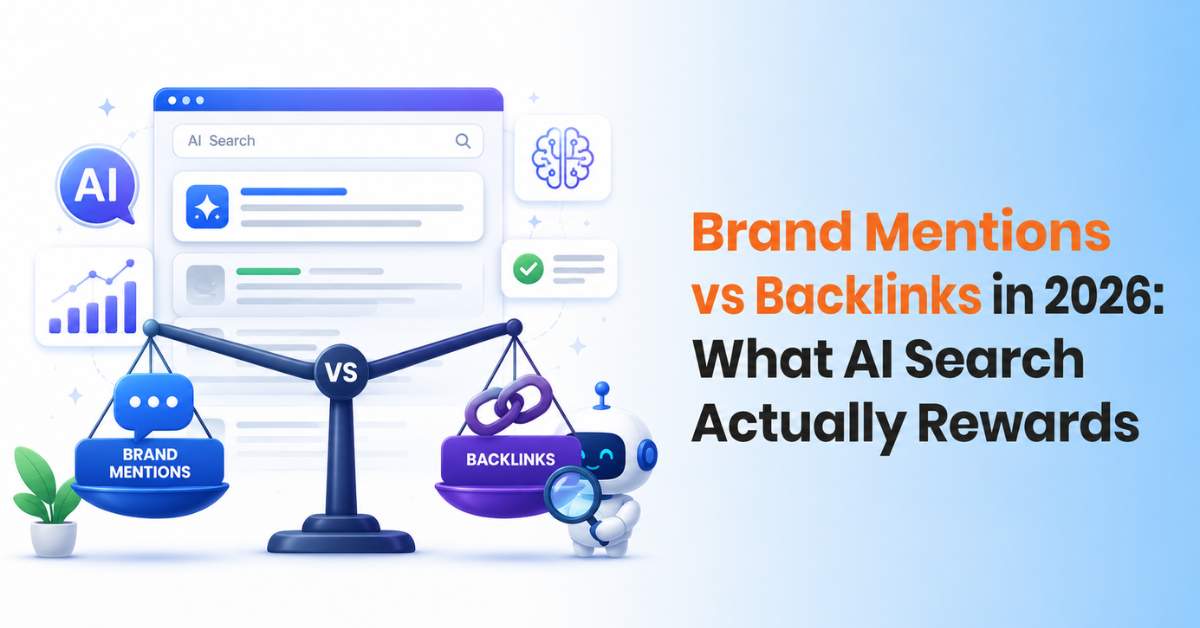
A year ago, the debate over backlinks versus brand mentions was mostly theoretical. In 2026 it isn't. As ChatGPT, Gemini, Perplexity, and Google's AI Overviews increasingly decide which brands get named in an answer — and which get skipped entirely — the signals that earn a citation have measurably diverged from the signals that earn a Google #1 ranking. This piece breaks down what the latest data actually says, where each signal still pulls its weight, and how to build a strategy that doesn't have to choose between them.
|
Quick answer: Backlinks still carry more weight in classic Google rankings, but brand mentions — linked or not — now correlate roughly three times more strongly with how often a brand gets cited in AI search tools. They aren't competing signals; they measure different kinds of trust, and the strongest 2026 strategies build both at once. |
Backlinks and Brand Mentions Aren't the Same Signal
A backlink is a hyperlink from another domain pointing back to your site. Traditional SEO has spent two decades treating it as a vote of authority, tracked through metrics like Domain Rating, referring domain count, and anchor text. A brand mention is broader: any reference to your company, product, or website name in text — in an article, a Reddit thread, a review, a podcast transcript, a comparison roundup — with or without a clickable link attached.
Generative engines don't crawl the web the same way a classic search index does. They're trained on and retrieve from a much wider slice of text, so a credible, consistent description of your brand can shape how an AI model represents you even if no link was ever involved.
|
Attribute |
Backlink |
Brand Mention |
|
Requires a hyperlink |
Yes |
No |
|
Passes classic link equity |
Yes |
No |
|
Counted by AI citation models |
Weakly |
Strongly |
|
Primary graph it feeds |
Link graph |
Entity graph |
|
Typical source |
Guest posts, PR, directories |
Reviews, forums, press, podcasts |
What the 2026 Data Actually Shows
The clearest evidence comes from an Ahrefs study spanning roughly 75,000 brands, which found brand mentions correlate at 0.664 with AI citation likelihood, versus 0.218 for Domain Rating — a backlink-based authority metric. A separate meta-analysis pooling 54 studies and nearly 17 million AI citations reached a similar conclusion: brand mentions outperform backlinks by roughly 3 to 1, and the content that actually gets cited tends to run about 25.7% fresher than a typical organic top-10 result.
One figure worth flagging with caution: some 2026 commentary claims brand mentions now account for as much as 55% of off-page influence, up from a small fraction a decade ago. That number comes from an industry estimate rather than a controlled study, so treat it as directional rather than exact — the correlation data above is the sturdier evidence.
There's also a widely cited academic source behind the current wave of “GEO” (Generative Engine Optimization) advice: a 2024 Princeton-led paper that tested nine content tactics across roughly 10,000 queries. The two tactics with the largest citation lift were adding relevant statistics and citing authoritative sources within the content itself. Pages that started out ranked lower benefited disproportionately, seeing up to a 115% visibility gain at position five — an effect the authors described as an “equalizer” for lower-authority pages. We break down what this shift means for backlink strategy specifically in our guide to how AI is redefining backlink quality.
|
Signal |
Correlation with AI citations |
|
Brand mentions (overall) |
0.664 |
|
Domain Rating (backlinks) |
0.218 |
|
Branded anchor text — Google AI Mode |
0.628 |
|
Domain Rating — ChatGPT specifically |
0.266 |
Why the Old Hierarchy Flipped
Classic SEO ranks pages largely through a link graph — who links to whom, and with what authority. Generative engines lean more on an entity graph: they build an understanding of “who you are” from how consistently and credibly you're described across many independent sources. A brand that shows up the same way — same positioning, same core facts — across reviews, articles, and community discussion reads as more trustworthy to a model than one with a handful of high-authority links but a thin, inconsistent footprint elsewhere. That's also why an unlinked mention in a trusted publication can carry real weight: the model doesn't need a clickable path to know you exist. For a fuller walkthrough of this shift, see our breakdown of SEO Strategy 2026: Ranking in Google's New AI Search Era.
Where Backlinks Still Carry the Most Weight
Backlinks haven't stopped mattering — they've become one input among several rather than the dominant one. (Our breakdown of guest posting ROI in 2026 has the full math.) They're still the strongest lever in a few specific situations:
- Classic Google rankings, which still lean heavily on link-based authority signals.
- New or low-authority domains that need crawl discovery and an initial trust baseline.
- Referral traffic and link equity that indirectly feed AI Overview inclusion, since a page generally has to rank reasonably well to be pulled into one.
- Editorial links placed inside body copy that also name the brand — these do double duty as both a backlink and a mention, which is the model behind Vefogix's link insertion service.
Where Brand Mentions Are Winning
Reviews, Reddit threads, podcast guest appearances, PR coverage, and comparison roundups all shape AI citation likelihood even without a single link. The effect isn't uniform across platforms, either. Google's AI Mode shows a particularly strong pull toward branded anchor text (0.628 correlation), while ChatGPT shows the weakest reliance on Domain Rating of the major assistants (0.266) — suggesting it leans harder on broader mention and consistency signals than on link-based authority. Public correlation data specific to Perplexity and Gemini is thinner so far, but the direction of travel looks similar: less weight on raw link counts, more on corroborated brand presence.
What This Means for Buyer Trust
There's a second layer worth factoring in. A 2026 Fractl consumer survey found trust in AI search recommendations dropped from 82% to 54% in a single year, and buyers now check an average of 2.4 platforms before validating a purchase decision. Google still leads AI tools roughly 3-to-1 for “trusted” product recommendations (39% versus 14%), with Reddit sitting at 15% in between. The takeaway: buyers are actively cross-checking what AI tools tell them, which makes a consistent, corroborated brand presence across multiple channels more valuable than winning any single citation.
The 2026 Off-Page Playbook
In practice, treating backlinks and brand mentions as separate campaigns is the mistake. A combined approach looks like this:
- Keep a backlink program running, but shift weighting toward editorial placements that name the brand in the body copy — not just in the anchor text.
- Build a dedicated mentions pipeline: PR outreach, Reddit and forum participation, podcast guesting, and review-platform generation.
- Make content citation-worthy by adding original statistics and citing credible external sources within your own pages.
- Keep evergreen content fresh — cited content in AI search skews noticeably newer than typical top-10 organic results.
- Track both sides: backlink profile (DR, referring domains) and brand mention volume and sentiment across AI answers.
- Prioritize consistency — the same core facts and positioning should show up everywhere your brand is described.
Tracking Both Signals
Measuring this now takes two different toolkits. Traditional backlink trackers still cover Domain Rating, referring domains, and anchor text. A newer category — AI-visibility trackers such as Otterly.ai, Semrush's AI Visibility Toolkit, and ZipTie — is built specifically to show whether and how a brand gets cited inside AI Overviews and chatbot answers, which is the piece a backlink checker was never designed to see.
Bringing It Together
None of this makes link building optional — it makes it more selective. The link programs that hold up in 2026 are the ones built to produce a genuine brand mention alongside the placement, not just an anchor-text drop-off on a low-relevance page. That's the model Vefogix's flexible guest posting and link building services run on — built for agencies, freelancers, and individual site owners alike, around editorial placements rather than volume.
If your team is weighing whether to outsource link building this quarter, it's worth asking any high-quality backlinks service two questions before you buy: does the placement include a real, in-body brand mention, and is the surrounding content actually going to get cited by the sites you're placing on? Vefogix's link building services pricing is built around exactly that distinction — transparent, scoped SEO link building packages rather than bulk-anchor deals, so agencies and in-house teams outsourcing link building services for SEO end up with placements that still count when the ranking signal is a mention, not just a link.
The Bottom Line
Backlinks and brand mentions aren't rivals — they're answering two different questions. Backlinks still tell classic search “who vouches for you.” Brand mentions increasingly tell AI search “who are you, and can multiple credible sources agree on that.” Building for 2026 means running both programs deliberately, measuring both, and treating any placement that produces only a link — with no real mention — as the weaker half of what it used to be.
Frequently Asked Questions
For classic Google rankings, an unlinked mention carries little direct weight. For AI search visibility, it can matter a great deal — generative engines build brand understanding from how consistently you're described across the web, not only from crawled hyperlinks.
No. They remain one of the strongest levers for classic Google rankings and for establishing initial trust for newer domains. What's changed is that they're no longer the dominant signal for getting cited inside AI-generated answers.
Google's AI Mode shows the strongest pull toward link-adjacent signals like branded anchor text. ChatGPT shows the weakest reliance on Domain Rating among the major assistants studied so far.
Pair a traditional backlink tracker with an AI-visibility tool built to show citations inside AI Overviews and chatbot answers — tools like Otterly.ai, Semrush's AI Visibility Toolkit, and ZipTie fall into this newer category.
No — the data supports combining both. Backlinks still drive classic rankings and initial discovery; mentions drive AI citation likelihood. The strongest placements do both at once.
PR outreach, podcast guesting, review generation, and participating credibly in community discussion (Reddit, forums, niche communities) tend to produce mentions faster than link building alone, though they work best run alongside it.
Somewhat, but less than brand mention consistency. A page generally still needs to rank well enough to be crawled and considered, so DR plays an indirect supporting role even where it isn't the strongest direct correlate.
Both are proxies for the same thing: whether independent sources treat you as a credible, trustworthy authority. Consistent, corroborated brand mentions across multiple credible sources are effectively an E-E-A-T signal AI models can read at scale. Vefogix's guide to E-E-A-T compliant guest posts covers this in more depth.