How to Build Backlinks for Service Pages Without Looking Spammy
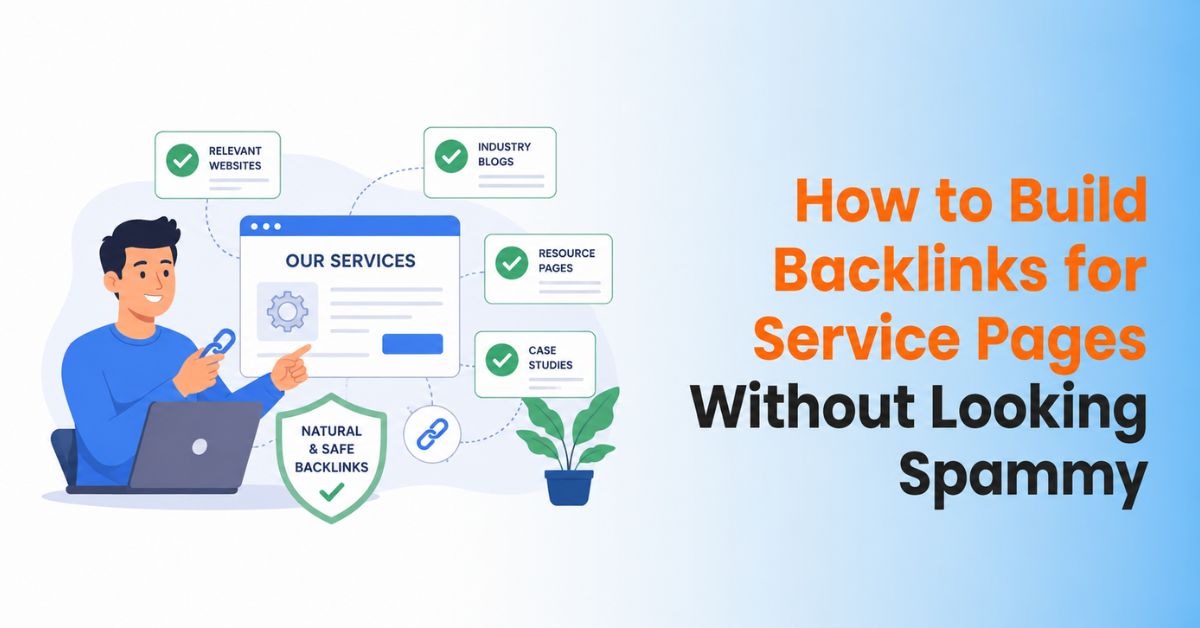
Building backlinks to a service page is different from building links to an informational article.
A blog post, research report, or industry guide can naturally attract references because it exists to educate people. A service page has a commercial purpose: it explains what a business sells and encourages visitors to take action.
That doesn't mean service pages should be excluded from link-building campaigns. It means the reason for the link needs to make sense.
A strong service-page backlink strategy combines relevant referring websites, useful content, descriptive anchor text, varied link sources, supporting pages, and a clear reason for someone to reference the destination.
The goal isn't to make a backlink profile look "random." The goal is to build links that are relevant, useful, and defensible from a user perspective.
Quick answer: To build backlinks to service pages without creating an unnatural pattern:
- Make the service page genuinely useful before promoting it.
- Choose referring pages based on relevance, not just DR or DA.
- Use descriptive anchor text that fits the surrounding content.
- Don't force the exact-match keyword into every placement.
- Build links to supporting content as well as commercial pages.
- Use different legitimate acquisition channels instead of repeating one tactic.
- Avoid large numbers of near-identical guest posts and placements.
- Evaluate the entire backlink profile rather than chasing a specific anchor percentage.
- Qualify paid or sponsored links appropriately when applicable.
- Measure whether the links improve visibility, traffic, and business outcomes — not just backlink count.
Google's guidance emphasizes people-first content, relevant anchor text, and avoiding link schemes designed primarily to manipulate rankings.
Why Service Pages Need a Different Link-Building Approach
Consider two pages:
Page A
"How to Evaluate Backlinks: A Complete Guide"
Page B
"SEO Link Building Services"
Page A naturally provides information that another website might reference. Page B is designed primarily to sell a service. That difference matters.
A website writing about SEO may naturally link to a backlink guide because its readers need more information. Linking directly to a commercial service page requires a stronger contextual reason.
This is why effective service-page link building should not be reduced to:
Find a website → publish an article → insert keyword → point it at the service page.
Instead, think about the relationship between your commercial pages, informational content, and linkable assets. For example:
↓
Detailed SEO guide
↓
Relevant service page
The supporting content gives publishers something genuinely useful to reference, while internal links help users move from information to the appropriate service.
1. Make the Service Page Worth Linking To
Before worrying about backlinks, improve the destination page.
A thin page that only says:
"We provide affordable SEO services. Contact us today."
gives another website very little reason to reference it.
A stronger service page can answer:
- What exactly is included?
- Who is the service for?
- How does the process work?
- What are the deliverables?
- What makes the service different?
- What industries or locations are supported?
- What does the service cost?
- What does the customer need to provide?
- How are results measured?
- What questions do potential customers usually have?
For a link-building service page, useful information might include publisher selection, campaign types, placement options, reporting, turnaround times, quality checks, and common campaign mistakes.
This gives the page informational value in addition to commercial intent.
If you're evaluating your own commercial page before starting outreach, see our guide on how to choose a link building service for additional criteria to consider.
2. Don't Build Every Link With the Exact-Match Keyword
Suppose you're promoting a page targeting:
link building services
That doesn't mean every backlink should use:
link building services
You may naturally see anchors such as:
- Vefogix
- Vefogix link building
- this link-building resource
- SEO link building
- backlink services
- view the service
- learn more
- this guide
- the company's website
- professional link building
The important distinction is that anchor text should describe the destination naturally, rather than being engineered around a predetermined percentage.
💡 Google recommends anchor text that is descriptive, reasonably concise, and relevant to both the linking page and the destination page.
3. Use the Anchor That Makes Sense in the Sentence
Instead of starting with:
"What anchor should I use?"
start with:
"What would a reader naturally click here?"
For example:
Businesses evaluating different SEO acquisition methods can compare link building approaches before choosing a strategy.
A partial-match anchor can work naturally here. But if the sentence reads:
Businesses should choose the best link building services because these link building services are among the best link building services...
the keyword is clearly being forced.
Good anchor text should help the reader understand what they're clicking. This is also why link authority matters beyond the anchor itself — the surrounding context, source page, destination, and relevance all contribute to how useful a link is.
4. Build Links to Supporting Content Too
One of the best ways to strengthen a commercial page without making every backlink commercial is to build a content ecosystem around it.
Suppose your primary page is:
SEO Link Building Services
You could create supporting resources such as:
- How to Evaluate Backlinks
- What Makes a Backlink Valuable?
- How Much Does Link Building Cost?
- Guest Posting vs. Niche Edits
- How to Choose Guest Posting Sites
- Link Building for SaaS Companies
- Link Building for Local Businesses
- Common Link-Building Mistakes
These pages can attract links for different reasons. For example:
Original research
→ attracts references
Backlink evaluation guide
→ earns educational links
Service page
→ captures commercial intent
Internal links connect the three. This approach also makes your website easier for users and search engines to understand.
5. Prioritize Relevance Over DR
DR and DA are useful metrics. They are not the entire decision. Imagine you have two potential publishers.
Publisher A
- DR 70
- General entertainment website
- Very little SEO content
- Large number of unrelated commercial links
Publisher B
- DR 40
- Digital marketing publication
- Real organic traffic
- Regular SEO content
- Audience interested in search marketing
For an SEO-related service, Publisher B may provide a more logical contextual environment. When evaluating a website, consider: topical relevance, organic traffic, audience, content quality, publisher reputation, indexing, outbound-link patterns, editorial standards, country or regional relevance, and link placement.
DR can be one filter, but it shouldn't become the campaign objective.
If guest posting is part of your strategy, read our guide on how to choose the right sites for guest posting before selecting publishers.
6. Check the Page Where the Link Will Actually Appear
A common mistake is evaluating only the domain. The domain may look good while the individual linking page is weak.
Before accepting a placement, look at:
The topic
Does the article discuss something related to your industry?
The audience
Would the readers realistically care about your service?
The page quality
Does the article provide useful information, or does it exist mainly to contain links?
The surrounding links
Does the page contain dozens of unrelated commercial links?
The placement
Is the link part of the main content where it makes contextual sense?
The destination
Does the service page actually help the reader who clicks?
This page-level evaluation is much more useful than simply saying "the site has DR 60, so it's good."
7. Don't Turn Guest Posting Into a Link Factory
Guest posting can support content marketing and outreach, but repetitive guest-post campaigns can create an artificial footprint.
For example, imagine 40 articles that all have:
- similar topics
- similar introductions
- the same target keyword
- the same destination URL
- the same anchor
- similar article structures
- similar publisher types
The problem isn't that the articles are guest posts. The problem is the repetitive pattern.
Instead, vary the actual editorial purpose. One article might discuss how SaaS companies can build authority. Another: how marketers evaluate backlink quality. Another: common SEO mistakes when launching a new website. Another: how to compare link-building strategies.
A link should appear because it contributes to that particular article — not because the campaign requires another placement.
8. Don't Rely on One Link Acquisition Method
A stronger backlink profile can develop through multiple legitimate channels.
Digital PR
Create something journalists and publishers have a reason to reference: original research, surveys, industry data, expert analysis, trend reports, proprietary statistics.
For more ideas on earning links as search behavior evolves, see our guide to link building in the AI search era.
Guest contributions
Write useful content for relevant publications where the contribution has genuine editorial value.
Resource links
Create guides, tools, templates, calculators, or research that other websites can recommend.
Brand mentions
Monitor mentions of your company and identify legitimate opportunities to turn relevant unlinked mentions into links.
Partnerships
Industry associations, integrations, suppliers, and legitimate business relationships can sometimes produce relevant references.
Linkable assets
Build resources that naturally attract attention instead of making every campaign about a commercial URL.
9. Match the Link to the Page's Search Intent
Not every service page deserves the same type of backlink. Consider:
"SEO Services"
versus:
"SaaS Link Building Services"
The second page has a much clearer audience. You can identify websites discussing SaaS growth, SaaS marketing, B2B SEO, startup marketing, software marketing, and organic acquisition.
Now the outreach has a clear reason. The link isn't simply:
"Please link to our service."
It becomes:
"This resource is relevant to the problem your readers are already researching."
That distinction can dramatically improve the quality of outreach.
10. Build Internal Links Around the Service Page
External backlinks aren't the only way to strengthen a service page. Internal links help establish relationships between your content. For example:
- → How to Evaluate Backlinks → Link Building Services
- → Link Authority in SEO → Link Building Services
- → How to Buy Backlinks Safely → Link Building Services
- → Guest Posting Services Guide → relevant service page
- → Link Building in the AI Search Era → Link Building Services
You can also use contextual links from relevant articles to your Link Building Services page when the service is the logical next step for the reader.
The internal link should be useful to the reader. Don't add links simply to increase the number of internal links on a page.
11. One Strong Contextual Link Can Beat Several Forced Links
More links aren't automatically better. Imagine an article contains five links to the same commercial page. The reader has little reason to click the first one, let alone the fifth.
Instead, use links where they genuinely help the reader. For example:
Before launching a campaign, marketers should understand how to evaluate link authority and distinguish useful placements from links that only look impressive on paper.
The link adds value because the reader can learn more about the topic. That is a stronger reason for the link than:
Buy link building services here.
12. Understand the Difference Between Editorial and Paid Links
This is an important distinction. A relevant paid placement is not automatically equivalent to an earned editorial backlink.
Google's spam policies identify buying or selling links for ranking purposes as link spam. Google also discusses paid articles, advertorials, guest posts, and press releases containing links that pass ranking credit or use optimized anchor text for ranking manipulation.
If you are considering paid placements, read our guide on how to buy backlinks safely and understand the difference between advertising, sponsorship, editorial coverage, and links intended to manipulate rankings.
Google recommends appropriate link qualification for paid or sponsored links.
🚨 Don't frame link building as: pay for a link → make it dofollow → use the keyword → rank faster. That is precisely the kind of simplistic approach this article should discourage.
13. Don't Obsess Over "Safe Link Velocity"
You may see SEO advice claiming that you should build exactly 10 links per month, or 50 links per month. There is no universal Google-approved backlink velocity.
A website can naturally receive hundreds of backlinks after a successful product launch, research report, news story, or viral campaign.
The better question is:
Does the backlink growth have a credible reason?
A sudden increase caused by genuine publicity is very different from automatically generating hundreds of similar commercial placements. Focus on the quality and context of the acquisition pattern rather than an arbitrary monthly number.
14. Build the Brand, Not Just the Keyword
Service-page campaigns become less natural when every external reference is designed around a commercial keyword.
For a company such as Vefogix, external references might naturally include:
- Vefogix
- Vefogix marketplace
- Vefogix platform
- Vefogix's SEO resources
- Vefogix link building
- the Vefogix website
- relevant branded URLs
That is how people naturally reference businesses. The objective should be to increase the number of meaningful references to the brand and its resources, not simply manufacture keyword anchors.
15. Think About Your Backlinks as a Portfolio
Instead of asking:
How many backlinks do I need?
ask:
What would a credible backlink portfolio for this business look like?
Depending on the industry, that portfolio might contain: branded references, editorial mentions, industry publications, resource links, relevant guest contributions, digital PR coverage, partner references, links to original research, links to educational content, and commercial-page references where genuinely appropriate.
The exact composition will vary by business. There is no universal anchor-text formula or referring-domain target that works for every website.
For a deeper explanation of why some links are more valuable than others, see our guide to link authority in SEO.
The objective is relevance, diversity, credibility, and consistency.
A Practical Service-Page Link-Building Framework
Here's a simple process you can actually use.
Step 1: Audit the destination page
Before outreach, check: search intent, content depth, unique value, trust signals, internal links, conversion elements, FAQs, pricing or service details, and supporting resources.
If the page isn't useful, improve it first.
Step 2: Create supporting content
Build several resources around the service. For example:
SEO Link Building Services
Supporting content:
- What Are Link Building Services?
- How to Evaluate Backlinks
- Link Authority Explained
- How to Choose Guest Posting Sites
- How Much Does Link Building Cost?
- Link Building for SaaS
- Link Building for Local SEO
Now your website has multiple pages that can earn references.
Step 3: Identify relevant publishers
Create a prospect list based on: niche, audience, geography, organic traffic, editorial quality, and content relevance.
Use DR or DA as supporting metrics rather than the only selection criteria.
Step 4: Choose the right destination
Don't automatically point every link at the service page. Ask:
Which page is most useful to the reader?
Sometimes that will be the service page. Sometimes it will be a guide, a study, a tool, a statistics page, a case study, or a resource.
Step 5: Write for the publication, not the backlink
A good outreach campaign starts with the publisher's audience. Before submitting an article, ask:
Would this article still be useful if the backlink were removed?
If the answer is no, the content probably needs more work.
Step 6: Review the backlink profile regularly
Track: referring domains, anchor text, destination URLs, topical relevance, link attributes, new and lost links, organic traffic, ranking changes, referral traffic, and conversions.
Don't judge a campaign solely by the number of links acquired.
Example: Building Links to an SEO Service Page
Suppose your target page is:
SEO Link Building Services
Instead of building 20 identical guest-post links directly to that page, create a broader campaign.
We Audited 100 Backlinks: Which Metrics Actually Predicted Their Value?
This can attract references from SEO publishers.
How to Evaluate Backlinks Before Building Them
This gives marketers a resource they can reference.
SEO Link Building Services
This is where users can evaluate the service.
How to Choose the Right Guest Posting Sites
Now you have several pages that can attract links for different reasons. The internal linking structure connects them. The result is a content and authority ecosystem, rather than a collection of pages competing for backlinks independently.
What a Spammy Campaign Looks Like vs. a Better Campaign
| Spammy Pattern | Better Approach |
|---|---|
| Same exact-match anchor repeatedly | Descriptive anchors that fit the context |
| Every link points to one service URL | Different relevant destinations |
| Sites selected only by DR | Relevance + traffic + quality + authority |
| Dozens of similar guest posts | Different topics and editorial angles |
| Unrelated publishers | Publishers with audience overlap |
| Links inserted into irrelevant paragraphs | Contextual references |
| Fixed backlink quota | Acquisition based on legitimate opportunities |
| Links treated as the only goal | Links supporting broader content and brand visibility |
| Paid links treated as automatically editorial | Appropriate qualification and transparency |
How Many Backlinks Should You Build to a Service Page?
There isn't a universal number. The right target depends on: competition, industry, existing authority, search intent, content quality, referring-domain profile, brand strength, competitor authority, and available legitimate link opportunities.
💡 Don't decide that you need "100 backlinks" simply because a competitor has 100. A competitor may have 100 weak referring domains while another competitor has 30 highly relevant ones. Study the quality and relevance of the competitive link profiles, not just the raw count.
How to Know Whether Your Service-Page Campaign Is Working
Backlink count is only one measurement. Track at least four areas.
1. Search visibility
Monitor: target keyword rankings, impressions, clicks, and indexed pages.
2. Authority and link profile
Monitor: referring domains, relevant referring domains, new and lost links, anchor text, and link attributes.
3. Traffic
Look at: organic traffic, referral traffic, and landing-page traffic.
4. Business results
Ultimately, monitor: leads, inquiries, sales, conversion rate, and revenue.
A campaign that generates 100 backlinks but no qualified traffic or business value may be less useful than a campaign that generates 15 strong, relevant references.
Common Mistakes to Avoid
1. Treating DR as the goal
You choose websites based almost entirely on a third-party metric.
Evaluate relevance, traffic, audience, editorial quality, and authority together.
2. Using the same commercial anchor everywhere
The campaign becomes repetitive and keyword-driven.
Let descriptive anchor text follow the context.
3. Sending every link to one service page
Your informational content receives little external authority.
Build a network of useful resources and link to the page that best serves the reader.
4. Publishing repetitive guest posts
Similar placements create a predictable pattern.
Vary publishers, topics, audiences, formats, and destinations.
5. Buying links without understanding Google's policies
Paid links intended to manipulate rankings can fall under Google's link-spam policies.
Understand the distinction between editorial references, advertising, sponsorship, and links intended to manipulate ranking signals.
6. Measuring success by backlinks alone
You optimize for volume instead of outcomes.
Track rankings, traffic, referring domains, and conversions.
Final Takeaway
Building backlinks to service pages doesn't require hiding the commercial nature of the page. It requires building a better reason for the link to exist.
Start with a useful service page. Create supporting content that can naturally earn references. Choose publishers based on relevance and quality rather than one metric. Use descriptive anchor text instead of forcing the same keyword repeatedly. Diversify your link sources and destinations. And understand Google's policies before using paid or sponsored placements.
The strongest service-page campaigns don't rely on a single trick. They build a connected ecosystem of useful content, relevant references, brand visibility, internal links, and commercial pages.
That's a much more sustainable approach than treating backlink building as a numbers game.
If you're evaluating publishers or planning a campaign, Vefogix's Link Building Services lets you evaluate publisher options and choose placements based on factors such as niche, traffic, and authority.
Frequently Asked Questions
Yes. There is nothing inherently wrong with linking directly to a service page. The important question is whether the link is relevant and whether the acquisition method complies with search-engine guidelines.
No. Exact-match anchors should not be treated as a requirement. Use descriptive anchor text that naturally fits the linking page and accurately describes the destination.
No. DR can be useful for comparing websites, but it doesn't replace topical relevance, organic traffic, audience quality, editorial standards, or page-level relevance.
You can build links to both. Informational content often provides more natural linkable assets, while service pages capture commercial intent. A strong internal linking structure connects the two.
Guest posting itself isn't the issue. Google specifically warns against guest posts, advertorials, and similar content when links are used primarily to manipulate rankings.
No universal number exists. Don't follow an arbitrary backlink quota. Focus on legitimate opportunities, relevance, content quality, and the overall pattern of your link acquisition.
No. The anchor should make sense for the individual linking page and destination. A natural backlink profile will generally contain different ways of describing a brand, resource, or service.
Start with relevance and quality. Ask whether the website has a real audience, whether the page is useful, whether the topic fits your business, and whether the link makes sense for a reader. Metrics such as DR and DA should support that evaluation rather than replace it.