Bulk Guest Post Packages vs Individual Placements: Which Is Better for Your SEO Strategy?
Guest posting can be a useful part of an SEO and link-building strategy, but the way you purchase placements can affect how you manage your campaign.
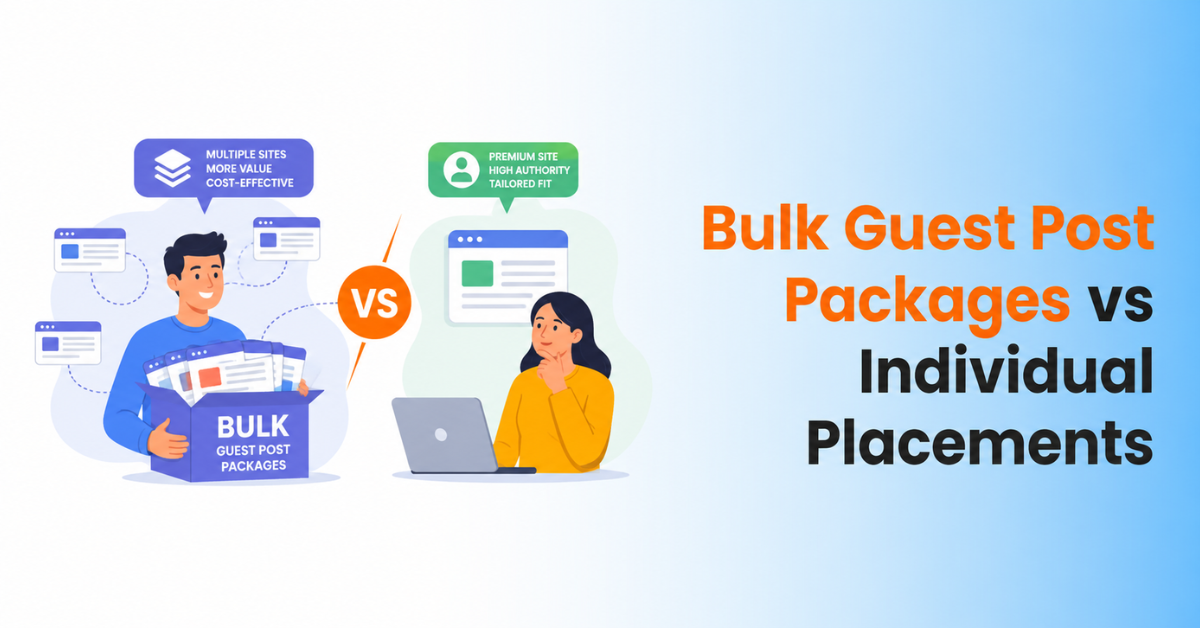
You can buy individual guest post placements one at a time, giving you more control over each publisher. Or, you can choose bulk guest post packages that bundle multiple placements into a single order, making larger campaigns easier to plan and manage.
So, which option is better?
The answer depends on your campaign size, budget, target pages, publisher requirements, and how much control you want over individual placements.
In this guide, we'll compare bulk guest post packages vs individual placements and explain when each approach makes sense.
Quick Comparison: Bulk Packages vs Individual Placements
|
Factor |
Bulk Guest Post Packages |
Individual Guest Post Placements |
|
Main advantage |
Scale and easier campaign management |
Greater control and flexibility |
|
Number of placements |
Usually multiple placements |
One placement at a time |
|
Publisher selection |
Based on package criteria |
Can be selected individually |
|
Budget |
Planned upfront |
Spread across individual purchases |
|
Campaign speed |
Can be easier for larger campaigns |
May require more manual management |
|
Flexibility |
Lower once the package is selected |
Higher |
|
Best for |
Larger campaigns and multiple target pages |
Selective, highly targeted campaigns |
|
Evaluation |
Package criteria should be reviewed carefully |
Each publisher can be evaluated separately |
Neither option is automatically better. The right choice depends on what you need from your link-building campaign.
What Are Bulk Guest Post Packages?
Guest post packages bundle multiple guest posting placements into one order.
Instead of finding and purchasing every placement separately, you select a package with defined requirements such as:
- Number of guest posts
- Publisher criteria
- Authority metrics
- Niche or category
- Number of links
- Content requirements
- Delivery timeline
- Reporting or placement confirmation
For example, a package might offer 10, 20, or more guest post placements under a single order.
This approach can be particularly useful when you already know that your campaign needs multiple placements.
However, the number of placements should never be the only factor you consider.
A package offering more websites is not necessarily better than a smaller package with stronger topical relevance and publisher quality.
What Are Individual Guest Post Placements?
Individual placements are purchased separately.
Instead of committing to a package, you can evaluate a publisher, decide whether it fits your campaign, and purchase the placement independently.
You can also use a guest post marketplace to compare available publishing opportunities based on your campaign requirements.
This gives you more control over factors such as:
- Which website publishes your article
- Topical relevance
- Publisher quality
- Organic visibility
- Target page
- Anchor text strategy
- Content requirements
- Placement terms
- Budget allocated to each opportunity
Individual placements can therefore work well when you have a smaller number of priority pages or very specific publisher requirements.
The trade-off is that managing many individual placements can take more time.
Bulk Guest Post Packages vs Individual Placements
The biggest difference is scale versus control.
A bulk package is designed to make multiple placements easier to purchase and manage. Individual placements give you more flexibility to evaluate and select opportunities one by one.
1. Campaign Size
If you need several placements across multiple pages, a bulk package can simplify campaign management.
For example, an agency managing several client campaigns may need a predictable number of placements each month. Purchasing them individually could create additional administrative work.
Individual placements are more suitable when you only need a few links or want to test publishers before expanding the campaign.
Choose bulk when: you need multiple placements.
Choose individual placements when: you need only a small number of highly targeted opportunities.
2. Publisher Selection
This is one of the most important differences.
With individual placements, you can generally assess each guest posting website before deciding whether to purchase it.
With a bulk package, your choices depend on the publisher criteria and selection process included in the package.
Before buying a bulk package, ask:
- How are publishers selected?
- Can you review the websites before placement?
- Are niche-specific publishers available?
- What authority metrics are required?
- Is organic traffic or visibility considered?
- Are websites manually reviewed?
A package should not be judged solely by the number of websites included.
3. Budget Management
Bulk packages can make budgeting easier because you know the package price before starting the campaign.
For agencies and businesses with a fixed monthly link-building budget, this can make planning more straightforward.
Individual placements provide more flexibility because you can decide how much to spend on each opportunity.
For example, you might spend more on one particularly relevant publisher and less on another.
That flexibility can be valuable when publisher quality varies significantly between opportunities.
4. Cost Per Placement
Bulk packages may offer a lower average cost per placement because multiple placements are purchased together.
But this should not be assumed.
A $500 package containing 20 poor-fit placements isn't necessarily better value than five carefully selected placements costing $100 each.
When comparing guest post pricing, calculate the effective cost per placement and then evaluate what you're actually receiving for that price.
Consider:
- Publisher quality
- Topical relevance
- Organic visibility
- Content quality
- Link terms
- Number of links
- Placement permanence
- Reporting
- Replacement or support terms
The cheapest placement is not always the best-value placement.
5. Flexibility
Individual placements have a clear advantage when your requirements change frequently.
You can adjust your publisher selection based on:
- New target pages
- New content topics
- Different geographic markets
- Changing campaign priorities
- Publisher availability
- Budget changes
Bulk packages are more structured. That can be an advantage for predictable campaigns, but it may provide less flexibility than selecting every placement independently.
6. Campaign Management
Managing 20 individual placements can take significantly more coordination than purchasing a package containing 20 placements.
With individual placements, you may need to:
- Find potential publishers.
- Review each website.
- Compare pricing.
- Contact or order from publishers.
- Provide content requirements.
- Track publication.
- Verify the live placement.
- Maintain campaign records.
A bulk package can consolidate much of this process.
This makes bulk packages particularly attractive to teams and agencies managing larger campaigns.
When Should You Choose a Bulk Guest Post Package?
A bulk package may be a good fit when:
- You need multiple guest post placements.
- You have several target pages.
- You manage multiple websites or client campaigns.
- You want predictable campaign budgeting.
- You prefer managing one package instead of many individual orders.
- The package provides clear publisher criteria.
- You have reviewed the provider's quality standards.
- The package matches your niche and campaign requirements.
Bulk packages are especially useful when scale and operational efficiency are more important than selecting every publisher individually.
When Should You Choose Individual Guest Post Placements?
Individual placements may be the better option when:
- You only need a few placements.
- You have specific publishers in mind.
- Topical relevance is your highest priority.
- You want to review every website individually.
- Your campaign has a limited or flexible budget.
- You are testing a new link-building strategy.
- Different target pages require different types of publishers.
- You want maximum control over publisher selection.
For highly selective campaigns, buying placements individually can make it easier to focus your budget on the opportunities that matter most.
What About High DA Guest Posts?
Authority metrics can be useful when comparing publishers, but DA should not be treated as the only measure of quality.
Domain Authority is a third-party metric. A website with a higher DA score is not automatically a better placement for your campaign.
If you're specifically comparing high DA guest posts, consider:
- Is the website relevant to your industry?
- Does it have genuine organic visibility?
- Is the content useful and editorially maintained?
- Does the website publish content related to your topic?
- Does the site appear to have a healthy backlink profile?
- Are the placement and link terms appropriate?
A highly authoritative website with little topical connection may be less relevant to your campaign than a smaller but genuinely relevant publisher.
This is why both bulk packages and individual placements should be evaluated using more than one metric.
How to Compare Guest Post Packages
If you're considering a bulk guest post package, don't compare packages based only on price and placement count.
Use a checklist like this:
Publisher Quality
Check the websites included in the package and review their overall quality.
Topical Relevance
Look for publishers that are relevant to your industry, audience, or content topic.
Organic Visibility
Where possible, evaluate whether the publisher receives genuine search visibility rather than relying only on authority metrics.
Link Terms
Confirm:
- Number of links per article
- Link attributes
- Target URL restrictions
- Anchor text requirements
- Whether links are editorially placed
Content
Find out whether content writing is included and what standards apply.
Delivery
Check the expected publication timeline and how completed placements are reported.
Replacement Policy
Understand what happens if a placement is removed or becomes unavailable, where a replacement policy is offered.
How to Compare Individual Guest Post Placements
When purchasing placements individually, use the same quality standards.
Don't let the additional control lead to inconsistent evaluation.
For every potential publisher, record:
|
Metric |
What to Check |
|
Niche |
Does it match your topic? |
|
Organic visibility |
Does the site have meaningful search visibility? |
|
Authority |
What do relevant third-party metrics indicate? |
|
Content quality |
Is the existing content useful and well maintained? |
|
Link placement |
How and where will the link be included? |
|
Price |
What is the total placement cost? |
|
Delivery |
How quickly will the article be published? |
|
Reporting |
Will you receive a live URL and placement details? |
This makes it easier to compare individual opportunities objectively.
Guest Post Pricing: Which Option Gives Better Value?
There is no universal answer.
Bulk packages can have a lower average cost per placement, but individual placements can give you greater control over where your budget goes.
Instead of asking:
“Which option is cheaper?”
ask:
“Which option gives me the right placements for my campaign at a reasonable cost?”
For example, a bulk package may be better value for an agency that needs 20 relevant placements.
But if you only need three highly relevant placements, purchasing 20 simply because the package has a lower average price may not make sense.
Your campaign requirements should determine the purchase—not the other way around.
Bulk Guest Post Packages for Agencies
Agencies often have a stronger use case for bulk guest post packages because they may need to coordinate placements across multiple clients.
A package can help agencies:
- Plan monthly link-building activity
- Set predictable budgets
- Manage larger placement volumes
- Reduce repetitive ordering
- Organize campaign deliverables
If you manage multiple campaigns, guest posting services for agencies can also be worth considering when you need a more structured approach to publisher selection and campaign management.
However, agencies should still match publishers to each client's niche and requirements.
A technology client, for example, may need a very different publisher profile from a travel or home improvement client.
Individual Placements for Highly Targeted Campaigns
Individual placements can be particularly useful when relevance matters more than volume.
Suppose you have one important service page that needs a highly relevant contextual placement.
Instead of purchasing a large package, you could focus your budget on finding a publisher that:
- Covers your industry
- Has relevant content
- Reaches the right audience
- Has genuine organic visibility
- Meets your link and editorial requirements
This approach can make sense when precision matters more than scale.
Can You Combine Both Approaches?
Yes.
You don't necessarily have to choose one approach for every campaign.
A practical strategy can be to use bulk packages for broader campaign coverage while purchasing selected individual placements for priority pages or highly relevant publishers.
For example:
- Bulk placements: Support broader campaign scale.
- Individual placements: Focus on priority pages and particularly relevant publishers.
This hybrid approach can provide a balance between efficiency and control.
How Vefogix Can Help With Guest Post Campaigns
Vefogix provides link building services and marketplace opportunities that can be evaluated according to different campaign requirements.
For buyers looking for multiple placements, a guest post package can simplify campaign planning by bringing several placements into one order.
For more selective campaigns, you can browse guest post opportunities and evaluate individual publishers based on your own requirements.
If guest posting is only one part of your off-page strategy, you can also explore link building services for a broader approach to link acquisition.
The important point is to compare opportunities based on the campaign—not simply choose the package with the largest number of links.
Final Takeaway
Bulk guest post packages and individual placements serve different campaign needs.
Choose a bulk guest post package when you need multiple placements, predictable planning, and a more efficient way to manage campaign volume.
Choose individual placements when you want greater control over publisher selection, have a smaller number of target pages, or need highly specific opportunities.
You don't have to choose one approach exclusively, either. A combination of bulk placements and carefully selected individual opportunities can provide both scale and flexibility.
Whatever approach you choose, don't evaluate guest posts by price, placement count, or DA alone. Look at the complete picture: publisher quality, topical relevance, organic visibility, content quality, link terms, pricing, and campaign fit.
Frequently Asked Questions
Not necessarily. Bulk packages can be more efficient for larger campaigns, while individual placements provide more control. The better option depends on campaign size, publisher requirements, budget, and how much flexibility you need.
They can have a lower average cost per placement, but this varies by provider and package. Always compare the complete deliverables rather than assuming that bulk pricing represents better value.
There is no fixed number that works for every website. Consider your target pages, campaign objectives, existing link profile, budget, and available relevant publishers.
DA can be one comparison metric, but it shouldn't be your only selection criterion. Relevance, organic visibility, content quality, and overall publisher quality should also be evaluated.
They can be useful when a business has a limited number of target pages or wants to select publishers carefully. A smaller campaign does not necessarily require a large package.
Bulk packages can be convenient for agencies managing multiple campaigns, especially when they need predictable placement volumes. Agencies should still verify that the publishers fit each client's niche and requirements.
Yes. A campaign can use bulk placements for scale and individual placements for priority pages or highly relevant publishers.
Review publisher quality, topical relevance, organic visibility, authority metrics, content requirements, link terms, pricing, delivery timelines, reporting, and any applicable replacement or support terms.