Can AI Understand Why Your Website Deserves Trust?
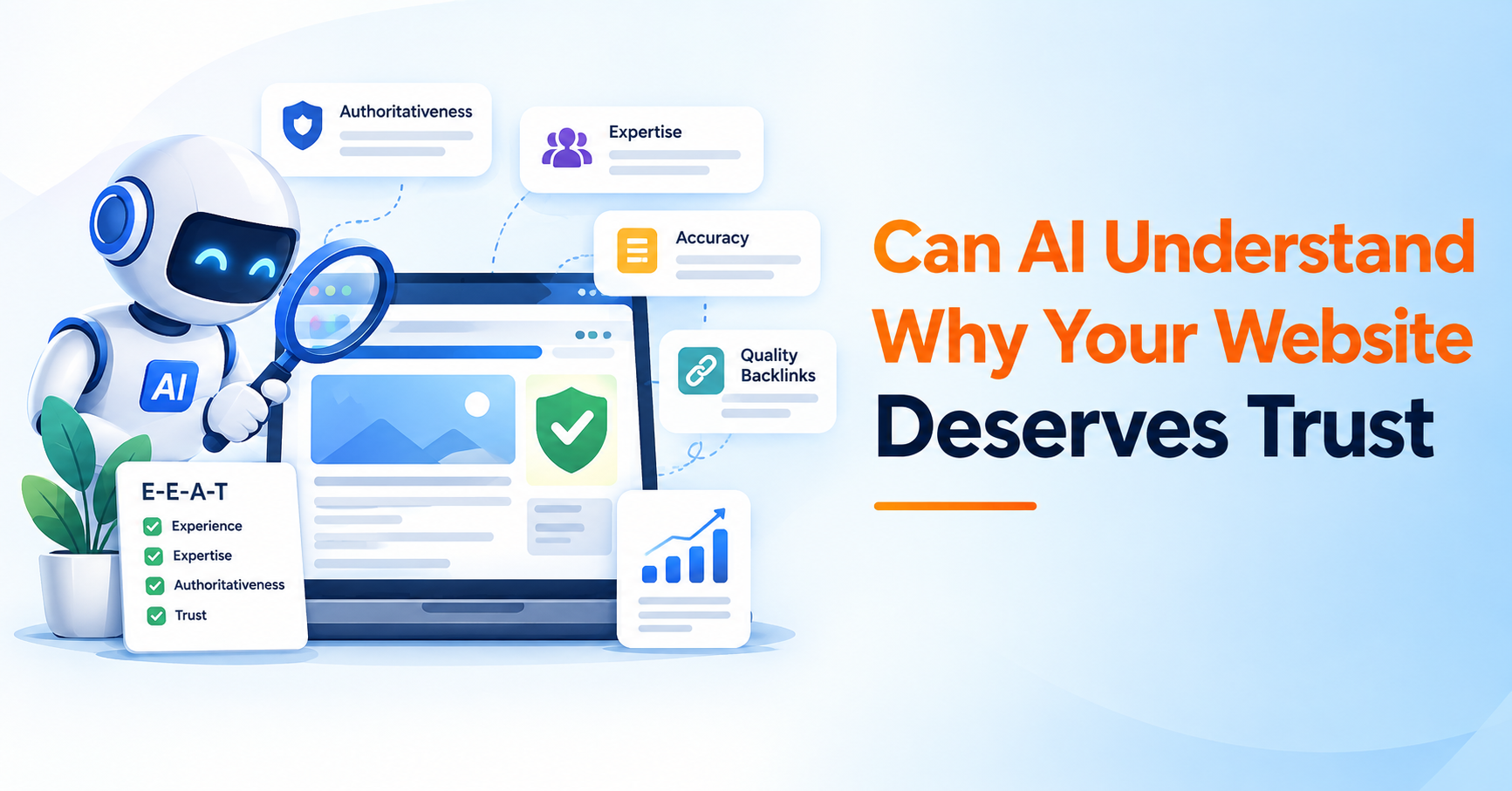
For years, the central SEO question was simple: does Google know this page exists? Today, a harder question is becoming increasingly important: does an AI-powered search experience have enough evidence to understand why this source is credible?
Search is no longer only a ranked list of links. Tools such as ChatGPT, Gemini, and Perplexity can read, compare, and summarise information from multiple sources before a reader ever clicks through to a site.
That shift changes what E-E-A-T for AI search means in practice and raises the stakes for brands that want their content to become a credible source.
From Keyword Matching to Credibility Checking
Google introduced Experience, Expertise, Authoritativeness, and Trustworthiness (E-E-A-T) as a concept used in its Search Quality Rater Guidelines. Human quality raters use those guidelines, and they do not directly determine a page's ranking position. They help describe the qualities associated with high-quality content.
AI search should not be described as simply applying Google's E-E-A-T framework as a direct scoring system. A more useful way to think about the relationship is that AI-generated answers also need credible, understandable sources.
When a system retrieves and synthesises information, signals such as author identity, evidence, consistency, relevance, and independent corroboration can help establish context and credibility.
The practical goal, therefore, is not to “optimise for an AI score.” It is to make important information easy to understand, verify, and cite.
How AI Search Trust Signals Differ From Traditional SEO Signals
|
Signal |
Traditional SEO |
AI-Search Visibility Context |
|
Backlinks |
One ranking input among many |
Can provide third-party corroboration when relevant and editorially meaningful |
|
Author identity |
Can support content quality |
Can make the experience and expertise behind a claim clearer |
|
Brand mentions |
Often considered in authority/reputation context |
Linked and unlinked mentions can provide additional context about how a brand is discussed |
|
Content freshness |
Important when freshness is relevant to the query |
Keeping time-sensitive information accurate can reduce outdated or conflicting claims |
|
Structured data |
Supports machine-readable page information and search features |
Can provide clearer context about entities, authors, organizations, and content |
|
Cross-site consistency |
Not usually evaluated as one single page-level signal |
Consistent facts across independent sources can strengthen confidence in entity information |
The Trust Signals That Can Strengthen AI Search Visibility
• Verifiable Author Expertise: A named author with a useful bio, relevant credentials, and a history of work in the subject area gives readers clearer context about who created the information.
• Consistent Entity Information: The brand name, description, products, services, and important facts should remain accurate and consistent across the website and relevant third-party profiles.
• Independent Corroboration: Credible sites discussing or linking to a brand can provide context that the brand does not control alone.
• Structured Data: Appropriate schema can give search systems clearer machine-readable information about articles, people, organizations, and other entities.
• Original Insight: First-hand data, case studies, experiments, or experience can give an article information that is not simply reproduced from another source.
• Citation-Ready Facts: Statistics, definitions, findings, and important claims should be clearly written and supported so they can be understood without guesswork.
What Makes Content Citation-Worthy?
Being visible isn't enough if the content doesn't provide a clear reason to trust it.
• Make important claims easy to verify. Put the claim in a clear sentence and support it with an appropriate source where evidence is available.
• Show who created the content. Author bios, relevant experience, and editorial responsibility make the source easier to evaluate.
• Add original evidence. A first-party dataset, case study, experiment, or documented workflow can make a page more distinctive.
• Keep facts consistent. If your company name, services, statistics, or product descriptions differ across the web, resolve the inconsistencies.
• Use authoritative references. When making claims about search systems, policies, or industry standards, link to primary documentation whenever possible.
• Write for extraction as well as reading. Clear definitions, concise answers, tables, lists, and descriptive headings make important information easier to interpret.
The AI Citation-Worthiness Framework
Use this simple 40-point framework to audit whether a page gives readers—and AI-powered search experiences—enough context to understand its credibility.
|
Signal |
Audit Question |
Score |
|
Experience |
Does the content demonstrate first-hand knowledge or practical experience? |
/5 |
|
Expertise |
Is the author qualified to discuss the subject? |
/5 |
|
Authority |
Do reputable sources recognize the brand, author, or subject expertise? |
/5 |
|
Consistency |
Are important brand and entity facts consistent across the web? |
/5 |
|
Evidence |
Are important claims supported by data or reliable sources? |
/5 |
|
Originality |
Does the page provide original insight, data, or examples? |
/5 |
|
Relevance |
Do independent sources discuss the brand in a relevant context? |
/5 |
|
Clarity |
Can important facts and answers be identified without ambiguity? |
/5 |
|
Total |
|
/40 |
A higher score doesn't guarantee an AI citation. It simply provides a practical way to identify gaps in the credibility and usefulness of a page.
Where Link Building Fits Into AI Trust Signals
Backlinks have not disappeared as part of a broader trust and visibility strategy. A relevant editorial link from an independent website can provide third-party context about a brand or piece of content.
But a link should not be treated as a guaranteed AI-ranking or citation signal.
For AI-search visibility, relevance and editorial context matter more than treating link acquisition as a volume exercise. A smaller number of relevant placements can be more useful than a large collection of unrelated links, particularly when the surrounding content genuinely supports the connection.
This is also where provider quality matters. A responsible link building agency should evaluate topical fit, publisher quality, spam history, audience relevance, and editorial context rather than simply selling a target number of links.
If teams choose to buy link building services, the useful question is straightforward: Is this a real, relevant publication, and does it make editorial sense for this brand to be mentioned there?
How AEO, GEO, and E-E-A-T Connect
|
Dimension |
Traditional SEO |
AEO |
GEO |
|
Goal |
Improve search visibility |
Provide direct answers |
Increase likelihood of representation in AI-generated answers |
|
Focus |
Relevance and page quality |
Questions and answer clarity |
Context, entities, evidence, and source credibility |
|
Methods |
Content, technical SEO, links, site signals |
Concise answers, FAQs, clear definitions |
Authoritative, consistent, original, citation-friendly information |
These approaches overlap rather than replace one another. Strong fundamentals support all three.
A Practical Checklist to Build Trust AI Can Recognize
• Audit author pages and add real bios with relevant credentials and links to legitimate professional profiles.
• Add or update appropriate Article, Person, and Organization schema where it accurately describes the page and entities.
• Align brand descriptions and key facts across the website, social profiles, and relevant directory listings.
• Earn relevant, editorially independent mentions rather than pursuing large batches of unrelated placements.
• Publish original data, a case study, an experiment, or a first-hand account when your organization has genuine experience to share.
• Review time-sensitive content regularly and update it when facts, sources, statistics, products, or recommendations change.
• Search relevant questions in AI tools and record whether your brand, pages, or competitors are being surfaced as sources.
• Track citation visibility as an observation, not as a guaranteed ranking metric.
Common Mistakes That Undermine AI Trust
• Publishing AI-generated content without meaningful human review, expertise, or fact-checking.
• Allowing important brand facts to drift out of sync between the website and third-party sources.
• Treating link building as a numbers game instead of evaluating relevance, quality, and editorial context.
• Leaving pages without a clear author or indication of who is responsible for the content.
• Repeating generic information without adding original experience, evidence, examples, or a useful point of view.
• Leaving time-sensitive content untouched after facts, statistics, products, policies, or recommendations change.
• Making strong claims about how a specific AI system ranks or cites pages without reliable evidence.
The Bottom Line
AI search has not replaced the fundamentals of trustworthy content. It makes the quality and consistency of those fundamentals more visible.
A brand that wants to become a credible source should focus on real expertise, accurate and consistent entity information, original evidence, useful content, and relevant independent mentions. The goal is to create information that a reader can understand, a search system can interpret, and an independent source can reasonably corroborate.
Frequently Asked Questions
E-E-A-T stands for Experience, Expertise, Authoritativeness, and Trustworthiness. For AI search, the useful application is to make the experience, expertise, evidence, and credibility behind your content clear and verifiable.
No. Google has stated that E-E-A-T itself is not a specific ranking factor. Its Search Quality Rater Guidelines describe qualities raters use when evaluating search results and content quality.
Traditional SEO evaluates many signals to determine search visibility. AI-generated search experiences can additionally retrieve, compare, and synthesize information from multiple sources, making source clarity, consistency, evidence, and contextual relevance especially important.
A citation-worthy page is clear, relevant, credible, well-supported, and useful for answering a specific question. Strong authorship, original evidence, authoritative references, consistent entity information, and clear facts can all contribute.
Backlinks can still contribute to broader authority and discovery, but they should not be treated as a guaranteed AI citation signal. Relevance, editorial context, and the credibility of the referring publication are more meaningful than raw link volume.