How to Evaluate Guest Post Websites Beyond DA and DR Metrics
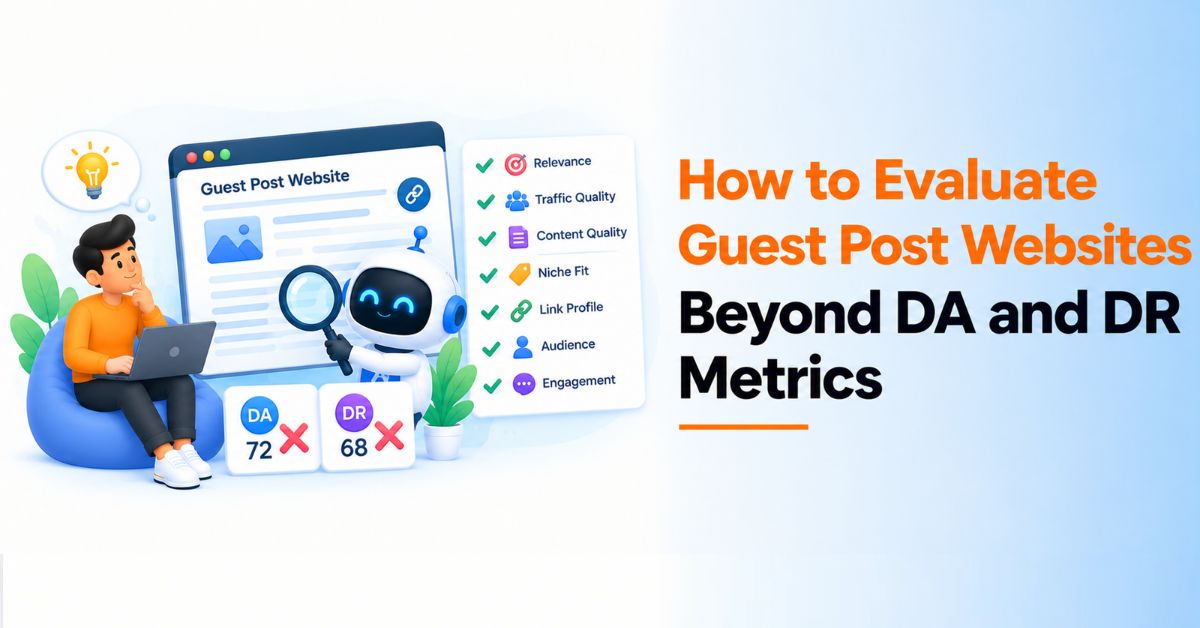
Picture two publishers. The first has a DR of 80, a polished homepage, and a prominent “Write for Us” page. The second has a DR of 35, publishes useful articles in your industry, and attracts consistent organic traffic from your target market. Which would you choose?
The higher DR might look more attractive at first. However, domain authority metrics alone cannot tell you whether a website reaches the right audience, publishes reliable content, or provides a relevant place for your backlink.
If you want to evaluate guest post websites effectively, look beyond a single score. Check traffic quality, topical relevance, editorial standards, audience location, and outbound links before committing your budget. These eight checks can help you compare publishers and make more informed decisions.
1. Check Organic Traffic and Its Trends
Organic traffic helps you understand whether a website attracts visitors through search engines. Use tools such as Ahrefs or Semrush to review estimated monthly traffic and examine how it has changed over the past 12 months.
Look for:
- Consistent traffic patterns: Gradual growth or stable performance can indicate an established audience.
- Sudden increases or declines: Investigate major changes instead of assuming they indicate a penalty.
- Relevant landing pages: Check whether the website attracts visitors to articles related to your industry.
- Traffic across multiple pages: A site that receives visits from several useful articles may have a stronger content base than one relying on a single page.
Remember that third-party tools provide estimates, not exact analytics. Compare more than one source when the numbers seem unusual. A traffic decline can have several causes, so investigate before rejecting a publisher.
You can also use the Vefogix Bulk DA and PA Checker to compare authority metrics across multiple prospects. Use these scores as initial screening indicators rather than proof of a website's quality.
2. Evaluate Topical Relevance
A backlink should make sense in the context of the page that contains it. A website publishing detailed articles about your industry is generally a more natural fit than a publisher covering unrelated subjects simply to sell placements.
Review the website's categories and read several recent articles. Ask yourself:
- Does the publisher regularly cover your niche or related topics?
- Would its readers find your content useful?
- Does the proposed article fit naturally within its editorial focus?
- Are the topics connected, or does the site publish unrelated content mainly to accommodate paid links?
A general news website is not automatically unsuitable. It may be relevant when its audience, editorial coverage, and proposed article align with your campaign.
When researching potential publishers, competitor backlink analysis can also help you discover relevant websites. The Vefogix SEO tools page provides a starting point for exploring tools that support backlink and website research.
Prioritize a clear connection between the publisher, the article, and your target audience when comparing guest posting services.
3. Review Content Quality and Editorial Standards
A website can have strong authority metrics and still publish poor content. Read at least five to ten recent articles to understand the publisher's editorial standards.
Look for original information, accurate facts, clear writing, useful examples, and appropriate sources. Check whether articles offer genuine insights rather than repeating the same information found on dozens of other websites.
Also examine the authorship and presentation:
- Are author profiles available where appropriate?
- Do articles demonstrate relevant knowledge or experience?
- Are claims supported by credible sources?
- Is the content edited and organized for readers?
- Does the website work properly on mobile devices?
Be cautious when every article follows the same generic format, contains obvious factual errors, or exists mainly to accommodate external links.
A strong publisher should offer value to its readers even when the backlink is removed from the equation.
Once you have established your quality criteria, compare available guest post packages by niche, pricing, publisher details, and stated delivery requirements.
4. Check Audience Location and Engagement
Traffic volume matters, but audience fit can matter just as much. A website attracting 20,000 monthly visitors from an unrelated market may be less useful to your campaign than a smaller publisher reaching your target customers.
Use available traffic tools to review the countries and regions sending visitors. Then compare that information with your target market.
For example, a business selling services in Australia may prefer publishers with relevant Australian readership over websites whose audiences are concentrated elsewhere.
Where data is available, review additional engagement signals:
- Comments that contribute to the discussion
- Social media shares and meaningful replies
- Newsletter or community activity
- Traffic to relevant articles
- Referral visits and conversions from previous placements
These signals are not equally available on every website, and none independently proves that an audience is genuine. Use them alongside traffic history, content quality, and relevance.
5. Look for Spam Signals
A high DR or DA score does not guarantee that a website follows sound publishing practices. Check for patterns that suggest the site prioritizes selling backlinks over serving readers.
Warning signs include:
- Unrelated subjects appearing across the same website without a clear editorial reason
- Large volumes of thin or repetitive articles
- Excessive commercial anchor text
- Pages filled with unrelated outbound links
- A sudden increase in low-quality published content
- Traffic declines that coincide with other quality concerns
- Poor navigation, broken pages, or an abandoned editorial structure
A “Write for Us” page or a visible sponsored-content policy is not automatically a problem. Legitimate publications accept contributions and disclose commercial relationships.
Likewise, a website's failure to rank for its own brand name is not conclusive evidence of spam. Search visibility, brand recognition, and website quality need to be assessed together.
The aim is to identify patterns, not reject a publisher because of one isolated signal.
For a broader review of domain metrics, you can also explore the Bulk DA, PA, and Spam Score Checker. Remember that third-party scores should support your assessment, not replace manual checks.
6. Examine Outbound Links and Placement Terms
Review several existing articles and inspect the external websites they link to. Consider whether those links support the content and whether the publisher appears selective about what it recommends.
Pay attention to:
- The number and relevance of external links
- Whether commercial links fit naturally within the article
- The quality of linked destinations
- The use of sponsored or affiliate disclosures
- The placement location and surrounding text
- The link attributes specified in the publishing terms
Links to unrelated or questionable websites across many articles can indicate weak editorial control. However, a single link to a sensitive or commercial topic does not automatically make a publisher unsuitable.
Before ordering, confirm where your link will appear, whether the article will remain live, which link attributes will be used, and whether the publisher allows the required anchor text.
Links marked rel="sponsored" or rel="nofollow" are not necessarily worthless. They can still provide referral traffic, exposure, and relevant visitors. However, do not assume they will pass ranking signals in the same way as a qualifying editorial link.
If you are comparing other placement options, browse backlink building packages to review available services and their stated deliverables.
7. Check Indexing and Search Visibility
A published article is not the same as an indexed article. Before selecting a publisher, search Google for a sample of its recent articles and check whether important pages appear in search results.
You can also inspect individual article URLs using Google Search Console if you own or have access to the relevant property. Third-party tools may provide additional information, but they cannot confirm the indexing status of every URL with complete accuracy.
Check the following:
- Whether recent articles appear in search results
- Whether the website publishes substantial content that receives organic visibility
- Whether important pages have obvious technical problems
- Whether the article URL returns a valid page rather than a redirect or error
- Whether the publisher can provide the final live URL after publication
Avoid relying exclusively on a site: search or a third-party indexing indicator. Neither is a complete substitute for URL-level verification.
Indexing can change over time, and no publisher can guarantee that every article will remain indexed indefinitely.
For additional website analysis, visit the Vefogix SEO tools page to explore tools that support domain research and SEO checks.
8. Review Publishing Activity and Consistency
Check when the publisher last posted an article and how regularly it updates the website. Recent, useful content can indicate that the publication remains active, while long periods of inactivity may justify further investigation.
However, publishing frequency alone is not a ranking signal you can use to judge every website. Some specialist publications publish only a few high-quality articles each month and still attract a valuable audience.
Look at the bigger picture:
- Are recent articles useful and relevant?
- Has the editorial focus remained consistent?
- Are older articles maintained when necessary?
- Does organic traffic support the site's current publishing activity?
- Are new articles discoverable through the website's navigation or category pages?
A quiet publishing schedule is not an automatic rejection. Assess it alongside the publisher's traffic, content quality, and editorial history.
Build a Guest Post Website Evaluation Scorecard
After reviewing each publisher, record the findings in a spreadsheet. A simple scorecard makes it easier to compare websites consistently and explain why a placement was approved or rejected.
Use the following framework as a starting point. Adjust the weights to match your campaign goals.
|
Evaluation factor |
Suggested weight |
|
Organic traffic quality and trend |
20 |
|
Topical relevance |
20 |
|
Content quality and editorial standards |
15 |
|
Audience location and engagement |
10 |
|
Spam signals and overall quality |
15 |
|
Outbound links and placement terms |
10 |
|
Indexing and search visibility |
5 |
|
Publishing activity |
5 |
|
Total |
100 |
Score each factor from 0 to 5, then convert it to its weighted value. For example, a score of 4 out of 5 for a factor worth 20 points contributes 16 points to the total.
You could use 75 out of 100 as an initial review threshold, but this is a working guideline, not an industry standard. A high total should never override a serious concern about relevance, content quality, or the publisher's link practices.
Record the date of each review and reassess important publishers periodically. Traffic, ownership, editorial policies, and content quality can change.
How Vefogix Can Help You Compare Guest Post Websites
Manually evaluating publishers takes time, especially when you need placements across different industries, countries, and budgets.
The guest posting services page provides a starting point for comparing guest posting options. Buyers can also explore individual website listings and use available metrics, categories, traffic information, and pricing to narrow their choices.
Treat listed metrics as screening tools rather than automatic proof of quality. Review the specific publisher, article requirements, and placement terms before placing an order.
Businesses looking for more options can browse the SEO marketplace to compare available services across different campaign needs. For broader campaigns, link building services provide another option to consider alongside individual guest post placements.
The best choice depends on your objectives, audience, budget, and the actual deliverables included in each package.
Think Beyond DA and DR
DA and DR remain useful for comparing websites at an initial screening stage. They should not determine your final decision.
A better evaluation combines authority metrics with organic traffic, topical relevance, content quality, audience fit, and editorial standards. It also considers whether the placement offers genuine value to readers and whether the terms meet your campaign requirements.
Guest posts are only one part of a wider digital marketing strategy. When a business has a genuine announcement, product launch, or company update, press release distribution services may support brand visibility and media exposure. These placements serve a different purpose from editorial guest posts and should be evaluated against their own goals.
Ultimately, the aim is not to find the website with the biggest number. It is to choose a publisher that makes sense for your audience and your campaign.
vefogix
Frequently Asked Questions
Review organic traffic trends, topical relevance, content quality, audience location, outbound links, indexing, and publishing activity. Use DA and DR as initial comparison metrics rather than your only selection criteria.
Neither metric should be considered in isolation. Traffic helps you assess potential audience reach, while authority metrics provide comparative estimates of a domain's backlink profile. Relevance, editorial quality, and the intended purpose of the placement should guide the final decision.
Look for multiple warning signs, such as unrelated topics, thin content, excessive commercial links, poor editorial standards, and concerning traffic patterns. Verify these findings using more than one source before rejecting a website.
No. A lower-DR website may still be a good fit if it publishes relevant content, reaches your target audience, and maintains sound editorial standards. Evaluate the full picture rather than setting an arbitrary authority cutoff.
No. Traffic estimates can be inaccurate, and a website with visitors may still have poor editorial standards or little relevance to your business. Check traffic history, content quality, audience fit, and the specific placement before making a decision.
Review a publisher before ordering and reassess important placements periodically, such as every three to six months. Recheck sooner if traffic changes sharply, content quality declines, or the website changes ownership or editorial focus.
They can be. Nofollow links may generate referral visits, brand exposure, and audience engagement. Their value depends on the context and campaign objective, so do not evaluate them solely by whether they pass ranking signals.