How Backlinks Help Google Discover, Index, and Rank Your Website
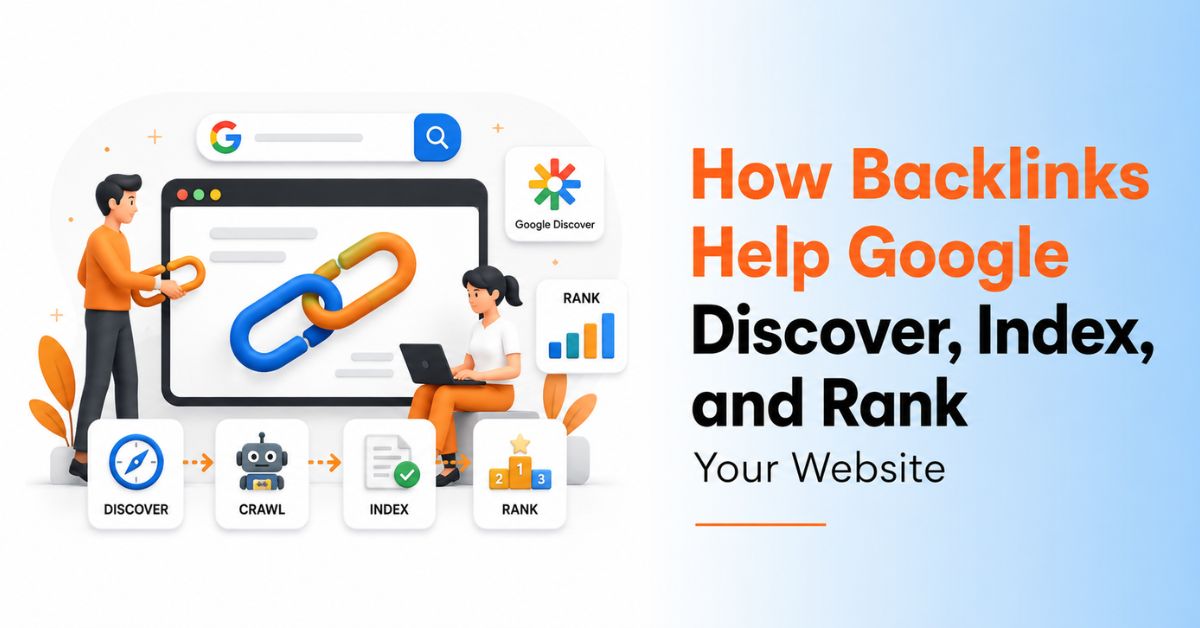
Backlinks are usually discussed as a ranking factor, but their role in SEO starts much earlier.
A link from another website can help Google discover a URL it hasn't previously encountered. Google may then crawl and process that page, decide whether it belongs in its index, and eventually consider it for relevant search results.
Backlinks can also provide referral traffic, introduce your content to new audiences, and help search engines understand relationships between pages.
However, a backlink does not guarantee crawling, indexing, rankings, or Google Discover visibility.
The simplest way to understand the relationship:
Backlink → Discovery → Possible crawling → Possible indexing → Ranking eligibility → Search visibility
And for Discover:
Indexed content + Discover eligibility + user interest → Possible Discover visibility
Let's look at how each stage actually works.
Do Backlinks Help Google Discover, Index, and Rank a Website?
Yes, but in different ways.
If you're new to link building, our guide to contextual backlinks and Google's ranking systems provides a deeper look at why relevance and context matter when evaluating external links.
1. What Is a Backlink?
A backlink is a hyperlink from another website to a page on your website. For example:
↓
YourWebsite.com/seo-guide/
The link becomes a pathway between the two pages. Backlinks can appear in:
- Editorial articles
- Industry publications
- Resource pages
- Research studies
- Interviews
- Product reviews
- Guest contributions
- Relevant business or partner pages
But backlinks are not interchangeable. A relevant editorial link from a legitimate website can be far more useful than hundreds of automatically generated links from unrelated pages.
The right question isn't:
"How many backlinks can I get?"
It's:
"Why would another website genuinely want to reference this page?"
If you're evaluating a backlink campaign, you can also use Vefogix's bulk DA, PA and spam score checker to compare third-party website metrics — but remember that these metrics are useful for prospecting, not substitutes for Google's own ranking systems.
2. How Backlinks Help Google Discover Your Pages
Google continuously discovers new and updated URLs across the web. One important discovery mechanism is links.
Imagine you publish example.com/ultimate-seo-guide/. If nobody links to the page and it has weak internal linking, Google has fewer pathways through which it can encounter that URL.
Now suppose an established website publishes an article containing a crawlable link to your guide. When Google crawls that article, it can discover the linked URL. That gives Google another pathway to your website.
Discovery is not the same as crawling
This distinction is critical.
Google learns that a URL exists.
Google actually requests and processes the URL.
Google doesn't crawl every URL immediately after discovering it. Its systems determine which URLs to crawl and when based on a range of factors.
So this statement is too strong:
"A backlink makes Google crawl your page."
A more accurate statement is:
A backlink can help Google discover your page, after which Google may decide to crawl it.
This is also why external backlinks should be supported by a good internal linking strategy across your own website.
3. From Discovery to Indexing
Once Google discovers a URL, the simplified process looks like:
Google describes Search as having three broad stages: crawling, indexing, and serving search results. Not every page discovered by Google reaches the index.
Backlinks can help with the discovery part of this process, but indexing depends on much more.
Do backlinks guarantee indexing?
No. A page can have dozens or even hundreds of backlinks and still not be indexed. Common reasons include:
- noindex
- Robots.txt restrictions
- Incorrect canonicalization
- Duplicate content
- Server errors
- Soft 404s
- Rendering problems
- Poor-quality or low-value content
- Weak site architecture
If you're troubleshooting an indexing problem, don't automatically order more backlinks. First check whether the page is technically accessible and indexable.
Vefogix also provides an SEO audit service that can be used as part of a broader technical SEO review.
4. How Backlinks Can Help Google Understand Your Content
Backlinks aren't just pathways between URLs. They can also provide context.
Suppose your page is about Technical SEO for SaaS companies. An article about SaaS marketing might naturally link to your guide while discussing technical SEO. That link establishes a relationship:
The surrounding content and anchor text can help users—and potentially search engines—understand why the target page is relevant. Google recommends descriptive anchor text because it helps users and Google understand the linked page.
This is one reason relevance and context matter more than simply accumulating links. For a deeper explanation, see our guide on the role of contextual backlinks in Google's ranking systems.
5. How Backlinks Can Support Rankings
After a page is indexed, backlinks can become part of the broader ranking picture. Google identifies link analysis systems, including PageRank, among its ranking systems.
But there is no public formula such as:
10 backlinks = position 5 or DR 70 backlink = 20 ranking points
Google uses many signals and systems to determine which pages are most relevant and useful for a search. A better SEO model is:
Backlinks can strengthen that overall foundation, but they don't operate independently.
If you're planning an active campaign, Vefogix's link building services can be used to build a broader backlink acquisition strategy rather than focusing on isolated links.
6. Quality and Relevance Matter More Than Raw Backlink Count
Not every backlink should be treated equally. Consider two hypothetical websites.
Website A
- High third-party authority score
- Almost no topical relevance
- Large number of unrelated outbound links
- Little real audience value
Website B
- Moderate third-party authority score
- Strong topical relevance
- Real audience
- Relevant editorial content
- Genuine reason to reference your page
Website B may be the more sensible link opportunity.
What makes a backlink worth pursuing?
Look for:
- Topical relevance
- Editorial context
- A legitimate publisher
- A real audience
- A useful destination page
- Natural placement
- Appropriate anchor text
- A genuine reason for the link to exist
If you want to understand how publishers and pricing vary, our article How Much Should You Pay for a Guest Post? covers factors such as publisher relevance, traffic, authority metrics, and placement costs.
Remember that DA, DR, and similar metrics are third-party measurements. They should help you evaluate prospects, not determine SEO value by themselves.
7. Anchor Text: Be Descriptive, Not Manipulative
Anchor text is the clickable text of a hyperlink. For example:
Read this guide to technical SEO for SaaS websites.
The linked phrase is the anchor text.
Descriptive anchor text helps users understand where a link leads, but that doesn't mean every backlink should use an exact-match commercial keyword. A natural backlink profile can contain:
- Brand names
- URLs
- Descriptive phrases
- Partial-match phrases
- Natural language
- Generic phrases where appropriate
Avoid forcing the same keyword into every backlink. For example, repeatedly building best SEO services, best SEO services, best SEO services is very different from naturally linking to a resource using language appropriate to the surrounding article.
This principle is particularly important when using guest posting services, because the goal should be useful editorial content rather than inserting keywords simply to manipulate rankings.
8. Backlinks and Internal Links Work Together
External and internal links serve different but complementary purposes. A backlink may introduce Google to your site, while internal links help Google navigate the relationships between your own pages. For example:
For businesses actively building external links, link insertion services can also be considered when an existing article genuinely benefits from a relevant resource.
The key is to make both internal and external links useful to the reader.
9. Why Internal Linking Matters for SEO
Internal links are one of the easiest parts of an SEO strategy to control. You decide:
- Which pages link to each other
- Where the links appear
- What context surrounds the link
- Which anchor text is used
- Which pages receive more internal references
For example, this article can naturally connect to: contextual backlinks, guest posting services, link building services, and guest post pricing. This creates topical relationships rather than leaving each article as an isolated page.
A strong internal linking structure can also help distribute users and crawlers across important pages.
10. What About Google Discover?
Google Discover is different from traditional keyword-based Search. Discover surfaces content to users based largely on their interests and activity.
The most important point: A page must be indexed by Google and meet Discover's requirements to be eligible for Discover.
Backlinks are therefore not a Discover switch. You cannot simply acquire backlinks and expect a page to start appearing in Discover. Instead, focus on content quality, relevance, originality, strong presentation, and the other factors Google identifies for Discover.
11. How Backlinks Relate to Google Discover
Although backlinks aren't a specific Discover requirement, they can still play an indirect role in the broader SEO ecosystem. For example:
- You publish original research.
- Industry websites reference the research.
- Those references generate backlinks.
- More people discover the research.
- Your brand and content gain wider exposure.
- Your site develops a stronger overall web presence.
But Discover itself depends on much more than backlinks. Google recommends focusing on:
- Helpful content
- Original insights
- Timely information
- Strong headlines
- High-quality images
- Avoiding clickbait
- Good page experience
For publishers creating content specifically to expand organic visibility, this is where a broader content marketing strategy can complement link acquisition.
12. Which Backlinks Should You Avoid?
Google's spam policies identify several forms of link spam, including links created primarily to manipulate rankings. Examples include:
- Buying or selling links for ranking purposes
- Excessive link exchanges
- Automated link-building
- Keyword-stuffed links
- Low-quality directory links
- Widely distributed footer or template links
- Low-quality widget links
- Scaled content created primarily to manipulate links or rankings
Paid advertising and sponsorship are different from buying links specifically to manipulate rankings. Applicable paid or sponsored links should be appropriately qualified.
The objective should be to build useful connections rather than manufacture ranking signals. If you want a managed approach, Vefogix's white-hat link building services focus on relevant placements rather than automated link schemes.
13. Why "More Backlinks" Isn't Always Better
Raw backlink count doesn't tell you enough. Consider:
Site A
- 5,000 backlinks
- Mostly irrelevant websites
- Repetitive anchor text
- Low-quality sources
- Little editorial context
Site B
- 300 backlinks
- Relevant industry publications
- Natural anchor text
- Strong editorial context
- Independent referring domains
- Useful content
The second profile may be strategically stronger despite having fewer links.
This is why link-building campaigns should track more than backlink quantity. Monitor:
- Referring domains
- Topical relevance
- Organic visibility of linking sites
- Link placement
- Anchor text
- Referral traffic
- Target-page rankings
- Organic impressions
- Indexed status
You can also use Vefogix's Competitor Guest Post Checker to investigate where competitors have obtained guest-post opportunities and identify potential publishers for your own outreach.
14. What to Do If a Page Isn't Indexed
Before building more backlinks, check the technical fundamentals.
Indexing checklist
- →Is the URL returning HTTP 200?
- →Is the page blocked by robots.txt?
- →Is noindex present?
- →Is the canonical correct?
- →Is the page accessible to Googlebot?
- →Is the content unique and useful?
- →Is the page internally linked?
- →Is it included in the XML sitemap?
- →Can Google render the important content?
- →Are there server errors?
- →Is the page behaving like a soft 404?
Backlinks can provide another discovery path, but they cannot override technical directives that prevent crawling or indexing.
If you're auditing an entire site, Vefogix's SEO audit services can be part of the diagnostic process.
15. A Practical Backlink Strategy
A sustainable link-building campaign can follow this process.
- Create something worth referencing — original research, industry statistics, detailed guides, case studies, free tools, templates, original data, expert analysis.
- Strengthen internal linking — connect your important pages through relevant internal links.
- Find relevant publishers — prioritize websites with topical relevance, real content, genuine audiences, organic visibility, and appropriate editorial standards.
- Earn or acquire relevant placements — digital PR, expert contributions, editorial outreach, relevant guest contributions, resource placements, research citations, industry partnerships.
- Keep anchor text natural — don't force exact-match commercial keywords into every placement.
- Monitor outcomes — indexed pages, organic impressions, rankings, organic clicks, referring domains, referral traffic, link status.
If guest posting is part of your strategy, see The Complete Guide to Guest Posting Services for a deeper look at publisher selection, content, and campaign considerations.
The goal should be useful, relevant links, not the highest possible backlink count.
16. How Vefogix Fits Into a Backlink Strategy
Finding relevant publishers manually can involve several steps: finding potential websites, checking topical relevance, reviewing traffic and SEO metrics, comparing publisher opportunities, managing content and placements, and monitoring links after publication.
Vefogix provides link building services and guest posting services for businesses looking to acquire relevant placements. You can also explore all Vefogix SEO and marketing services if your campaign requires content, link insertion, SEO, or related services alongside backlink acquisition.
The same principle applies whether you build links yourself or use a service:
Select backlinks because they make sense for your website and audience — not simply because a third-party tool assigns the publisher a high authority score.
Backlink Myths: Fact vs. Fiction
| Claim | Reality |
|---|---|
| Every backlink improves rankings. | False. Links vary in quality, relevance, and usefulness. |
| A backlink guarantees indexing. | False. Google does not guarantee indexing. |
| More backlinks always mean higher rankings. | False. Ranking depends on many signals. |
| High DR means Google values the link highly. | False. DR is a third-party metric. |
| Exact-match anchor text should be used everywhere. | False. Natural and descriptive anchors are preferable. |
| Backlinks directly trigger Google Discover. | False. Discover has its own eligibility and content considerations. |
| Internal links don't matter if you have backlinks. | False. Internal links help users and Google navigate your website. |
| Backlinks can fix poor content. | False. Links cannot replace useful content and satisfying search intent. |
| Paid links are always prohibited. | False. Advertising/sponsorship links can be appropriately qualified; links intended to manipulate rankings are the problem. |
Final Takeaway
Backlinks play several roles in SEO, but their importance should not be reduced to a simple ranking formula.
A relevant crawlable backlink can give Google another way to discover a page. Google may then crawl and process that page, decide whether it should be indexed, and eventually consider it within its ranking systems.
Backlinks can also provide contextual relationships, referral traffic, brand exposure, and broader authority signals. But they do not guarantee:
- Crawling
- Indexing
- Higher rankings
- Google Discover traffic
For Google Discover, the priority is indexed content that meets Google's requirements and provides useful, original, relevant information to users.
The strongest strategy is therefore:
Technical SEO + useful content + strong internal linking + relevant backlinks + ongoing measurement
Don't build backlinks simply to increase a number in an SEO tool. Build links because they connect useful content with relevant websites, audiences, and topics.
For businesses that want to scale this process, Vefogix's link building services and guest posting services provide options for sourcing relevant publisher placements. That is what makes a backlink strategy more sustainable—and much more useful for both users and search engines.
Frequently Asked Questions
Yes. Google uses links as one way to discover URLs across the web.
No. Discovery and crawling are separate processes, and Google determines algorithmically which URLs to crawl.
No. A backlink can provide another discovery pathway, but Google does not guarantee that a URL will be indexed.
They can. Google identifies link analysis systems, including PageRank, among its ranking systems. However, rankings depend on many signals.
No specific Google documentation says backlinks are a Discover eligibility requirement. A page must be indexed and meet Discover's requirements before it can appear there.
There is no universal number. Competition, content quality, search intent, site architecture, relevance, and many other signals influence rankings.
No. DR is a third-party metric. Relevance, context, publisher quality, audience, and the usefulness of the link should also be evaluated.
No. Natural, descriptive anchor text is generally a better approach than repeatedly forcing the same commercial keyword.
Not necessarily. Technical problems such as noindex, robots restrictions, canonical issues, server errors, and poor content should be investigated first.