How to Score a Backlink Before Buying It
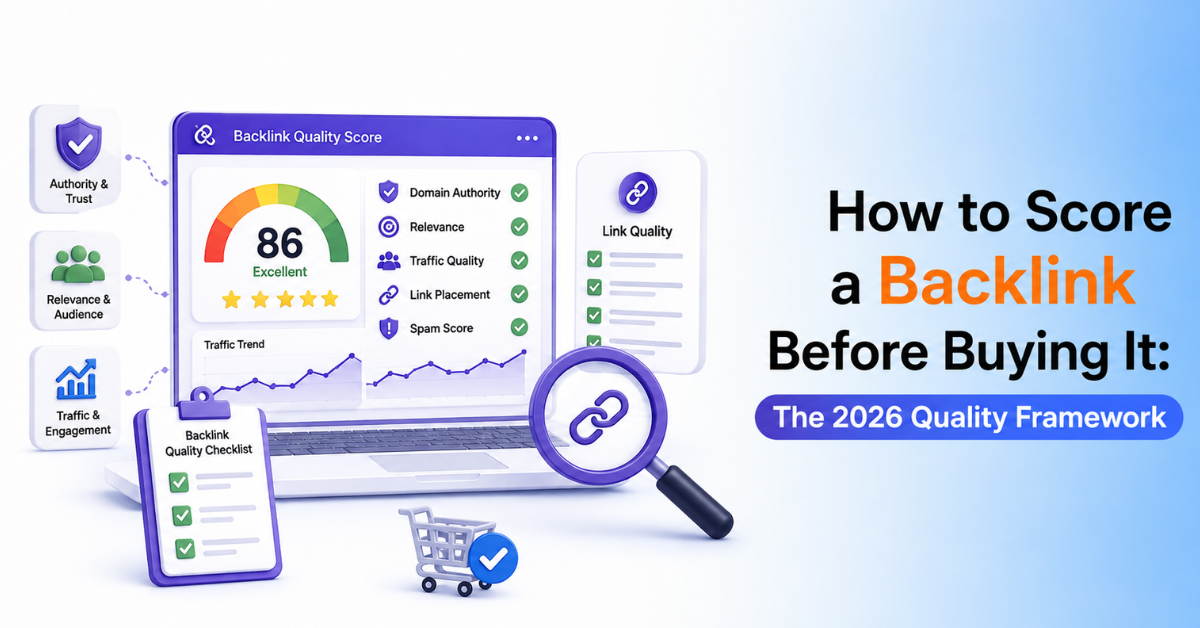
Most bad link purchases don't look bad on the surface. The domain has a decent DR, a plausible traffic number, and a price that seems fair. It's only three months later, when the link does nothing for rankings — or worse, gets flagged in a backlink audit — that the real problem shows up: it was never actually scored. It was approved on a gut feeling and a single metric.
A scoring framework fixes that. Instead of asking "does this look okay?", you're asking six specific questions, each worth a fixed number of points, and only buying when the total clears a threshold you set in advance. This guide walks through exactly how to build and use one.
Why You Need a Framework, Not Just a Gut Check
Domain Rating and Domain Authority tell you how many people link to a site — not whether those links belong in your backlink profile. A site can carry a strong authority score while sending almost no real traffic, sitting in the wrong niche entirely, or hosting content that reads like it was written to hit a word count rather than help anyone. None of that shows up if DR is the only number you check.
The fix isn't to ignore authority metrics — it's to put them in proportion, as one input among several. That's the whole idea behind a scoring framework: it forces every prospect through the same six checks, so a single strong number can't cover for five weak ones.
The 2026 Backlink Quality Framework: 6 Scoring Categories
Score every prospective placement out of 100, split across six categories. Adjust the exact weighting to fit your niche, but this split works as a solid default for most industries.
1. Topical Relevance — 20 points
Does the site actually publish content in or adjacent to your niche, or is it a general site that happens to accept guest posts on anything? A tightly relevant placement on a mid-authority site consistently outperforms an off-topic placement on a high-authority one. Score 15–20 for a close niche match, 5–14 for a loosely related category, and under 5 for a placement that only makes sense with a forced anchor.
2. Organic Traffic Quality — 20 points
Look past the total traffic number and check where it's coming from and where it's trending. Traffic concentrated in your target country, holding steady or growing over the past six months, and spread across multiple pages (not just one viral post) scores highest. A sudden traffic spike right before you were pitched the site is a reason to score this low, not high — it's a common sign of a short-term boost designed to look good during outreach.
3. Authority Metrics in Context — 15 points
Score DR or DA relative to what's typical in your niche, not against an arbitrary universal cutoff. A DR 35 site can be a strong buy in a niche where DR 40 is the ceiling, while a DR 55 site can be a weak buy in a niche saturated with DR 70+ publishers. Our DA and PA checker tools roundup is a good starting point if you need to pull these numbers at scale.
4. The Host Site's Own Link Profile — 15 points
Check what's linking to the site you're about to buy from. A healthy, natural-looking backlink profile with a spam score in a normal range scores well. A profile dominated by other guest posts, obvious link exchanges, or a rising spam score is a warning sign — you're not just buying a link, you're inheriting some of that site's link neighborhood.
5. Content and Editorial Standards — 15 points
Read a few live articles on the site before you buy. Real bylines, some depth beyond a listicle, and evidence of actual editorial review score high. Thin, templated posts stuffed with outbound links to unrelated sites score low, regardless of what the metrics say. Our guide to E-E-A-T compliant guest posts covers what strong editorial standards actually look like in practice.
6. Placement Terms and Transparency — 15 points
Score how clearly the seller states what you're actually getting: dofollow or nofollow, how long the link stays live, whether the price includes content writing, and whether metrics are disclosed upfront rather than only on request. Vague or shifting terms should pull this score down even if everything else checks out.
Scoring Table Template
|
Category |
Points |
What to Check |
Red Flag |
|
Topical Relevance |
20 |
Site's core content categories |
Generic "write for us" site accepting any topic |
|
Traffic Quality |
20 |
Geography, trend, page spread |
Sudden spike right before outreach |
|
Authority in Context |
15 |
DR/DA vs. niche norms |
High DR with negligible real traffic |
|
Host Site's Link Profile |
15 |
Who links to the host site |
Spam score climbing, exchange-heavy profile |
|
Editorial Standards |
15 |
Real bylines, content depth |
Thin, templated, keyword-stuffed articles |
|
Placement Transparency |
15 |
Dofollow status, permanence, pricing clarity |
Metrics only shared "on request" |
|
Total |
100 |
Suggested thresholds: 80+ = buy with confidence. 60–79 = negotiate on price or ask for more disclosure before committing. Below 60 = pass, regardless of how attractive the metrics look in isolation
A Worked Example
Say you're evaluating a marketing-niche site pitched to you at $180 for a guest post with a dofollow link.
- Topical relevance: the site covers marketing broadly, close but not an exact niche match → 15/20
- Traffic quality: steady traffic, mostly from your target country, spread across dozens of pages → 17/20
- Authority in context: DR 42, roughly average for this niche → 11/15
- Host site's link profile: clean, mostly earned links, low spam score → 13/15
- Editorial standards: real author bios, decent depth, occasional filler → 11/15
- Placement transparency: dofollow confirmed, no stated removal date, price includes writing → 12/15
Total: 79/100 — right on the edge. This is a "negotiate" case: ask for written confirmation the link stays live long-term, or push on price before committing.
Where to Get the Data to Score a Backlink
Building this profile for one domain takes ten to fifteen minutes if you know where to look. For traffic and authority data, a DA/PA checker handles the basics. For finding out where a site already sits in your competitors' backlink profiles — a strong relevance signal on its own — a competitor guest post checker shows you exactly which domains your competitors are already getting published on, which doubles as a relevance pre-filter before you even start scoring.
The bigger time cost isn't the scoring itself — it's finding domains worth scoring in the first place. This is where the choice of guest post service provider matters as much as the framework does. A disorganized outreach process means you're scoring random cold-pitched sites one at a time. Working through an established link-building marketplace means you're scoring from a pre-filtered pool where basic vetting has already happened, so your six categories are checking real quality differences rather than screening out obvious junk.
Why Working With a Vetted Guest Post Service Provider Still Matters
A scoring framework is only as good as the data feeding it, and that's where the choice of provider becomes part of the framework itself. Some link building service providers publish live metrics — traffic, DR, niche, spam score — directly on every listing. Others require you to request numbers by email, which introduces delay and gives room for cherry-picked screenshots instead of current data.
Vefogix's marketplace shows metrics upfront on each of its listings across a network of verified publisher sites, so the traffic and authority inputs to your scoring table are pulled from current data rather than a pitch deck. That doesn't replace the scoring process outlined above — you should still run every prospect through all six categories — but it does mean the numbers you're scoring against are more likely to hold up. If you want the fuller picture on evaluating any marketplace before you buy through it, our guide on how to choose the right sites for guest posting covers the marketplace-vetting side in more depth.
Common Scoring Mistakes to Avoid
- Letting one strong category (usually authority) offset three weak ones instead of tracking each separately
- Trusting a traffic number without checking its trend or geography
- Skipping the host site's own link profile, then being surprised when it gets flagged in a future audit
- Treating every niche the same instead of adjusting what "good" DR looks like for your specific space
- Buying based on the seller's pitch instead of independently verified numbers
- Never re-checking placements after purchase to confirm the link is still live and still dofollow
Quick Pre-Buy Scorecard
- Site's content is closely relevant to my niche
- Traffic is real, geo-relevant, and trending flat or up
- DR/DA is reasonable for what's typical in this niche
- Host site's own backlink profile looks natural
- Editorial content shows real depth and real authorship
- Link terms (dofollow status, permanence, price) are stated clearly upfront
- Total score clears my buy threshold before I commit
A framework only works if you actually apply it before you pay. Browse Vefogix's guest post marketplace to see live metrics on every listing, then run each prospect through the six categories above before you commit your budget.
Frequently Asked Questions
A structured method for evaluating a prospective backlink across multiple weighted categories — relevance, traffic, authority, the host site's own link profile, editorial quality, and placement terms — rather than relying on a single metric like DR.
80 or above out of 100 is a reasonable "buy with confidence" threshold using the framework above. Scores between 60 and 79 usually warrant more questions or price negotiation before committing.
Treat them as a starting point, not a final answer. Providers that publish live metrics on every listing, rather than only on request, tend to be more reliable — but running your own scoring pass is still worth the ten minutes it takes.
DA and DR measure link authority alone. They say nothing about topical relevance, traffic quality, editorial standards, or how transparent the seller is about placement terms — all of which this framework accounts for separately.
Most of the framework can be scored using free or freemium checkers for traffic, DA/PA, and spam score, plus manually reading a few live articles on the site. Paid tools speed up the process at volume but aren't required to apply the framework.
A quick check every few months is enough for most campaigns — confirming the link is still live, still dofollow if that was the agreement, and that the host site's traffic hasn't collapsed since purchase.
A traffic spike that appeared right before outreach began, paired with metrics the seller won't disclose until you ask directly. Together, those two signals show up far more often in low-quality placements than any single weak score does on its own.
Generally yes, when the marketplace vets publishers at intake and displays metrics openly — you're scoring against numbers that have already been checked once, rather than numbers supplied only by the seller in a cold pitch.