Link Building Pricing in 2026: We Analyzed 90,000+ Publishers (Vefogix Annual Report)
The Vefogix 2026 Link Building Pricing Report, drawn from 90,000+ marketplace publishers. Real transaction prices by DR tier, niche, geography, plus the asking-vs-paying gap that costs most buyers thousands.
Introduction
Most pricing data in the link building industry is guesswork. Buyers ask for quotes, brokers throw out numbers, and nobody knows whether the price reflects real publisher rates or markup theater. Without transaction data from real marketplaces, every buyer ends up negotiating from a position of incomplete information.
We built this report to change that. With 90,000+ active publishers in the Vefogix marketplace and full visibility into both listed prices and completed transactions, we have the data most buyers don’t. We know what publishers list and we know what gets paid. The two numbers are usually nothing alike, and the gap explains more about how the link building market really works than any pricing benchmark we’ve seen.
This report is for you if you want to know:
- How much a guest post or niche edit should cost in 2026
- Whether you’re being overcharged for premium DR placements
- How niche and geography affect what you should expect to pay
- Why listed prices and real prices are wildly different across the industry
Let’s get into the numbers.
Key insights
A quick summary of what we found, before the deep dive on each section.
2025 vs 2026 prices:
- The average Vefogix guest post grew from $158 to $185 between 2025 and 2026, up 17.1% across all DR tiers.
- Premium-tier publishers (DR 61+) saw the largest jumps, rising 21 to 22% year over year.
Guest posts vs niche edits:
- Guest posts on Vefogix average $185 in 2026.
- Niche edits (link insertions) average $95, which is 49% cheaper than guest posts.
- The price gap widens to 65 to 75% at DR 71+ tiers.
How DR affects pricing:
- DR 1-30 publishers average $55 per placement.
- DR 71+ publishers average $685 per placement.
- The gap between starter and authority tiers runs roughly 12.5x on Vefogix.
How niche affects pricing:
- The cheapest niche is personal blogs at $135 (27% below Vefogix average).
- The most expensive niche is beauty at $475 (157% above average).
- Regulated niches (finance, legal, casino, crypto) carry 60 to 80% premiums.
How geography affects pricing:
- The cheapest country is Bangladesh at $72 (61% below average).
- The most expensive country is Belgium at $495 (168% above average).
- Core English-speaking markets (US, UK, Canada, Australia, Ireland) average 45 to 65% above the Vefogix benchmark.
The asking vs paying gap:
- Average publisher asking price across the industry: $945 per backlink.
- Average Vefogix transaction price: $185 per backlink.
- Listed prices run roughly 5x higher than real transaction prices.
Data and methodology
Data source: Vefogix marketplace inventory and transaction data.
Total dataset: 90,000+ active publisher listings, with niche and geographic analysis covering publishers across 180+ countries.
A note on what these numbers represent: Vefogix prices reflect real transaction prices, meaning what buyers actually paid for completed placements, not initial list prices. This matters because list prices and transaction prices are very different numbers across the industry, and most pricing reports report one without distinguishing it from the other. The asking-vs-paying section breaks down why this difference is so significant.
2025 vs 2026 prices
The first question every buyer asks: how did link building prices change in the past year?
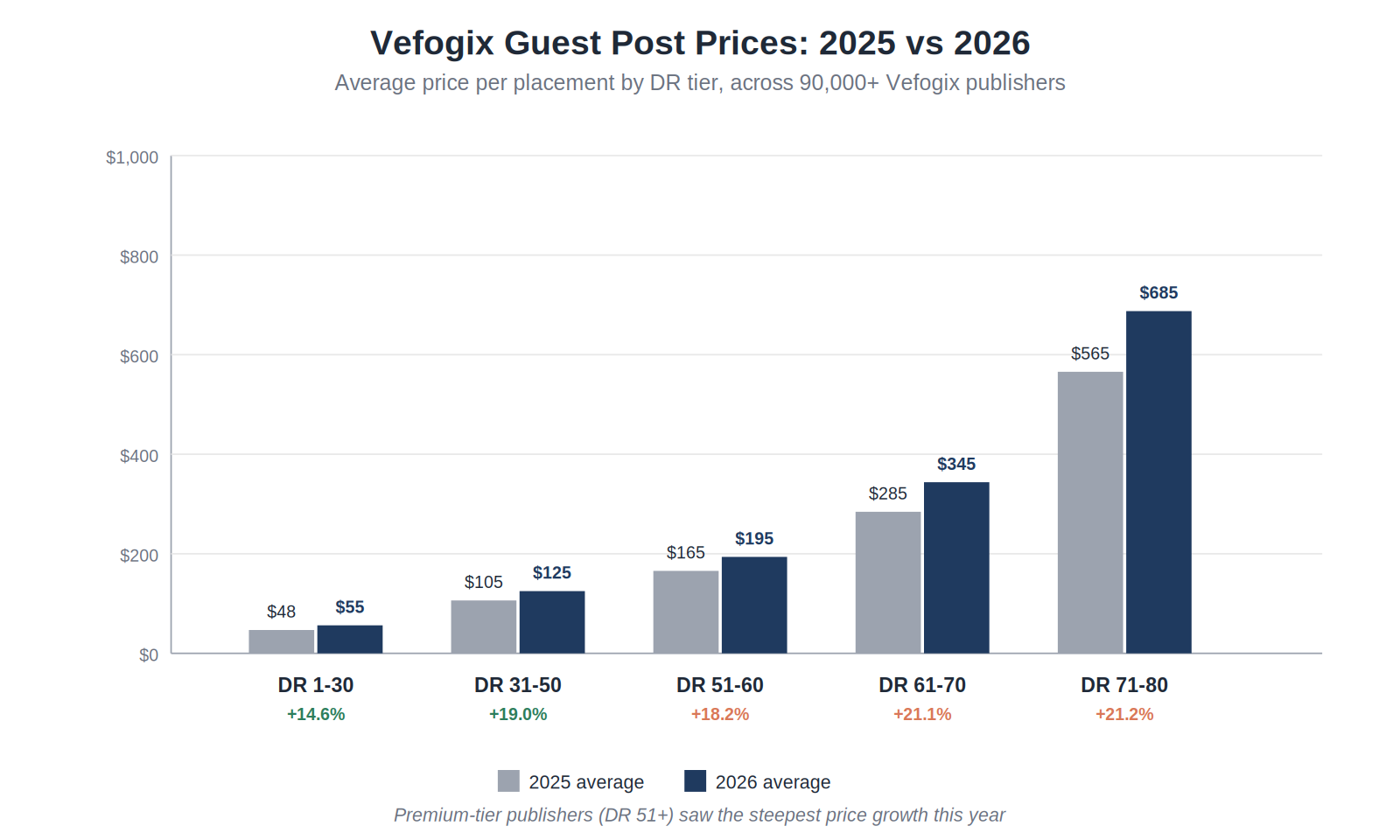
The average Vefogix guest post grew from $158 to $185, a 17.1% increase across all DR tiers. The growth was concentrated at the upper end of the DR spectrum, where authority-tier publishers held more pricing leverage than starter-tier sites.
Year-over-year change by tier:
- DR 1-30: $48 to $55 (up 14.6%)
- DR 31-50: $105 to $125 (up 19.0%)
- DR 51-60: $165 to $195 (up 18.2%)
- DR 61-70: $285 to $345 (up 21.1%)
- DR 71-80: $565 to $685 (up 21.2%)
A clear pattern emerges. Premium DR tiers grew faster than starter tiers because the supply of real DR 70+ publishers stayed flat while demand from agencies and ecommerce brands grew sharply. Authority-tier publishers raised prices more aggressively, knowing they had buyers willing to pay. Buyers looking for the best price-to-DR ratio increasingly settled into the DR 31-60 sweet spot, which is where most Vefogix inventory sits anyway.
Note: 2025 versus 2026 comparison excludes the top 1% of listings, which are primarily digital PR placements rather than standard link building inventory.
Guest post vs niche edit cost
Guest posts and niche edits drive 80% of paid backlink transactions in 2026. Knowing which one fits your campaign is mostly a function of speed, budget, and how much existing context matters for the placement.
Here’s what each format costs on average in 2026:
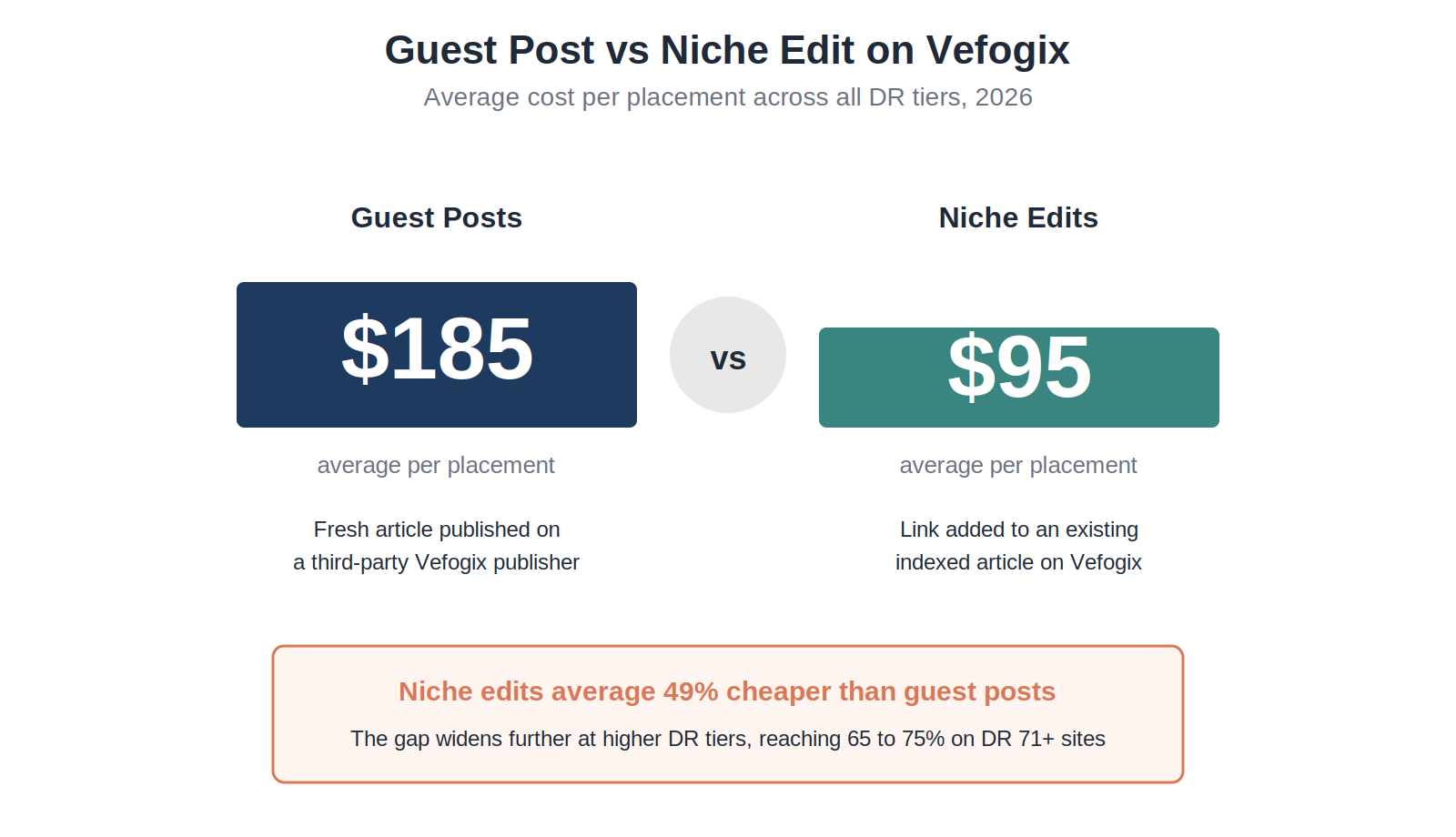
Guest posts average $185 per placement. The price reflects fresh content production, publisher outreach, content approval, and placement on a new article specifically commissioned for the buyer.
Niche edits average $95 per placement. The price reflects publisher relationship management and placement into an existing article that already ranks and has indexed authority.
Niche edits sit roughly 49% cheaper than guest posts on average, because the publisher doesn’t have to produce new content. The savings get larger at higher DR tiers. On DR 71+ publishers specifically, niche edits drop to 65 to 75% cheaper than equivalent guest post placements, because authority publishers charge premium content fees on fresh articles but accept smaller fees for adding a link to something already published.
Which format wins depends on the campaign goal. Guest posts produce fresh contextual content that lives indefinitely on the publisher’s site. Niche edits produce faster ranking lift because the host article already has age and indexed authority. Most balanced campaigns mix both formats: niche edits for fast wins on competitive keywords, guest posts for building topical authority over time.
How DR and traffic affect link building cost
Domain Rating (DR) is the single biggest factor in backlink pricing, but the math isn’t linear. Each DR tier doesn’t add a flat percentage. The jumps get steeper at the high end.
The breakdown across tiers:
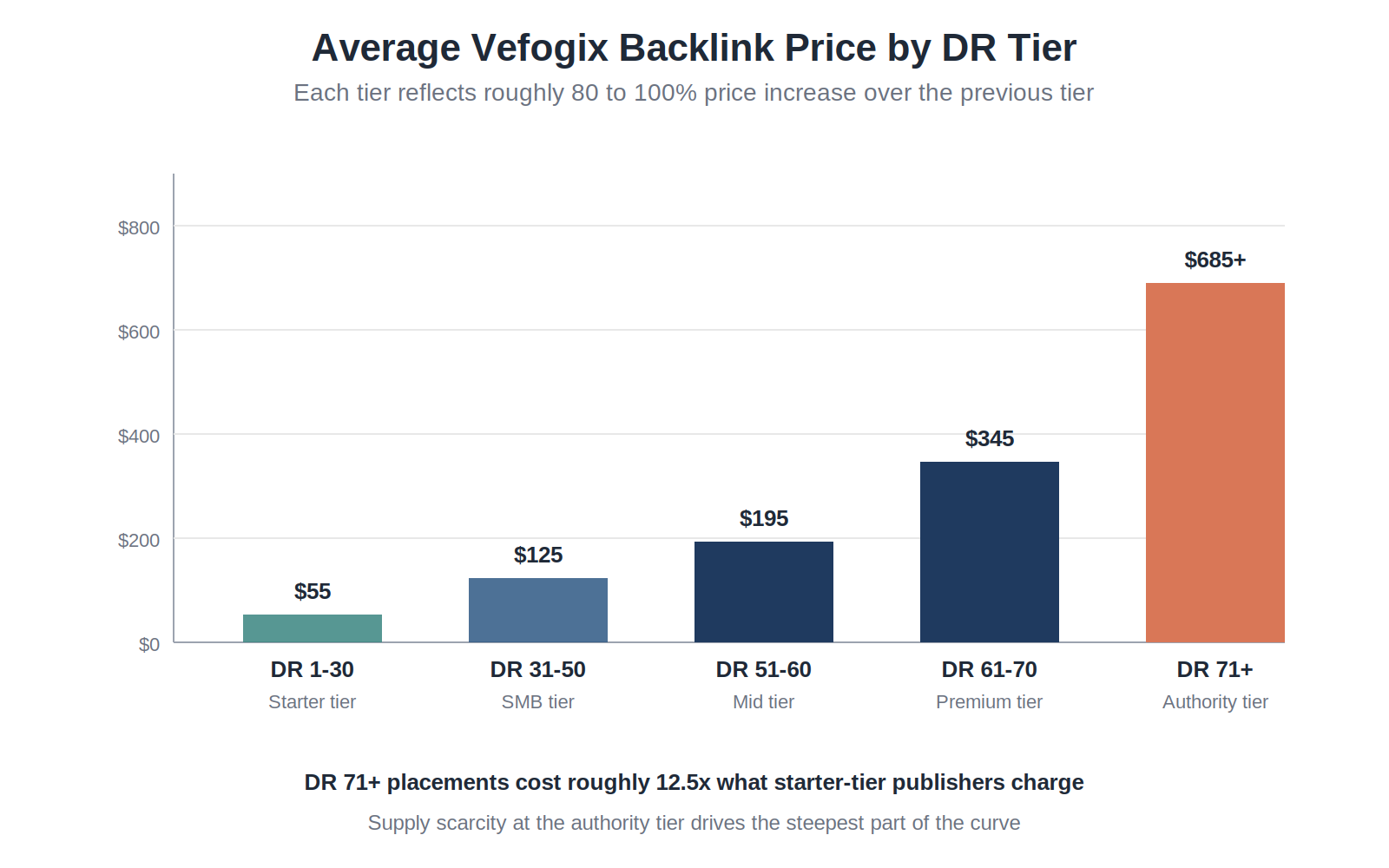
- DR 1-30 (starter tier): $55 per placement
- DR 31-50 (SMB tier): $125 per placement
- DR 51-60 (mid tier): $195 per placement
- DR 61-70 (premium tier): $345 per placement
- DR 71+ (authority tier): $685 per placement
The pattern is consistent. Each tier costs roughly 80 to 100% more than the previous tier. A DR 31-50 placement isn’t 10% more expensive than DR 1-30. It’s nearly 2.3x the price. DR 51-60 is roughly 1.6x DR 31-50. By the time you get to DR 71+, you’re paying roughly 12.5x the price of a starter-tier placement.
This isn’t a marketplace quirk. The pricing curve reflects supply economics. Real DR 70+ publishers with real organic traffic are genuinely rare. There are maybe a few thousand globally in any given language and niche. Real DR 1-30 publishers exist in the millions. Scarcity does its usual work to the price curve.
Traffic versus DR: Among Vefogix buyers, DR is a stronger price predictor than organic traffic, but not by as much as you’d expect. A DR 60 publisher with 8,000 monthly organic visitors averages roughly 18 to 22% more than a DR 60 publisher with 800 visitors. The traffic premium gets baked into pricing but doesn’t dominate the way DR does.
The takeaway for buyers: focus on DR for budgeting, but always verify Ahrefs organic traffic before approving any placement. A DR 60 publisher with no traffic is worth less than a DR 40 publisher with 5,000 monthly visitors. We cover the trust verification process in more detail in our link building services buyer’s guide.
How niche affects link building pricing
Niche premium might be the most overlooked pricing factor in link building. Buyers underestimate how much a “beauty link” or “finance link” costs compared to a generic placement. The gap can be 3 to 4x on the same DR tier.
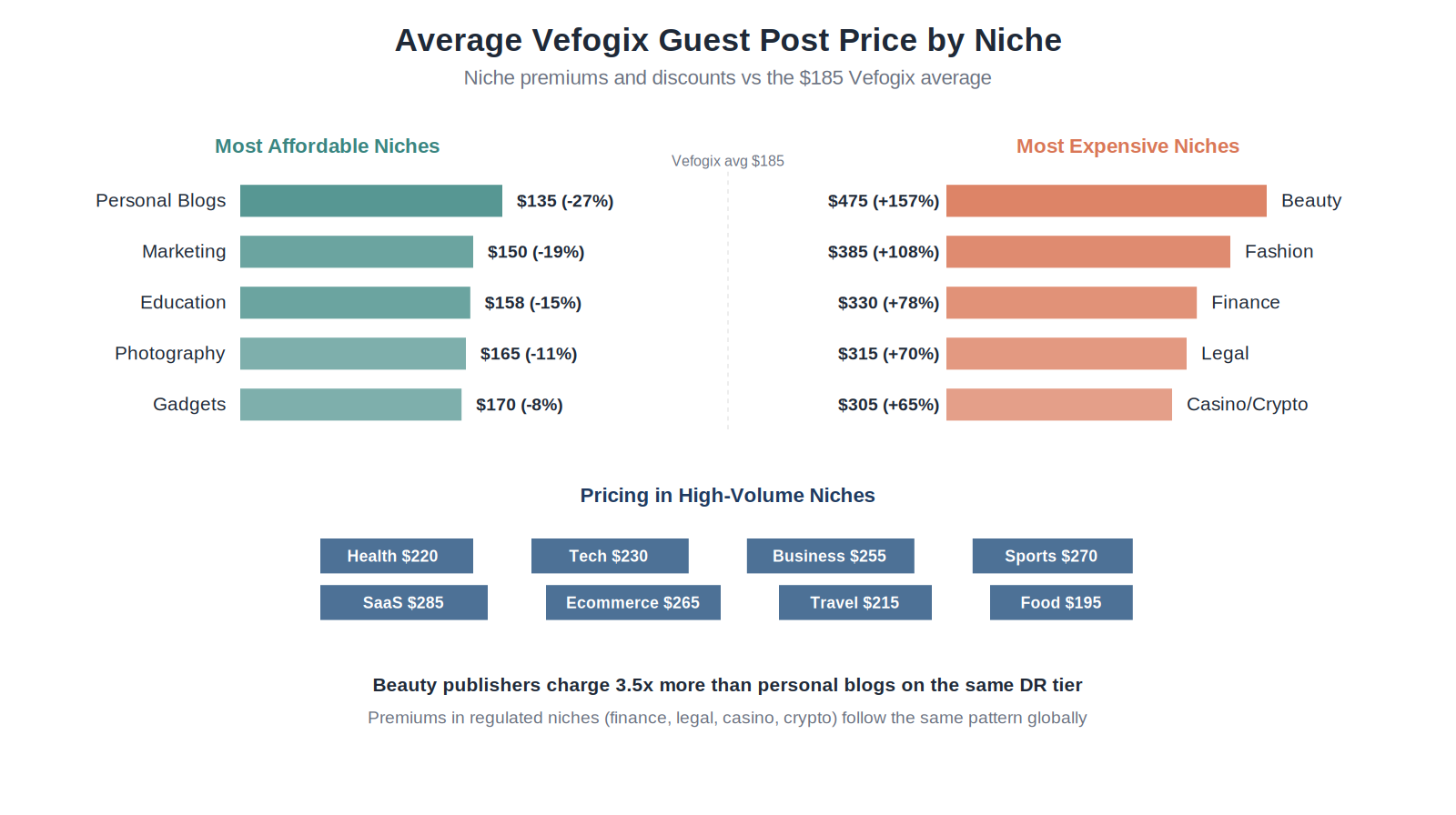
After analyzing pricing across 30+ niches in the Vefogix marketplace, here’s how the costs break down:
The cheapest niches:
- Personal blogs: $135 per placement (27% below the Vefogix average)
- Marketing: $150 per placement (19% below average)
- Education: $158 per placement (15% below average)
- Photography: $165 per placement (11% below average)
- Gadgets: $170 per placement (8% below average)
The most expensive niches:
- Beauty: $475 per placement (157% above average)
- Fashion: $385 per placement (108% above average)
- Finance: $330 per placement (78% above average)
- Legal: $315 per placement (70% above average)
- Casino/crypto: $305 per placement (65% above average)
The pattern across both lists is consistent. Premium consumer niches (beauty, fashion) and regulated commercial niches (finance, legal, casino, crypto) carry the biggest premiums because publishers in those spaces are flooded with paid placement requests and can charge accordingly. Personal blogs sit at the opposite end of the curve because the supply of personal blog publishers vastly exceeds the demand for placements on them.
High-volume niches:
- Health: $220 per placement (19% above average)
- Technology: $230 per placement (24% above average)
- Business: $255 per placement (38% above average)
- Sports: $270 per placement (46% above average)
- SaaS: $285 per placement (54% above average)
- Ecommerce: $265 per placement (43% above average)
- Travel: $215 per placement (16% above average)
- Food: $195 per placement (5% above average)
For buyers in high-cost niches like beauty or finance, the practical guidance is to focus link building on category and pillar pages rather than spreading budget thinly across product pages. Higher per-link costs need to be offset by higher per-link impact, and category pages distribute equity better than individual product placements. Our ecommerce link building guide covers the page-prioritization framework in more depth.
How location affects backlink prices
Geography matters as much as niche when it comes to backlink pricing. Some markets price 3 to 7x higher than others for the same DR-equivalent placement. Understanding where the value sits geographically can cut a campaign’s link budget in half without sacrificing quality.
Cheapest markets:
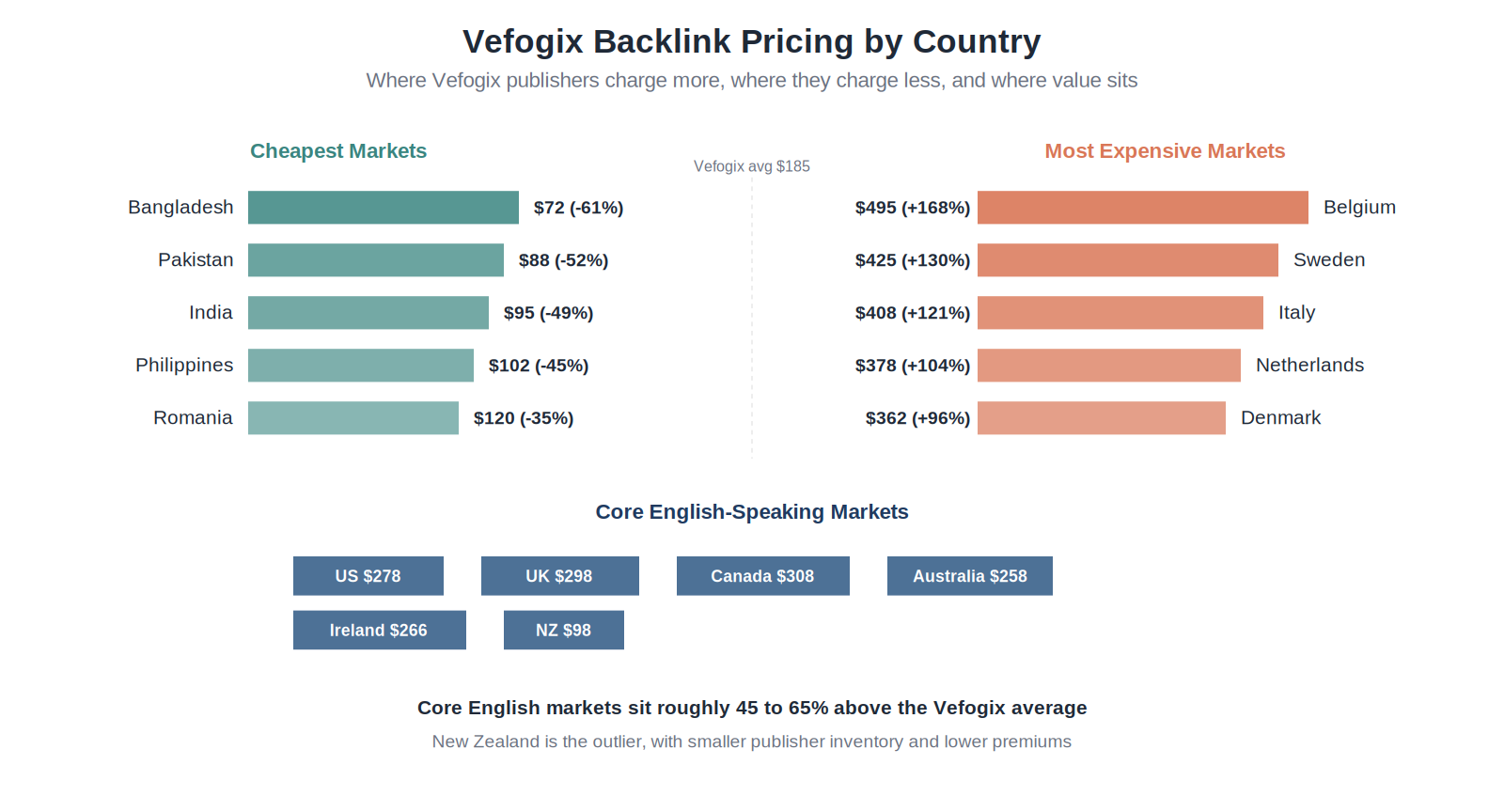
- Bangladesh: $72 per placement (61% below average)
- Pakistan: $88 per placement (52% below average)
- India: $95 per placement (49% below average)
- Philippines: $102 per placement (45% below average)
- Romania: $120 per placement (35% below average)
Most expensive markets:
- Belgium: $495 per placement (168% above average)
- Sweden: $425 per placement (130% above average)
- Italy: $408 per placement (121% above average)
- Netherlands: $378 per placement (104% above average)
- Denmark: $362 per placement (96% above average)
Core English-speaking markets:
- US: $278 per placement (50% above average)
- UK: $298 per placement (61% above average)
- Canada: $308 per placement (66% above average)
- Australia: $258 per placement (39% above average)
- Ireland: $266 per placement (44% above average)
- New Zealand: $98 per placement (47% below average)
The English-speaking market premium runs about 45 to 65% above the global Vefogix average across the US, UK, Canada, Australia, and Ireland. New Zealand is the outlier, mostly because the local publisher supply is smaller and global brands target it less aggressively than the other Anglophone markets.
For buyers running campaigns targeting US, UK, or Canadian audiences specifically, the math gets interesting. Building links from US-based publishers costs roughly 4x what you’d pay for the same DR-equivalent placement from Bangladesh or India. The question becomes whether the location of the linking domain meaningfully affects how Google evaluates the link for a US-targeted campaign. In our buyer data, the answer is usually no for most niches, but yes for local SEO and a handful of geo-sensitive verticals like legal and real estate.
The asking vs paying gap
This is the most important finding in the entire report, and it’s the section most buyers will benefit from reading carefully.
When you look at publisher inventory across the link building market as a whole, the average listed (asking) price for a backlink is $945. That’s the number you’d see if you scraped pricing pages or got formal quotes from traditional brokers and publisher contact pages.
But the average price buyers actually pay is closer to $185 in practice, based on real transaction data across Vefogix.
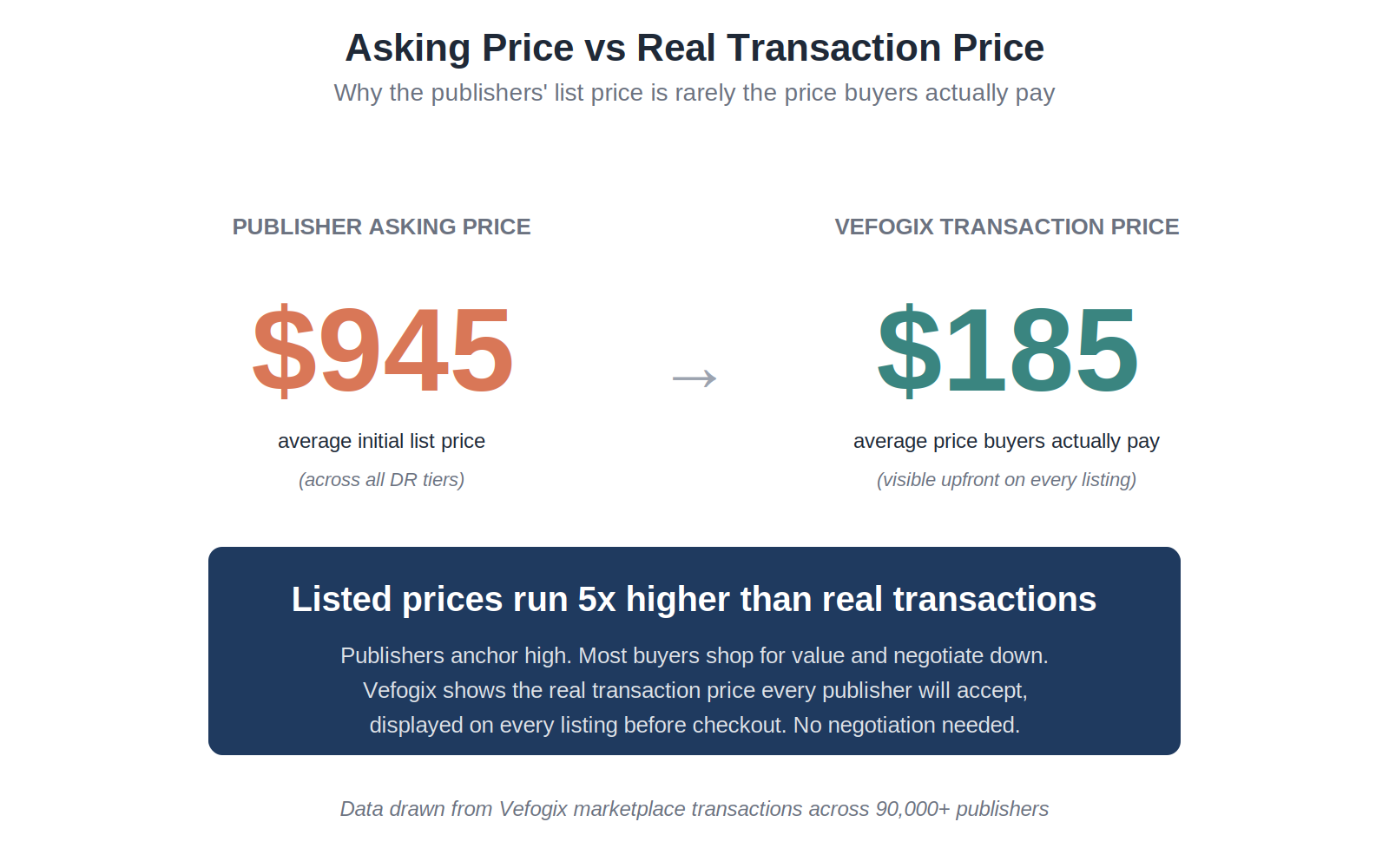
That’s roughly an 80% gap between asking and paying. Listed prices run about 5x higher than what closes in completed transactions. The gap widens further at premium DR tiers, where DR 70+ publishers list at 6x to 8x what buyers actually pay.
Three things drive this gap:
1. Publisher anchoring. Publishers list high because someone, somewhere, will pay it. The 10% of buyers who pay full asking price subsidize the 90% who negotiate hard. Listed prices are aspirational, not realistic. Publishers who list at $500 are usually happy to close at $150 if the buyer pushes back.
2. Broker markup theater. Many link building agencies and brokers source placements at marketplace rates and resell at “premium” markup. The retail asking price you see in a broker quote reflects what the broker hopes to charge a client unfamiliar with wholesale rates. Buyers who know the real prices skip the broker tax entirely.
3. Information asymmetry. Most buyers don’t have visibility into what publishers actually accept. They negotiate from a position of guessing. Publishers know their floor price. Buyers don’t. The gap reflects the information advantage publishers and brokers have over buyers without transaction data. To bridge this information asymmetry, running prospective domains through backlink price comparison tools, allows you to cross-reference backlink costs across multiple list providers and isolate where the massive markups are happening. This is the entire reason transparent marketplace pricing works differently.
This is the entire reason transparent marketplace pricing works differently. Vefogix shows every publisher’s real transaction price upfront. The asking price and the paying price are the same number, displayed on every listing before checkout. No negotiation, no broker markup, no bidding theater. You see the price every publisher will actually accept and you pay that price directly.
For a deeper look at how this changes the buying experience, see our buy backlinks guide and our link building packages comparison for context on how marketplace pricing stacks up against traditional package deals.
Bottom line
This report isn’t meant to set benchmarks every buyer must hit. The point is to give you visibility into how the link building market actually prices in 2026, so you can negotiate from real data rather than guesswork.
Three takeaways most worth remembering:
1. The DR price curve isn’t linear. Each tier costs roughly 2x the previous tier, not a linear bump. Budgeting for “10 DR 70 links” requires very different math than budgeting for “10 DR 30 links.” The further up the DR scale you go, the more expensive each additional tier becomes.
2. Niche and geography matter as much as DR. A DR 50 beauty placement in Belgium might cost more than a DR 65 personal blog placement in Pakistan. Always price-check across niche and geography, not just DR.
3. The asking vs paying gap is huge, and most of it is broker tax. Listed industry prices run 5x what most buyers actually pay. If you’re being quoted $800 for a DR 60 link, you’re probably paying for someone else’s markup. Marketplace pricing usually beats agency quotes by 50 to 70% on identical placements.
We’ll keep tracking this data and publish an updated version of the Vefogix Link Building Pricing Report each year. If there’s a specific cut of the data you’d find useful in the next version (region, niche, format, anything else), reach out and let us know.
For the broader operational guidance on building links from this pricing data, see our link building services pillar guide, our high DA backlinks buyer’s guide, and our dofollow backlinks complete guide.
Ready to see real transaction prices on every listing?
Vefogix gives site owners, SEOs, and agencies direct access to 90,000+ verified publishers. Live DA, DR, and Ahrefs traffic on every listing. Transparent per-listing pricing with no monthly minimums. Free signup.
→ Browse publishers on Vefogix
✓ 90,000+ verified publishers
✓ Real transaction prices upfront
✓ Free to join
✓ No broker markup
vefogix
Frequently Asked Questions
Backlinks cost between $48 and $685+ per placement on Vefogix in 2026, with the average guest post at $185 and the average niche edit at $95 across all DR tiers. Premium DR 71+ placements average $685 per link. Niche, geography, and traffic all influence the final price, with regulated niches and English-speaking markets carrying the highest premiums.
The average guest post on Vefogix costs $185 across all DR tiers in 2026, with prices ranging from $55 on starter-tier publishers (DR 1-30) to $685 on authority-tier publishers (DR 71+). The price grew 17.1% over 2025, with premium DR tiers seeing the steepest increases at 21 to 22%.
A guest post is a freshly written article published on a third-party publisher with a backlink inside. A niche edit (also called link insertion) adds a backlink to an existing indexed article that already ranks. On Vefogix, guest posts average $185 per placement and niche edits average $95, making niche edits roughly 49% cheaper across all DR tiers.
DR 71+ backlinks average $685 per placement on Vefogix in 2026. The premium reflects scarcity of real authority-tier publishers with verified organic traffic. Always verify both DA and Ahrefs organic traffic before paying premium prices, since DR scores can be manipulated and traffic-light publishers don’t pass real ranking equity.
Personal blogs, marketing, education, photography, and gadgets are the cheapest niches for link building in 2026. Personal blogs average $135 per placement on Vefogix (27% below the marketplace average). The most expensive niches are beauty, fashion, finance, legal, and casino/crypto, where regulated industries push prices up 65 to 157% above average.
The average asking price across the link building market is $945 while real transaction prices average $185, creating roughly a 5x gap. Publishers anchor list prices high. Most buyers negotiate down to a fraction of the listed price in private deals. Vefogix removes the gap entirely by showing the real transaction price upfront on every listing.
Bangladesh has the cheapest backlinks on Vefogix at $72 per placement on average, followed by Pakistan ($88), India ($95), Philippines ($102), and Romania ($120). These markets sit 35 to 61% below the global average. Most expensive countries are Belgium, Sweden, Italy, Netherlands, and Denmark, where placements run 96 to 168% above average.
Buying backlinks is safe in 2026 when the placements come from real publishers with verified organic traffic and editorial standards. The penalty risk comes from PBN sources, automated tools, and sites with manipulated metrics, not from paying for placements on real publishers. Vefogix verifies every publisher and shows DA, DR, and Ahrefs traffic on every listing.