How Does Link Insertion Work, and Why Does Anchor Placement Matter?
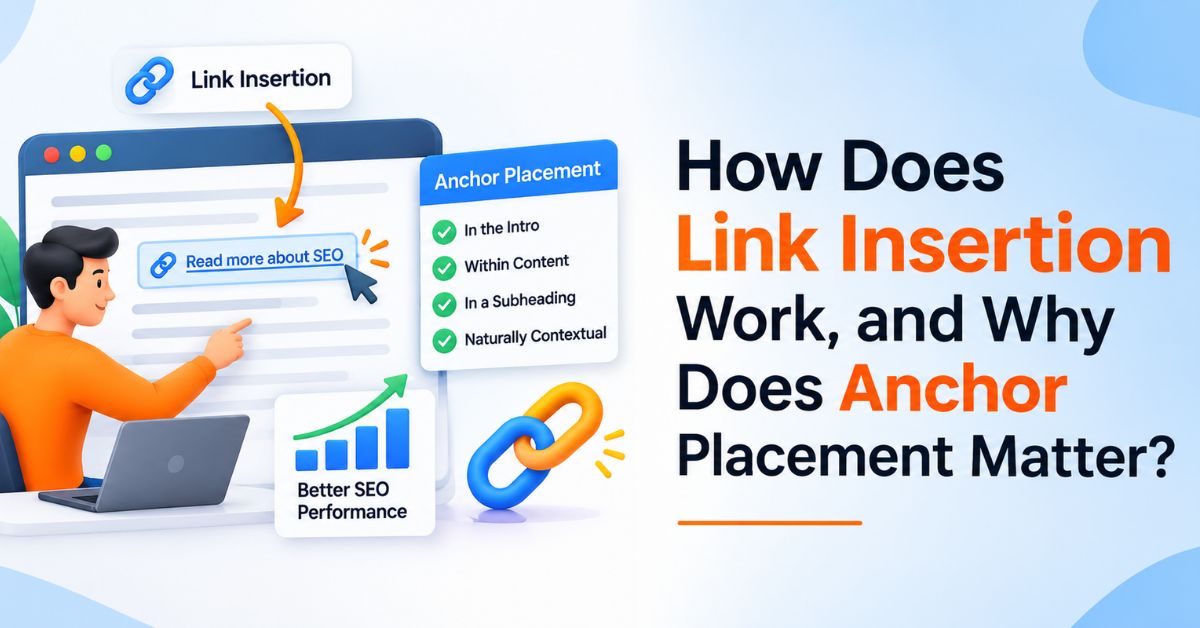
Link insertion is when you get a backlink added into an article that's already published, already indexed, and usually already ranking, rather than writing a new piece for it. It's often called a niche edit, and it's one of the two main ways people build links, alongside guest posting.
The difference between the two sounds minor until you see what it does to results. A link dropped into a three-year-old page that already ranks for its own keywords behaves nothing like a link on a guest post published this morning. Below: what link insertion actually is, why it works, how to find the right pages, what anchor text to use, where on the page the link should sit, and the mistakes that make it fail.
What Is Link Insertion, and How Is It Different From Guest Posting?
Link insertion means adding your link to an article someone else already wrote and published. Guest posting means writing a brand-new article specifically to carry your link. Both earn you a backlink. They behave very differently once that link goes live.
A link insertion joins content with a track record: existing rankings, existing traffic, an existing backlink profile Google already trusts to some degree. A guest post starts at zero on all three. It can build that history over time, but on day one it's an unproven page, no matter how well it's written.
|
Link Insertion |
Guest Posting |
|
|
Content |
Added to an existing article |
A new article written for you |
|
Time to go live |
Usually faster, no drafting or review of new content |
Slower, content has to be written and approved |
|
Host page history |
Aged, already indexed, often already ranking |
Starts with zero history |
|
Your control over context |
Limited, you're working inside someone else's piece |
High, you shape the whole article |
|
Typical cost |
Often lower, no content production involved |
Often higher, includes writing |
|
Main risk |
Link removed later if the site treats it as a rented placement |
Thin or low-effort content that never ranks |
Neither one replaces the other. Most link building campaigns worth running use both, leaning on guest posts to build new assets and niche edits to attach to pages that are already proven.
Why Does Link Insertion Work So Well for SEO?
Because the link inherits trust the host page has already earned. Google weighs a link partly on how strong and trusted the page hosting it is, not just the domain it sits on. A five-year-old article that's built its own backlinks, ranks on page one for a handful of terms, and gets steady organic visits is a stronger host than a page published yesterday with no history at all.
There's also a content-relevance effect that's easy to miss. An article that's been ranking for years has usually been through some kind of editorial refinement, sometimes updated, sometimes expanded, and it's proven itself useful to readers and to Google. A link dropped into a paragraph that's genuinely relevant to that proven content reads as a citation, not a placement, which is the effect every link builder is actually trying to produce.
Google has also filed patents describing how a link's age factors into the ranking signal it passes, treating links that have sat in place for a while as more trustworthy than ones that just appeared. That gives aged articles a structural edge a brand-new guest post page simply can't match on day one.
None of this is automatic. A niche edit placed into a weak, low-traffic, barely-indexed article carries almost none of this benefit, which is why vetting the host page matters as much as securing the placement.
Finding Link Insertion Opportunities
You find them by looking for pages that already rank, already get traffic, and already touch your topic without fully covering it. Most campaigns succeed or fail right here, not at outreach. A well-written pitch to the wrong page still gets ignored, or worse, accepted somewhere that does nothing for your rankings.
|
Technique |
What it does |
|
Competitor backlink gap analysis |
Pull a close competitor's backlink profile in Ahrefs or Semrush and filter for contextual links inside blog content, not homepage or sitewide links. A site that's already placed a niche edit for two or three competitors is likely to place one for you too. |
|
Targeted search operators |
A search like intitle:"link building tips" or inurl:guide combined with your actual topic surfaces articles already built around language close to your intended anchor text. |
|
Pages that mention your topic in passing |
An article that references your subject in one sentence without linking anywhere is close to a perfect candidate. Adding the link completes a thought the piece already started instead of introducing something foreign. |
|
Page-level traffic, not domain score |
A domain authority number says nothing about whether the one article hosting your link gets visits. Check traffic at the page level before you pitch. |
A cooking blog that mentions a rare spice once, in passing, next to your unlinked in-depth guide to that spice, is the textbook version of this pattern. The sentence is already there. You're just finishing it.
Reaching Out and Securing the Placement
Once you've got a shortlist of candidate pages, it's outreach and negotiation from here, not more research. Lead with the specific article and the specific sentence, not a generic request to "add a link somewhere." An email naming the exact paragraph you think your link belongs in, and explaining what it adds for a reader, gets a reply far more often than a bulk template ever does.
Before you pitch, check the page itself, not just the domain's overall metrics. A site can carry a strong authority score while the one article you want a link in gets zero monthly visits and hasn't been touched in years. It's the page-level signal that matters, since that's what your link will actually sit inside.
Placement and anchor text get agreed together, not as two separate conversations, because where the link lands and what words carry it decide most of whether the insertion actually helps. Once the editor publishes the edit, the job isn't quite done. Some sites sell niche edits as a recurring service rather than a one-time placement and quietly pull the link once payment stops, so checking back weeks or months later is part of the process, not an afterthought.
What Anchor Text Should You Use for a Link Insertion?
Mix it, leaning toward partial match and branded anchors, with exact match used sparingly. The anchor is the clickable text carrying the link, and the type you pick sends Google a different signal than the words themselves do.
|
Anchor type |
Example |
Best for |
Risk level |
|
Exact match |
"link building services" |
A profile that's thin on keyword signal and needs one or two strong ones |
Highest, the most scrutinized type |
|
Partial match / branded-plus-keyword |
"Vefogix's link building services" |
Most niche edits, the safest high-value default |
Low to moderate |
|
Branded |
"Vefogix" |
A profile already heavy on keyword anchors that needs natural variety |
Low |
|
Generic |
"this guide," "this resource" |
Blending in as an ordinary editorial link |
Very low |
|
Naked URL |
the bare web address |
The same natural-profile reasons as generic anchors |
Very low |
A profile with forty backlinks all reading "best link building services" looks engineered no matter how legitimate each placement was on its own, and that pattern can suppress the value of the whole set, not just the newest link.
Does Where the Link Sits on the Page Actually Matter?
Yes, as much as the link itself. Two links on the same page, pointing to the same destination, can perform completely differently depending on where they sit and what surrounds them. This is the part of link insertion that gets the least attention and probably deserves the most.
A link placed naturally within the first third of an article, in a paragraph actually discussing the related topic, carries more weight than one tacked onto the final sentence of the conclusion, or dropped into an "additional resources" list at the bottom that reads as an afterthought. The sentence immediately before and after the link should make sense if someone actually clicked through, because surrounding text that doesn't genuinely relate to your destination signals a transactional insertion rather than an editorial one.
How many other outbound links share the page matters too. A page with three outbound links passes meaningfully more authority per link than one with forty, since the page's total link equity gets divided across everything it points to. A page that reads like a link directory dilutes every link on it, yours included.
|
Strong placement |
Weak placement |
|
In-content, inside the actual paragraph text |
Sidebar widget or a "related posts" box |
|
First third of the article, in context |
Final sentence or an afterthought list at the bottom |
|
A handful of other outbound links on the page |
Dozens of other outbound links diluting the page |
|
One relevant article, chosen for fit |
Every article on the site carries the same link |
That last row is worth sitting with. A link that appears sitewide, in every article or the footer, reads as a template insertion, not an editorial choice, and it's exactly the pattern Google's spam systems are built to catch.
What Are the Risks of Link Insertion?
The biggest one is a link that quietly disappears. Some sites sell niche edits as a subscription rather than a permanent placement, pulling the link once payment stops or after an agreed window passes. Periodic re-checks of live links aren't optional busywork, they're how you find out a paid placement is actually still there. Related to that, a host page that was ranking well when you placed a link can decline over time if the site stops maintaining it, which quietly reduces the value of your placement even though nothing about your link changed. Spreading insertions across multiple host pages, rather than concentrating value in just one or two, limits how much any single decline costs you.
The other major risk sits in patterns rather than any single placement. Running the same exact-match anchor across every niche edit in a batch creates an obvious signature, even when each individual site looks legitimate. The same goes for sites that insert links into content with no real connection to your topic, just because they have an open slot, or clusters of sites that all accept niche edits, all share suspiciously similar design templates, and all link to the same small set of destinations. That last pattern is close to the definition of a private blog network, and it's exactly what Google's spam systems are trained to catch, regardless of how each individual link was negotiated.
A Worked Example
Say you run a business selling industrial safety equipment, and you've published a detailed guide on confined space entry procedures. A search for intitle:"workplace safety" inurl:blog turns up a manufacturing trade publication's three-year-old article on general warehouse safety checklists. Reading it, you find one paragraph that mentions confined space hazards in passing, with a single sentence noting that "specialized procedures apply" and nothing linked to back it up.
That sentence is the opening. You reach out to the site's editor, point to that exact paragraph, and suggest linking "specialized procedures" to your confined space entry guide, since it directly expands on a claim the article already makes but never explains. The editor agrees, adds a short clause referencing your guide, and links the phrase naturally within the existing paragraph rather than appending a new line at the bottom of the article.
The result is a link sitting inside a three-year-old article that still ranks for "warehouse safety checklist" and gets steady organic visits, placed in a sentence genuinely relevant to your product, carrying a partial-match anchor rather than an exact-match one. That combination, an aged and trafficked host page, a contextually justified sentence, and a natural anchor, is what separates a niche edit that moves rankings from one that's technically live but does nothing.
Finding the Right Pages Is the Hard Part
The anchor and placement rules above only matter once you've found a host page worth placing a link in, and that's the step that eats real time: checking organic traffic, confirming genuine topic fit, ruling out sites built purely to sell placements. Doing that vetting at scale, across a large pool of candidates, is where most of the actual work lives.
If you'd rather hand that off, Vefogix's link insertion service works through pre-vetted, already-ranking pages instead of cold outreach to unknown sites, with anchor text and placement matched to what your existing backlink profile needs. For a mix that includes new content alongside niche edits, the link building services page covers both approaches together.
vefogix
Frequently Asked Questions
Yes, these terms describe the same tactic. "Niche edit" tends to be used more in link-building circles, while "link insertion" is the more descriptive, client-facing term, but both mean placing a link inside an already-published article rather than creating new content for it.
It depends entirely on execution. A link placed naturally into genuinely relevant, high-quality content that a human editor would plausibly add on their own is a normal part of how the web has always worked. A link bought and forced into irrelevant content purely to manipulate rankings is what Google's guidelines target, and the difference comes down to relevance and placement, not the tactic itself.
Pricing varies widely by site authority and niche, but link insertion is often less expensive than guest posting on the same site, since there's no new article to write and no editorial review of brand-new content. The tradeoff is less control over exactly how and where the link appears, since you're working within an existing piece rather than one written specifically for you.
Most link-related ranking effects take weeks to months to show up, not days, and they depend heavily on how often the host page itself gets recrawled by Google. A frequently updated, high-traffic page tends to get recrawled faster than a quiet corner of a smaller site, which affects how quickly the new link gets noticed at all.