AI Visibility Is More Than a Score: How to Measure Mentions, Citations, Rankings, and Real SEO Impact
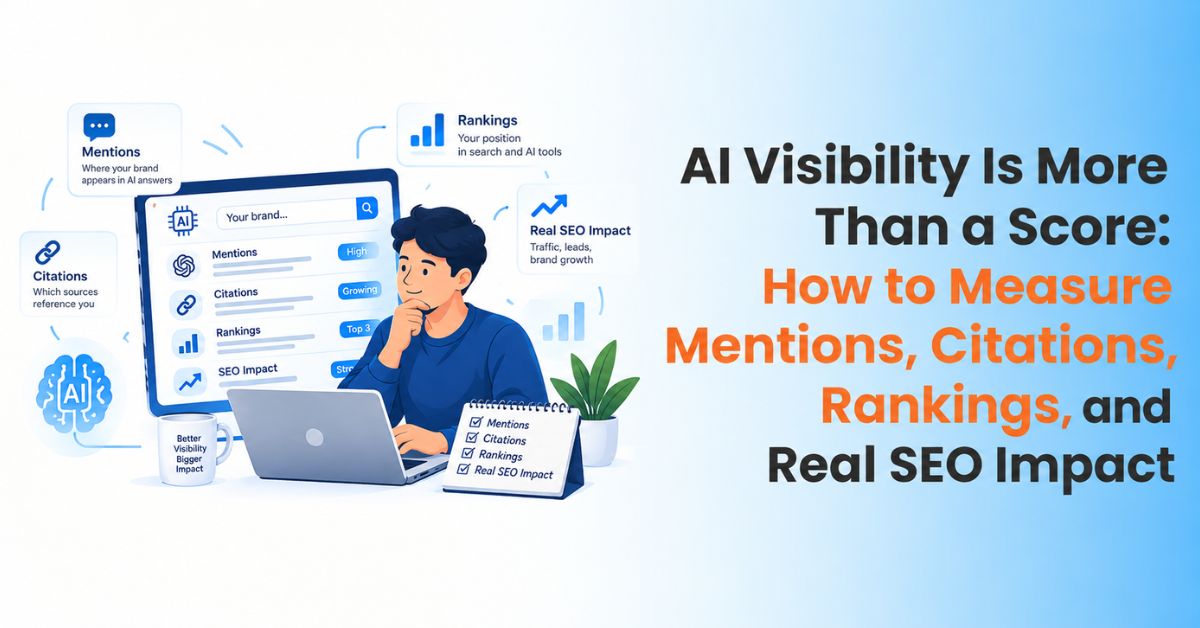
AI search has created a new SEO measurement problem.
A website can rank well in Google but rarely appear in ChatGPT or Google's AI results. A brand can be mentioned frequently by AI systems without receiving a single website visit. A page can even be cited by an AI answer while ranking outside the traditional top 10.
That makes one simple "AI visibility score" difficult to interpret.
If you want to understand how your brand is performing in AI search, you need to look beyond a single number. Mentions, citations, rankings, query coverage, referral traffic, and conversions each tell a different part of the story.
What Is AI Search Visibility?
AI search visibility is the extent to which your brand, website, products, or content appear in AI-generated search experiences.
These experiences include:
- Google AI Overviews
- Google AI Mode
- ChatGPT
- Gemini
- Perplexity
- Other AI-powered search and answer platforms
Traditional SEO usually asks:
"Where does my page rank?"
AI search adds several new questions:
"Does the AI mention my brand?"
"Does it cite my website as a source?"
"Which pages are being cited?"
"Which competitors appear instead of me?"
"Does AI visibility lead to meaningful business results?"
Those questions require different measurements.
Why an AI Visibility Score Is Not Enough
Many AI visibility tools combine multiple signals into a single score. This can be useful for monitoring changes over time, but the score alone does not explain why visibility changed.
For example, your score could increase because:
- Your brand was mentioned in more answers.
- More of your URLs were cited.
- Your competitors became less visible.
- The tool changed its tracked prompts.
- The tool added or changed the AI models it monitors.
The opposite can also happen. A lower score does not automatically mean that your SEO strategy has failed.
AI-generated responses are variable. The same prompt can produce different answers, brands, and citations at different times. This makes large sets of tracked queries more useful than judging performance from a handful of prompts.
The better approach is to treat an AI visibility score as a diagnostic signal, not the final measure of SEO success.
1. Track Brand Mentions
A brand mention happens when an AI system names your company, product, website, or brand in its response.
For example, someone could ask:
"What are the best freelance SEO marketplaces?"
If the AI response includes your brand, you have earned a mention.
Mentions can tell you whether AI systems recognize your brand within a particular topic or category.
Track:
- Total brand mentions
- Mentions by AI platform
- Mentions by topic
- Mentions compared with competitors
- Mention share within your target prompts
- Changes in mentions over time
But there is an important limitation.
A mention does not necessarily mean that the AI used your website as a source.
Your brand could be mentioned based on information retrieved from another website.
That is why mentions and citations should be measured separately.
2. Track AI Citations
A citation is different from a mention.
A citation occurs when an AI system links to or identifies a webpage as a source for its answer.
This is particularly valuable for SEO because it tells you which pages are being considered useful sources for AI-generated answers.
Track:
- Number of cited URLs
- Citation frequency
- Citation share compared with competitors
- Pages receiving citations
- Topics generating citations
- AI platforms citing your pages
- New versus previously cited pages
For example, imagine your brand is mentioned in 100 AI responses but your website is cited only 10 times.
That tells you something different from a brand that appears in 50 responses and receives 40 citations.
The first brand may have strong recognition but weaker source visibility. The second may have stronger source-level visibility.
3. Measure Mentions and Citations Separately
This is one of the most important distinctions when measuring AI search performance.
Consider four situations:
|
Situation |
What it tells you |
|
Brand mentioned + website cited |
Strongest combination of recognition and source visibility |
|
Brand mentioned + no citation |
Brand recognition without direct source attribution |
|
Website cited + brand not mentioned |
Content is useful as a source, but brand recognition may be weaker |
|
Neither mentioned nor cited |
Little visible presence for that query |
A combined score can hide these differences.
If your overall AI visibility falls, you should first determine whether the decline came from mentions, citations, or both.
That gives you a much better starting point for optimization.
4. Continue Tracking Traditional Rankings
AI search does not make traditional SEO irrelevant.
Google's AI-generated results can cite pages that rank in the traditional top 10, but they can also cite pages ranking outside the top 10 or even outside the top 100 for the original query. Research cited by Search Engine Journal found that 37.1% of analyzed AI Overview URLs also ranked in Google's organic top 10 for the same query, while other cited URLs ranked much lower or did not appear in the top 100.
This means you should track both:
Traditional search visibility
and
AI search visibility
The two datasets can reveal opportunities that either one alone would miss.
For example, a page ranking at position 15 for a broad keyword may still be cited in an AI answer because it provides useful information for a related subtopic.
That is particularly important because AI systems can break a complex search into related questions before generating an answer.
5. Track Query Coverage, Not Just Keywords
Traditional SEO often revolves around a keyword list.
AI search is broader.
Users may ask the same question in many different ways:
- Best SEO marketplace for small businesses
- Where can I hire an SEO freelancer?
- Best websites for buying backlinks
- How do I find guest post opportunities?
- Which marketplace offers guest posting services?
These prompts may have different wording but represent the same underlying search intent.
Your AI visibility tracking should therefore cover topics and intents, not just exact-match keywords.
Build prompt groups around:
- Informational searches
- Commercial investigation
- Comparison searches
- Service searches
- Problem-based questions
- Brand searches
- Competitor comparisons
- Industry-specific questions
This creates a more realistic picture of how often your brand appears across the conversations that matter to your business.
6. Measure Which Pages AI Systems Prefer
Knowing that your website was cited is useful.
Knowing which page was cited is much more useful.
Create a report showing:
|
Metric |
Example |
|
AI platform |
ChatGPT |
|
Prompt/topic |
Best SEO marketplaces |
|
Brand mentioned |
Yes |
|
Website cited |
Yes |
|
Cited URL |
/marketplace/ |
|
Competitor cited |
Competitor A |
|
Citation type |
Direct source |
|
Date checked |
September 2026 |
Over time, patterns can emerge.
You may discover that:
- Guides receive more citations than service pages.
- Comparison content attracts competitor-related queries.
- Detailed informational pages are cited more frequently.
- Some commercial pages receive strong organic rankings but few AI citations.
These findings can influence your content strategy.
7. Do Not Assume Schema Automatically Creates AI Visibility
Structured data is useful for helping search engines understand webpages, but adding schema should not be treated as a guaranteed AI visibility tactic.
Recent research discussed by Search Engine Journal found that pages cited by AI systems were more likely to contain JSON-LD, but adding JSON-LD itself did not produce a statistically significant citation increase across the platforms studied.
The practical lesson is simple:
Use structured data to describe your content accurately, but do not expect schema alone to make a page visible in AI answers.
Content relevance, topical coverage, source credibility, page quality, and broader authority still matter.
For websites working on these foundations, on-site optimization services can be part of the broader SEO process.
8. Measure Competitor Visibility
AI search is not a zero-sum ranking system in the same way as a traditional SERP position.
Your visibility can change because your competitors become more visible.
Suppose your brand appears in 30% of your tracked prompts in January and 25% in February.
That does not necessarily mean your content became worse.
A competitor may have increased its presence from 15% to 35%.
That is why competitive tracking should include:
- Your brand mention rate
- Competitor mention rate
- Your citation rate
- Competitor citation rate
- Shared prompts
- Unique prompts
- Topic-level visibility
- Platform-level visibility
This helps distinguish an actual loss of visibility from a change in the competitive landscape.
9. Connect AI Visibility With Website Performance
AI visibility is not the end goal.
Business results are.
A brand can receive more AI mentions and citations while receiving less website traffic. Conversely, a page can receive relatively few citations but generate valuable visitors and leads.
That means AI visibility should eventually be connected with:
- Organic traffic
- AI referral traffic
- Leads
- Sign-ups
- Sales
- Assisted conversions
- Revenue
Your analytics data should therefore sit alongside your AI visibility data rather than being replaced by it.
A useful measurement framework looks like this:
AI visibility → website visits → engagement → leads → conversions
This makes it easier to identify which AI visibility improvements actually matter to the business.
10. Watch AI Referral Traffic
AI-generated answers can send users directly to websites.
Track referral traffic from AI platforms where your analytics setup can identify it.
Look at:
- Sessions
- Engaged sessions
- Landing pages
- New users
- Conversion rate
- Leads
- Revenue
Then compare these visitors with traffic from traditional organic search.
The numbers may behave differently.
Someone arriving from an AI answer may already have researched several options and could be further along in the buying journey.
That makes the quality of AI-referred traffic worth monitoring, not just the volume.
11. Build an AI Visibility Dashboard
A practical AI search dashboard does not need dozens of metrics.
Start with a small set of signals.
Visibility
- Brand mention rate
- Citation rate
- Share of AI answers
- Visibility by platform
Search performance
- Organic rankings
- Organic impressions
- Organic clicks
- AI Overview visibility where available
Content
- Most-cited pages
- Most-mentioned topics
- Pages gaining visibility
- Pages losing visibility
Competition
- Competitor mentions
- Competitor citations
- Topic-level share of visibility
Business outcomes
- AI referral traffic
- Leads
- Conversions
- Revenue
This gives you enough information to understand what changed without turning the dashboard into another vanity-metric report.
How to Diagnose a Drop in AI Visibility
When your AI visibility falls, do not immediately start changing content.
First ask what actually changed.
Mentions decreased, but citations stayed stable
Your source content may still be useful, while brand recognition has changed.
Check:
- Competitor visibility
- Brand positioning
- Prompt coverage
- Platform-specific changes
Citations decreased, but rankings stayed stable
Look at the pages replacing your URLs.
Check whether:
- Their content better matches the question.
- They cover related subtopics more completely.
- Their pages better match the underlying search intent.
- New sources have become more relevant to the AI system.
Rankings and AI citations both decreased
This points toward a broader SEO issue.
Review:
- Search intent
- Content quality
- Internal linking
- Technical SEO
- Topical coverage
- Backlinks and authority
- Competitor content
AI visibility increased, but traffic decreased
Do not automatically call the campaign a success.
Check whether the additional visibility is producing meaningful visits, leads, or sales.
Visibility is valuable, but visibility without business impact is not the complete SEO story.
What Should You Actually Measure?
There is no single metric that can accurately describe AI search performance.
A better framework is:
1. Presence: Does AI mention the brand?
2. Source visibility: Does AI cite the brand's website?
3. Search visibility: Does the website still perform in traditional search?
4. Competitive visibility: How does the brand compare with competitors?
5. Content visibility: Which pages and topics are being surfaced?
6. Traffic: Are AI platforms sending visitors?
7. Business impact: Are those visitors becoming leads or customers?
Each metric answers a different question.
Together, they provide a much more useful picture of AI search performance.
How to Improve AI Search Visibility
Measurement should lead to action.
If your website is rarely mentioned or cited, focus on improving the signals that make your content useful as a source.
This can include:
- Creating comprehensive topic coverage
- Answering specific questions directly
- Building topical authority
- Improving content structure
- Strengthening internal links
- Publishing original data and research
- Building relevant backlinks and mentions
- Keeping important information accurate and current
- Improving entity and brand consistency
- Using appropriate structured data
- Creating content around related search intents
AI search optimization should not replace traditional SEO.
It should build on it.
For businesses looking for specialized support, AI SEO packages on Vefogix include services focused on AI SEO, GEO, AEO, content optimization, and related search workflows.
You can also explore the broader SEO services marketplace to compare services based on scope, deliverables, pricing, and turnaround time.
Final Takeaway
AI search visibility is becoming easier to track, but that does not mean every visibility score tells the full story.
A single number can tell you that something changed.
It usually cannot tell you what changed or whether the change matters to your business.
That is why SEO teams should separate mentions from citations, AI visibility from traditional rankings, and visibility from actual outcomes.
The most useful AI search measurement strategy is not about achieving the highest possible visibility score.
It is about understanding where your brand appears, why it appears, which sources AI systems trust, how competitors compare, and whether that visibility contributes to meaningful business results.
That is the difference between tracking AI visibility and actually using AI search data to improve your SEO strategy.
Frequently Asked Questions
AI search visibility measures how often a brand, website, or webpage appears in AI-generated search results and answers. It can include brand mentions, website citations, and visibility across platforms such as Google AI Overviews, ChatGPT, Gemini, and Perplexity.
AI search visibility can be measured by tracking brand mentions, website citations, prompt coverage, competitor visibility, traditional search rankings, AI referral traffic, and conversions. Looking at these metrics together provides a more complete picture than relying on a single visibility score.
An AI mention means that an AI-generated answer names your brand or business. An AI citation means the AI system also references or links to a webpage as a source. A brand can receive mentions without its website being cited, so these metrics should be tracked separately.
Traditional rankings can influence AI visibility, but they do not completely determine it. AI systems can cite pages that rank outside Google's traditional top results, meaning a page may have opportunities to appear in AI answers even when it does not rank highly for the original search query.
No. AI visibility should complement traditional SEO rather than replace it. Organic rankings, traffic, AI citations, mentions, and conversions measure different aspects of search performance and should be analyzed together.
Schema markup can help search engines understand the content and entities on a webpage, but it does not guarantee AI citations or mentions. It should be part of a broader SEO strategy that includes useful content, topical relevance, technical SEO, internal linking, and authority building.
AI systems may answer more of a user's question directly, reducing the need to visit a cited website. A brand can therefore gain more mentions or citations without seeing an equivalent increase in clicks. This is why AI visibility should also be measured against referral traffic, leads, and conversions.
A useful starting set includes brand mention rate, citation rate, AI share of visibility, competitor mentions and citations, cited URLs, traditional organic rankings, AI referral traffic, leads, and conversions. The exact metrics can be expanded based on the business's goals.