Building Topical Authority Using Strategic Guest Posting

Most brands still treat guest posting as a link-count exercise: publish on the highest-DR site available, drop a link, and move to the next. That approach used to work. It doesn't anymore — not with Google's ranking systems weighting topical depth so heavily, and not with AI Overviews and LLM-based search pulling answers from sources that demonstrate comprehensive coverage of a subject, not isolated high-authority mentions. The brands winning visibility today aren't the ones with the most backlinks. They're the ones that have built topical authority — and strategic guest posting, sourced deliberately rather than opportunistically, is one of the fastest ways to build it.
What Is Topical Authority, and Why Does It Matter More Than Ever?
Topical authority is a measure of a website's perceived expertise and credibility on a specific subject, evaluated by search engines and AI models based on the breadth, depth, and accuracy of its content across an entire topic area — not the ranking of any single page.
Unlike raw domain metrics that lean heavily on link volume, topical authority is built through three pillars:
- Breadth. Covering all the meaningful subtopics within a niche, not just the one or two keywords with the highest search volume.
- Depth. Providing comprehensive, expert-level insight on each subtopic rather than surface-level summaries.
- External validation. Earning topically aligned, contextual backlinks from other trusted sites already active in the same subject area.
Google itself frames this as an evaluation exercise rather than a direct ranking input: its Search Central documentation on helpful content describes E-E-A-T (Experience, Expertise, Authoritativeness, Trust) as the framework its human quality raters use to assess whether content reflects real expertise, and recommends site owners self-assess their own pages against it. That framework rewards exactly the kind of layered, subject-wide coverage that a well-sequenced guest posting campaign is built to produce.
Why Scattergun Guest Posting Doesn't Build Authority
The old playbook — grab whatever guest post slot is available on the highest-metric site — optimizes for the wrong variable. Domain Rating tells you how strong a site is. It tells you nothing about whether that site's audience, content history, or subject focus has anything to do with yours.
Three Mistakes That Show Up Again and Again
- Chasing metrics over relevance. Sites are chosen for their DR or traffic numbers, with no check on whether the site has ever published anything in the same topic area.
- Publishing with no thematic thread. Ten guest posts across ten unrelated niches leave no discernible pattern for search engines — or AI models — to recognize as expertise.
- Repeating identical anchors and angles. The same money keyword, stuffed into the same anchor text, across every placement — a pattern that reads as manipulation rather than authority.
A Framework for Building Topical Authority Through Guest Posting
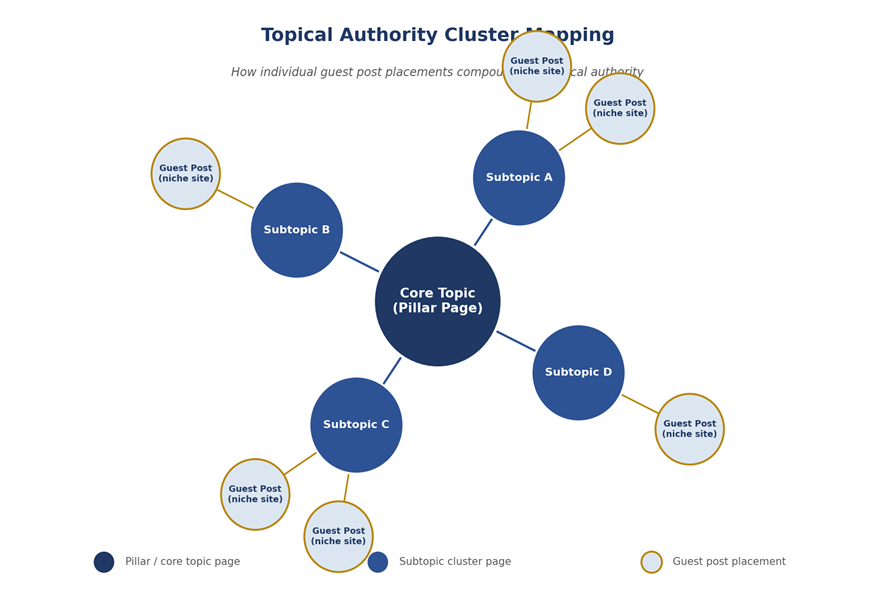
1. Map Your Core Topic Clusters First
Before requesting a single placement, break your core subject into 8–12 subtopics your audience actually searches for. This becomes your placement roadmap, not a list of one-off ideas.
2. Choose Guest Post Sites by Topical Fit, Not Just Metrics
A DR 40 site that has published five other articles in your exact niche carries more topical weight than a DR 70 general news site. Filter by category and content history before filtering by metrics.
3. Sequence Your Content like a Campaign
Space placements to build on each other — a foundational piece first, then supporting angles, then a comparison or data-driven piece — so the cluster reads as expertise rather than a scattered list.
4. Vary Angles and Anchor Text within the Cluster
Within the same cluster, vary the anchor text, the specific page you link to, and the angle of the article. Natural link profiles look organic because they are.
5. Strengthen Semantic Anchors and Co-Occurrence
Anchor text is only part of the relevance signal. The words and entities that surround a link — what SEOs call co-occurrence — tell Google's Knowledge Graph what the linked page is really about, independent of the anchor itself. A guest post where the surrounding paragraph naturally references related entities, terminology, and concepts from your topic reinforces relevance even when the anchor text itself is generic ("read more here" or your brand name). Prioritize publishers and writers who can weave that surrounding context naturally, rather than optimizing anchor text in isolation.
6. Pass Link Equity through Internal Link Reciprocity
A guest post that lands on a strong, well-optimized page still underperforms if that page doesn't distribute authority onward. Make sure every pillar or landing page receiving guest post links also links down into its supporting tier-2 cluster assets — the subtopic pages, FAQs, and comparison content beneath it. This reciprocity is what turns a single inbound link into authority that spreads across the entire cluster instead of pooling on one page.
7. Track Cluster-Level Authority, Not Link Count
Track how your entire topic cluster performs in rankings and AI citations — not just how many links you've acquired. Authority is a cluster-level metric, not a link-count metric.
Guest Posting Agency vs. Guest Post Outreach Service vs. Marketplace
Each model gets you guest posts. They don't get you topical authority in the same way, and picking the right one depends on how much control you want over site selection versus how much strategic sequencing you want handled for you.
|
Model |
Best For |
Trade-Off |
|
Hands-off execution and strategic sequencing across a topic cluster |
Higher cost, less direct control over which sites are chosen |
|
|
Guest Post Outreach Service |
Custom pitching and relationship-building with niche publishers |
Slower turnaround, results depend heavily on the outreach team's skill |
|
Guest Post Marketplace |
Speed, transparent pricing, and full control over niche, DR, and traffic filters |
Requires you to bring your own topical strategy and site-selection discipline |
In practice, the fastest path to real topical authority is usually a hybrid: use a guest posting agency or a guest post outreach service when you need pitching relationships and sequencing strategy handled for you, and use a guest post marketplace when you want direct, filterable control over exactly which niche, DR range, and traffic profile each placement comes from.
Where Guest Post Marketplaces Fit Into the Strategy
Executing a topical cluster campaign requires rigorous filtering, which is where dedicated marketplace platforms assist SEO strategists. Manual outreach offers high customization, but it's slow to scale across 8–12 subtopics at once. A platform with direct index filters lets a team prioritize topical relevance over raw Domain Rating — the core discipline this whole framework depends on.
This is the gap vefogix is built to close, as one of the best guest post marketplace options for brands trying to build a genuine topical cluster rather than a random pile of links. Key features worth evaluating in any marketplace layer, including VefoGix's:
- Topical filtering. Filtering publishers by exact sub-category, traffic profile, and niche alignment — not just DR — across VefoGix's 117,000+ verified sites.
- AI site matching. AI-assisted publisher discovery based on content and subject similarity, which speeds up finding topically relevant sites versus manual outreach.
- White-label support. A private-label option that lets agencies run this entire cluster strategy under their own brand for multiple clients at once.
Whether you're running placements yourself, working with a guest posting agency, or leaning on a guest post outreach service to handle pitching, the marketplace layer is typically where topical-fit filtering actually happens — and it's the step most brands skip.
What This Looks Like in Practice
Consider a B2B SaaS brand targeting “invoice automation” as a core topic. Instead of buying five guest posts on unrelated high-DR finance and business sites, a cluster-first approach maps the subject into subtopics — approval workflows, AP automation ROI, integration with accounting software, and compliance — then places one to two guest posts per subtopic specifically on publishers that already cover finance operations or accounting software. Each post links to a different supporting page on the brand's own site, and each of those pages links back up to the core pillar guide. Within a few sequenced rounds, search engines and AI answer engines see a site that consistently shows up across every angle of “invoice automation” — not just one page with a pile of unrelated backlinks.
Common Mistakes That Quietly Kill Topical Authority
- Treating each placement as a one-off. One post per subtopic, then moving on, leaves the cluster half-built and easy for a competitor to out-publish.
- Ignoring the publisher's own topical history. A guest post on a site that has never covered your subject area contributes far less than one on a site with an established history in it.
- Over-optimizing anchor text. Exact-match anchors on every placement read as manipulation to both algorithms and AI crawlers evaluating natural mention patterns.
- Skimping on the guest post content itself. A thin, templated 500-word guest post signals low effort regardless of the host site's authority — depth matters as much off-site as it does on-site.
- Forgetting internal linking on your own site. Guest posts that don't link back into your own internal topic cluster waste the authority they generate instead of compounding it.
The Takeaway
Topical authority isn't built link by link — it's built cluster by cluster. Every guest post should answer one question: does this reinforce a specific subtopic my audience already cares about, on a site that has credibility in that exact space? Get that filtering right, whether through a guest posting agency, a guest post outreach service, or a well-filtered guest post marketplace like Vefogix, and the backlinks stop being isolated mentions and start compounding into the kind of authority both Google and AI search actually reward.
Frequently Asked Questions
Map your topic into 8–12 subtopics first, then place guest posts on publishers with an established history in each specific subtopic — sequenced over weeks, not dropped all at once on unrelated high-DR sites.
Most clusters need at least one to two topically-relevant placements per subtopic to register as a coherent signal; a single post per cluster rarely moves the needle on its own.
Yes, but less in isolation — the surrounding co-occurring terms and entities in the guest post now carry as much relevance signal as the anchor text itself.
Neither is universally better: a marketplace gives you direct control and speed for filtering by niche, while an agency or outreach service is better suited to relationship-based pitching and full-service sequencing.
They tend to favor sources that appear consistently and credibly across an entire subject area, which is why topical clusters outperform isolated high-authority mentions in AI-generated answers.