Topical Authority in SEO: How Content Clusters and Quality Backlinks Build Rankings in 2026
Google has stopped rewarding sites for ranking a single keyword at a time. It rewards sites that own an entire topic.
What Topical Authority Really Means
Topical authority in SEO describes how completely and credibly a website covers a given subject. When Google evaluates a page, it never judges that page in isolation. It reads the page against everything else the site has published on the same theme. A site with twenty well-linked, well-researched articles on project management software will consistently beat a competitor with one great article and nothing else.
This idea comes directly from how Google's Helpful Content System and its language models process information. Instead of matching keywords, these systems map entities: real-world concepts, their attributes, and how they relate to one another. A site that has answered nearly every meaningful sub-question on a topic is telling Google, in effect, that it genuinely understands the subject.
Google's own Search Quality Rater Guidelines treat Experience, Expertise, Authoritativeness, and Trust (E-E-A-T) as the evaluative lens behind topical authority. The “experience” dimension Google added in 2023 pushed sites toward demonstrated, first-hand knowledge rather than content stitched together from other sources.
Why 2026 Makes a Cluster Strategy Non-Negotiable
Two shifts have pushed topical authority from a nice-to-have to a requirement in 2026.
The first is the flood of AI-generated content. So much shallow, keyword-stuffed writing is now published automatically that Google has become far more aggressive about rewarding depth and topical coherence. Sites publishing thin content across scattered topics are being suppressed at rates not seen since the Panda updates of 2011–2012.
The second is the rise of AI answer engines. Google's AI Overviews, Perplexity, and ChatGPT's browsing feature all pull their citations from sources they judge authoritative on a topic. A site with a genuine content cluster gets cited far more often than a site with one strong standalone page. Topical authority now drives organic click traffic and AI referral traffic at the same time.
A 2025 SEMrush analysis of 1.7 million URLs found that sites built around structured content clusters ranked on page one for 74% more keywords than sites publishing standalone articles at a comparable domain authority.
How Content Clusters Actually Work
A content cluster is a hub-and-spoke model: one pillar page and several cluster pages, all tied together with internal links.
The pillar page covers a broad topic comprehensively, usually 3,000 to 6,000 words, and targets a high-volume head term such as “project management software” or “topical authority in SEO.” It addresses the most important questions at a high level, then links out to cluster pages for the deeper dives.
Cluster pages are tighter, 1,000–2,500-word pieces built around long-tail and semantic variants. Each one owns a single subtopic in depth — “how to choose project management software for small teams,” “project management software for agencies,” or “free project management tools compared.” Every cluster page links back to the pillar.
Internal links are the connective tissue that makes the whole structure work. A link from a cluster page to the pillar reinforces the pillar's relevance; a link from the pillar to a cluster page passes authority downward and tells Google the two pages are related. It's the architecture, as much as the content itself, that triggers topical authority signals.
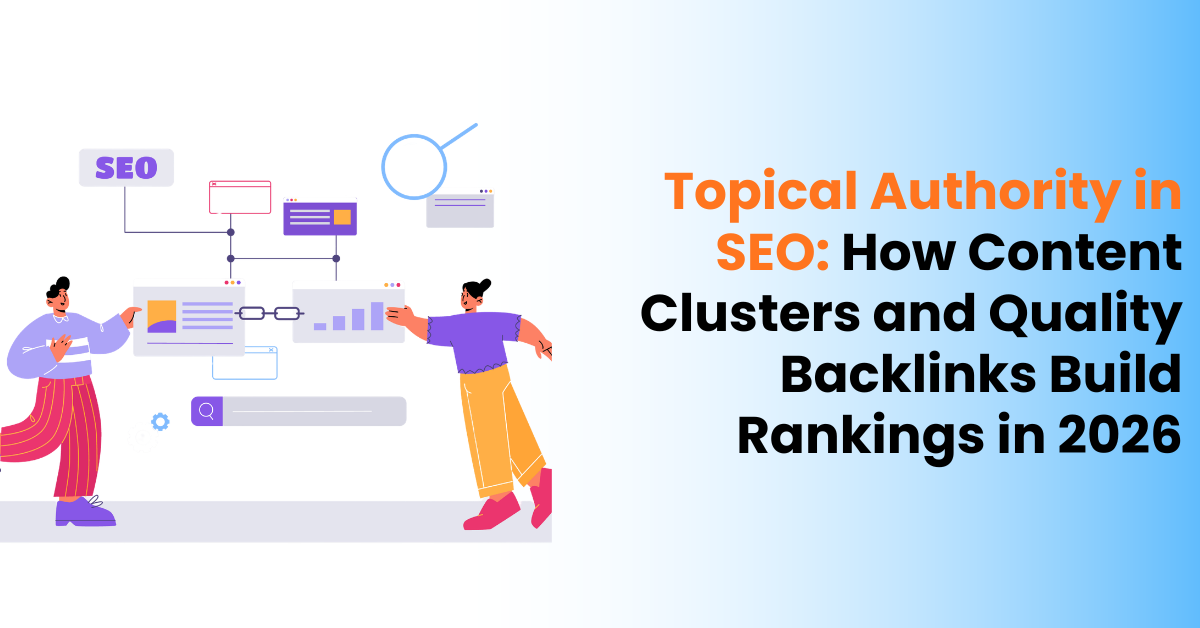
The diagram at the top of this article illustrates a working cluster: each connected node is a real page with its own keyword target and its own job inside the structure.
Building Pillar Pages That Actually Rank
A pillar page earns its ranking through three qualities: comprehensiveness, clarity, and linkability.
Comprehensiveness means the page answers every first-order question a reader would ask about the topic. Google's “People Also Ask” panel, SEMrush's Topic Research tool, and AnswerThePublic are useful for mapping that full question set. If a competitor's page answers a question yours doesn't, your coverage still has a gap.
Clarity means an approachable reading level, short paragraphs, clear headers, and specific claims instead of vague ones. “Many businesses struggle with project management” is weak. “68% of projects miss their original deadline, according to PMI's 2024 Pulse of the Profession report” is strong. Specificity is what readers and AI systems both choose to cite.
Linkability means the page is genuinely worth referencing. Original data, well-built comparisons, and thorough guides earn backlinks on their own. Write the pillar as if it's meant to become the definitive resource on the topic — because that's precisely the goal.
Semantic SEO: The Layer Underneath Keywords
Semantic SEO optimizes content for meaning and context rather than for exact keyword strings. It's the technical foundation that topical authority is built on.
Google's language models are trained on enormous volumes of text, so they already understand that “CRM software,” “customer relationship management tools,” and “sales pipeline software” are closely related concepts — even when a single article never uses all three phrases. Content that covers a topic's full semantic field, including adjacent concepts and supporting terms, signals real depth.
Three tactics build that semantic richness:
- Entity coverage: name the real people, products, companies, studies, and events tied to your topic. Google's Knowledge Graph rewards pages that reference real-world entities accurately.
- Synonym and variant coverage: weave in natural variants of your primary keyword. A page on “content clusters” should also mention “topic clusters,” “hub-and-spoke content,” and the “pillar-cluster model” without forcing any of them in.
- Question-answer pairing: structure sections around the questions readers actually ask. Each H2 or H3 can double as an implicit FAQ entry, which raises the odds of appearing in AI Overviews and featured snippets.
The Role of High-Quality Backlinks
Content clusters build internal topical authority. Backlinks build external authority. Competitive niches in 2026 require both.
Google's link graph is still one of its strongest ranking signals. A 2024 Ahrefs study covering 920 million web pages found that pages with zero external backlinks rank in the top 10 for almost no search queries, regardless of how good the content is. The cluster strategy builds the architecture; backlinks supply the authority needed to rank inside it.
Not every backlink carries the same weight. A single link from a topically relevant, high-authority domain is worth more than dozens from unrelated or low-authority sites. Google's Penguin algorithm, which has run in real time since 2016, actively discounts or penalizes manipulative link patterns — link farms, paid networks, and irrelevant mass placements among them.
What Counts as a Quality Backlink in 2026
|
Backlink type |
Why it works |
Risk level |
|
Editorial mention in high-DA content |
Earned naturally; topically relevant |
None |
|
Guest post on a niche-relevant site |
Reaches a real audience; lasting placement |
Low, if the site is legitimate |
|
Niche edit / link insertion |
Placed in existing indexed content; fast equity transfer |
Low, with manual vetting |
|
Digital PR (data-driven stories) |
Earns links from news and media outlets |
None |
|
Link exchange (direct A↔B) |
Easily detected; discounted by Google |
High |
|
PBN (private blog network) |
Against Google's guidelines; manual penalty risk |
Very high |
White-Hat Link Building: The Strategies That Actually Work
White-hat link building earns backlinks through merit, not manipulation. The strategies below produce durable high-quality backlinks that strengthen topical authority without risking a Google penalty.
Guest post outreach remains one of the most scalable tactics available. The key is qualifying sites carefully: target domains with real, verifiable traffic (check Ahrefs or SEMrush), genuine editorial standards, and real topical overlap with your niche. One guest post on a site with 40,000 monthly organic visitors and a DR of 55 outperforms ten posts on sites with no measurable traffic.
Niche edits and link insertions place a backlink inside an existing article on a relevant site. Because that article already has backlinks and traffic of its own, the link equity transfers faster than a link placed in a brand-new post. The tactic stays white-hat when the content is genuinely relevant, the placement reads naturally, and any paid arrangement is disclosed as required. Skip any service offering bulk niche edits at rock-bottom prices — they're almost always built on scraped or low-quality sites.
Digital PR earns links by producing content with real news value: original surveys, industry data, sharp data visualizations, or expert commentary on a trending story. One data-driven piece that lands coverage in three industry publications can generate 20–40 high-authority backlinks. It's a slow strategy, but it produces the highest-quality links of any tactic on this list.
Broken link building finds dead outbound links on relevant sites and pitches your content as the replacement. Ahrefs' “Broken Backlinks” report and the Check My Links Chrome extension both automate the discovery step. Cold outreach for broken-link replacement typically converts at 5–10%, which makes it volume-dependent but low-risk.
Internal Linking: The Most Underrated Multiplier
Internal linking may be the single most underused lever in SEO content marketing strategy. Most sites build content clusters and then never optimize the links that actually hold them together.
Every internal link passes a share of a page's PageRank to whatever it links to. A well-linked cluster behaves like a closed loop, circulating authority from the pillar to the cluster pages and back again. A poorly linked cluster is just a set of standalone pages that happen to share a domain.
Four internal linking rules worth following:
- Every cluster page should link to the pillar using descriptive anchor text that includes the target keyword — never “click here” or “read more.”
- The pillar should link to every cluster page from a contextually relevant sentence, not from a generic list dropped at the bottom of the page.
- New cluster pages should link to existing cluster pages wherever there's a genuine topical connection. That's what turns a hub-and-spoke into a mesh.
- Orphan pages — pages with no internal links pointing to them — are a silent ranking killer. Audit for them quarterly with Screaming Frog or SEMrush's Site Audit.
How to Build a Topical Authority Plan in Six Steps
Building topical authority is a sequential process, and the steps below hold up across almost any niche.
- Choose a topic boundary. Pick a subject narrow enough to dominate but broad enough to support 20–40 articles. “Marketing” is too broad; “email marketing for SaaS companies” is workable.
- Map the question universe. Use SEMrush, Ahrefs, or AnswerThePublic to pull every keyword cluster tied to your topic, then group them by intent — informational, navigational, commercial, transactional
- Assign pillar and cluster roles. The broadest, highest-volume keyword becomes the pillar; each subtopic becomes a cluster page. Aim for one pillar supported by eight to twenty cluster pages.
- Publish the pillar first. Launching the pillar before the cluster pages gives them a topical anchor to reinforce
- Build cluster pages incrementally. Two to four cluster pages a month, each linked to the pillar and to related cluster pages, beats a rushed batch. Consistency matters more than volume.
- Acquire backlinks targeting the pillar. Use guest post outreach, niche edits, and digital PR to build external links into the pillar page. As pillar authority grows, it flows through the internal links to the rest of the cluster.
Building Rankings That Compound
Topical authority isn't a single tactic — it's a compounding asset. Every cluster page published strengthens the pillar. Every quality backlink earned lifts the authority of the whole cluster. Every internal link placed correctly improves how equity flows across the site.
The sites that dominate search results in 2026 and beyond won't be the ones chasing individual keywords. They'll be the ones systematically building the most complete, credible, and interconnected body of content in their niche — and earning the outside validation to back it up.
Start with one pillar. Build the cluster. Earn the links. Repeat.
vefogix
Frequently Asked Questions
Topical authority is the degree to which Google treats a site as a credible, comprehensive source on a specific subject. It's built by publishing a structured, interlinked set of pages that cover a topic in depth — not by targeting isolated keywords on unconnected pages.
Most sites see measurable gains within three to six months of launching a structured content cluster. Full topical dominance in a competitive niche typically takes nine to eighteen months of consistent publishing and link acquisition.
A pillar page is a comprehensive, long-form page covering a broad topic. Cluster pages are focused pieces on specific subtopics that link back to the pillar. Together they form a content cluster that signals topical authority to Google.
Yes. High-quality backlinks from topically relevant sites remain one of Google's strongest ranking signals. Content clusters build internal authority; backlinks supply the external authority needed to rank in competitive searches. The two are complementary, not interchangeable.
A niche edit, also called a link insertion, places a backlink inside existing content on a third-party site. Because that content already has traffic and indexed authority, niche edits often transfer link equity faster than links placed in newly published guest posts. The practice is white-hat when placements are topically relevant and sites are manually vetted.