Will AI Replace Digital Marketers in 2026? An Honest Answer from the SEO Trenches
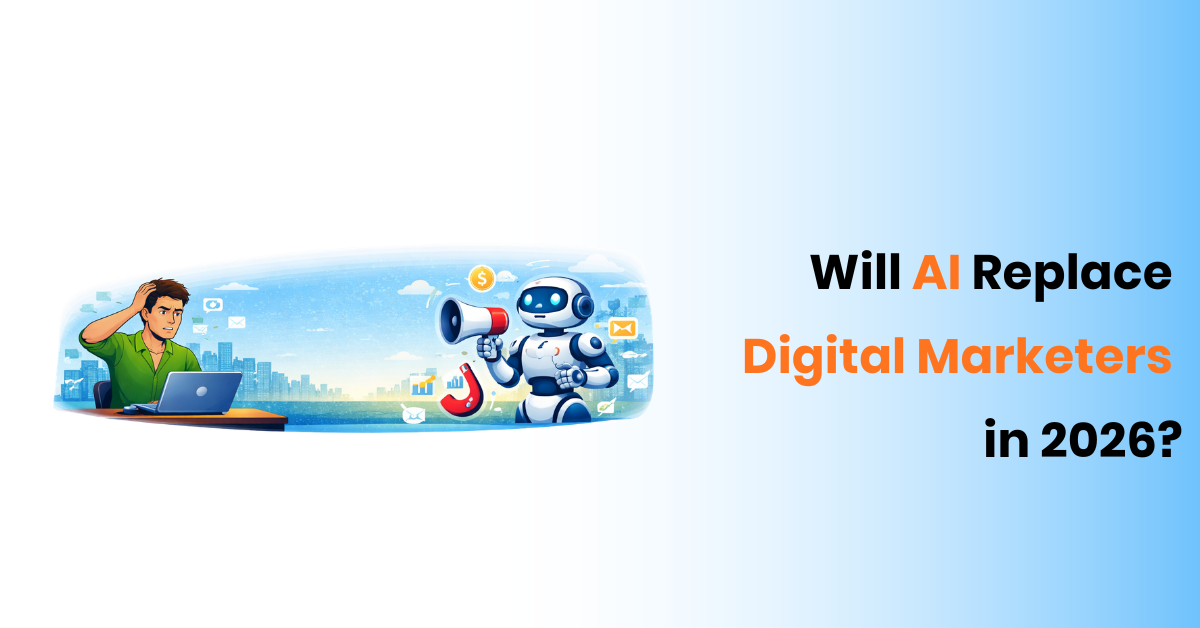
Quick Answer: AI is replacing specific marketing tasks — not marketing roles. The gap between those two things is where the entire conversation breaks down, and understanding it clearly determines whether you treat 2026 as a threat or an advantage.
What's Actually Getting Automated (And What Isn't)
Let's be direct about what AI has genuinely taken over, because the answer matters more than the fear.
In 2026, AI tools handle first drafts of blog posts and ad copy, keyword clustering, topic gap analysis, basic technical SEO audits, social post scheduling, A/B test variant generation, and performance report summaries. These tasks are faster with AI — often by an order of magnitude. That's real, it's happening, and pretending otherwise helps nobody.
Here's the part that gets missed in most of these conversations: compressing the time to produce something is not the same as replacing the judgment about what to produce, why, and whether it will actually work.
A marketer who spent 10 hours a week producing first drafts now spends 2. That freed 8 hours should be going into strategy, client relationships, and the interpretive work that AI genuinely cannot do. The marketers feeling the most pressure are the ones who haven't made that shift — who are still competing on output volume rather than outcome ownership.
|
Task |
AI's Current Role |
Human Role Still Required |
|
First draft content |
Fully automated |
Editorial judgment, brand voice, strategy |
|
Keyword research |
Fast clustering |
Intent interpretation, priority decisions |
|
Technical SEO audit |
Surface issues |
Root cause analysis, fix prioritization |
|
Link building outreach |
Draft pitch emails |
Relationship building, site vetting, anchor strategy |
|
Performance reporting |
Data aggregation |
Insight extraction, strategic response |
|
Campaign strategy |
N/A |
Fully human — context, risk, accountability |
The 5 Things AI Still Cannot Do in Marketing
1. Understand Your Client's Actual Business Context
AI works with inputs. It doesn't know that your client's margins are under pressure from a new competitor entering the market, that their sales team closes best when leads arrive with a specific level of product education, or that a brand repositioning six months ago made last year's content strategy obsolete. Business context — built through real relationships over real time — shapes every strategic decision that actually moves revenue. AI doesn't have it and cannot build it.
2. Make Judgment Calls That Go Against the Data
Data and judgment are not interchangeable. A campaign can show strong click-through rates and weak conversion simultaneously. The data says the ad is performing. Experienced judgment says the audience is mismatched and the problem is upstream. An AI tool surfaces the metrics. A marketer decides what they mean, what caused them, and what to change. That interpretive layer is where experience compounds in ways no tool replicates.
3. Build the Relationships That Drive Real Results
Link building, editorial outreach, influencer partnerships, and PR all run on trust between people. AI can help draft a pitch. It cannot build the relationship with an editor that makes a pitch land. It cannot read the room on a press call, negotiate the terms of a content partnership, or know when pushing harder is the right move versus when to back off. These interactions require human presence and human judgment — consistently.
4. Take Accountability for Outcomes
Strategy involves risk. Decisions that look correct on paper sometimes fail in practice, and someone needs to own that — diagnosing what went wrong, adjusting, and communicating clearly with clients or leadership about what happened and what's next. AI tools produce outputs. They carry zero responsibility for results. In any real client relationship, someone human has to own the outcomes, and that person still needs to know what they're doing.
5. Understand Why People Actually Buy
Marketing is ultimately about human behavior: emotion, identity, trust, status, fear, aspiration. AI can identify behavioral patterns in historical data. It cannot understand the underlying human experience that creates those patterns, and it cannot translate that understanding into creative and strategic choices that genuinely move people. The marketer who understands exactly what a prospect is afraid of when they hesitate at checkout is doing something that cannot be prompted into existence.
How AI Is Reshaping SEO and Link Building Specifically
SEO is where AI's impact is most visible and most frequently misunderstood — often by people who either overclaim what AI can do or dismiss it entirely.
The tools have genuinely changed the speed of keyword research, content briefing, internal linking maps, and technical audits. A competent SEO practitioner using AI tools in 2026 covers more ground than they could without them. That efficiency gain is real and not going away.
What hasn't changed is what Google actually rewards.
Rankings still depend on topical authority, demonstrated expertise, content that genuinely satisfies search intent, and a backlink profile built from editorially placed links on relevant, credible sources. AI can produce content faster. It cannot manufacture the authority signals that make content rank — and Google's 2025–2026 core updates have specifically targeted AI-volume content that lacks those signals.
Guest posting and editorial link building illustrate the gap clearly. The research into which publications are worth pursuing, the relationship management with editors, the judgment about whether a specific site carries real authority versus inflated metrics, and the anchor text strategy across an entire domain — none of these decisions can be delegated to a tool. AI can draft the outreach email. It cannot decide whether a DA 45 site with declining organic traffic is worth the placement fee, or whether a particular link would strengthen or weaken your overall profile. That requires context AI doesn't have. It's why experienced SEO specialists and guest posting services are still in high demand even as AI tooling has improved significantly.
What Happened When a Brand Went 100% AI — A Real 2025 Case Study
In mid-2025, a B2B SaaS company decided to replace its content team with AI-generated output. They published over 100 pieces in a single month — more content than the previous year combined.
Traffic initially increased as the new pages got indexed. The growth looked like a win.
Within three months, it collapsed.
The content had no coherent search intent alignment across pages, no internal linking structure that signaled topical authority to Google, and no editorial perspective that gave the algorithm a reason to prefer it over established competitors with years of consistent publishing. Recovering required a full content audit, restructuring hundreds of pages, rebuilding internal link architecture from scratch, and a sustained link building campaign to restore the topical authority the volume play had fragmented.
The AI produced the content. The failure was entirely strategic. And it took experienced human judgment — not more AI — to diagnose and fix it.
At Vefogix, we've seen this pattern across multiple client recoveries since Google's March 2026 core update. The businesses hit hardest were those that treated AI as a content factory rather than a tool that supports human-driven strategy. The recovery playbook is always the same: audit intent alignment, rebuild internal architecture, restore authority signals through quality link building, and add the editorial layer that AI volume content stripped out.
The New Role Emerging: From Task Executor to Growth Strategist
The shift in marketing isn't from "marketer" to "no marketer." It's from marketer-as-task-executor to marketer-as-growth-strategist.
The tasks AI has automated were always means to an end. The end — qualified traffic, conversions, brand authority, improving unit economics — still requires human ownership at every step.
The marketers gaining ground right now share specific characteristics. They use AI tools fluently, which means they produce more without sacrificing quality. They think in systems — funnels, attribution, compounding levers — not individual deliverables. They connect every activity directly to a measurable business outcome and communicate that connection clearly to clients and leadership. And they take ownership of results, not just outputs.
The marketers under the most pressure are those whose value proposition was primarily volume: more content, more reports, more links, without the strategic layer that explains why any of it should work. That value proposition has been compressed by AI. The solution is moving up the stack — not producing more, but thinking more clearly about what should be produced and why.
What Business Owners Should Know Before Cutting Marketing Budgets
If you're evaluating marketing investment in 2026, the right question isn't whether AI can do what a marketer does. It's what you actually need marketing to accomplish.
If you need volume production — first drafts, keyword lists, basic reports — AI tools handle more of that than they did a year ago. That's genuinely true and worth factoring into staffing decisions.
If you need someone to own your growth strategy, make judgment calls about budget allocation across channels, build the editorial relationships that earn real backlinks, and diagnose why your conversion rate is 0.8% when competitors are at 2.1% — that still requires a person with real expertise.
One skilled marketer using AI tools well can cover what a larger team handled three years ago. But that marketer still needs to be genuinely skilled — capable of strategy, analysis, and decisions that AI supports but doesn't replace. Hiring a less experienced person and expecting AI to fill the expertise gap consistently produces poor results. AI output quality is directly proportional to the strategic direction and quality control applied to it.
How to Stay Indispensable as a Marketer in 2026
Use AI Tools as a Default, Not an Experiment
Marketers still evaluating whether to adopt AI tools are behind. The question in 2026 is which tools fit which tasks and how to extract the best output — not whether to use them. Fluency with AI is now a baseline expectation, not a differentiator.
Move Your Value Up the Stack
If a prompt can replace what you do, the solution isn't to write better prompts — it's to provide the judgment that makes prompts worth running. Strategy, business context, interpretation, and relationship work are all significantly harder to compress with AI than execution tasks. That's where marketers need to live in 2026.
Get Specific About Outcomes, Not Activities
The marketers with the strongest positioning are those who connect their work directly to revenue metrics — not traffic volume, not impressions, not follower counts, but leads generated, conversion rates, customer acquisition cost, and retention. AI makes it easy to produce more activity. Demonstrating that activity drives measurable results is still a human responsibility.
Build Skills Where AI Has Structural Limits
Editorial link building through real relationships, conversion rate optimization, audience research, client communication, and analytical interpretation are all areas where human skill compounds over time. Invest in the skills that AI cannot replicate at scale — because those are the ones that will hold their value as the tools continue to improve.
Have a question about AI's impact on your specific marketing strategy? Reach out to the Vefogix team or browse our SEO marketplace to find specialists who work at the intersection of AI tools and human expertise.
vefogix
Frequently Asked Questions
Lead with outcomes, not process. Instead of describing what you do — "I write content, build links, run campaigns" — describe what you're responsible for producing and what it has delivered. "I own organic lead volume. Over the last 12 months, that's grown from X to Y through a combination of content strategy, link building, and technical optimization." AI tools don't own results. You do. That accountability is the core of your value proposition.
Some will try, and some will succeed temporarily. The clients who reduce marketing investment based on AI's ability to produce content volume faster will mostly discover that content volume was never the primary driver of their results. Clients who understand that they're paying for strategy, expertise, and accountability will find those things haven't become cheaper. Price pressure concentrates on commodity deliverables; strategic services priced on outcomes hold their value.
Roles defined primarily by content volume production — generalist content writers producing large quantities of undifferentiated output, coordinators whose main function is scheduling and reporting, and task-based SEO practitioners doing routine audits — face the most pressure. Roles defined by strategy, specialized expertise, client relationships, and outcome ownership are significantly more insulated. Every major technology shift in marketing has followed the same pattern: tools eliminate tasks, not roles built on judgment and accountability.
Yes, and the timeline matters. Seniority doesn't protect against irrelevance when tools fundamentally change what senior-level work looks like. The practitioners gaining the most from AI right now are experienced marketers who already have a strong strategic foundation — they're using AI to multiply output without sacrificing the quality and judgment that defines their value. That combination is the most defensible position in the current market.
Not effectively. AI can assist with outreach email drafting, site research aggregation, and content creation for guest posts. But the decisions that determine link building quality — which sites are worth pursuing, whether a specific placement strengthens or weakens a backlink profile, how to structure anchor text across a domain, and how to build the editorial relationships that earn genuine placements — require human expertise and contextual judgment. This is why link building services and guest posting platforms run on human strategy even when AI assists with the execution layer.
The pattern was consistent: an initial traffic increase as new pages indexed, followed by a significant drop within 90–120 days as Google's quality assessment systems caught up. The March 2026 core update specifically targeted sites with high content volume and low topical coherence — a fingerprint of AI-mass-publishing strategies. Recovery required content audits, intent realignment, internal architecture rebuilding, and sustained link building to restore authority signals. Volume without strategy produced short-term indexing and long-term damage.
Yes — and arguably more so. AI Overviews and conversational search have changed how some informational queries are answered, but they've increased the importance of topical authority, genuine expertise signals, and quality backlink profiles. Sites with strong authority are cited in AI responses; sites without it are invisible in both traditional and AI-assisted search. The fundamentals of what makes a site authoritative haven't changed. The bar for meeting them has risen.
At Vefogix, AI assists with efficiency — content drafting, publisher research aggregation, and campaign reporting. The judgment layer — site selection, anchor strategy, quality vetting of the 90,000+ publishers in our marketplace, and client strategy — remains human-driven. The reason is simple: the decisions that determine whether a link building campaign actually improves rankings require context, relationship knowledge, and risk assessment that AI tools cannot reliably provide at the level our clients need.