AI Search Visibility to Leads: How to Measure the Journey
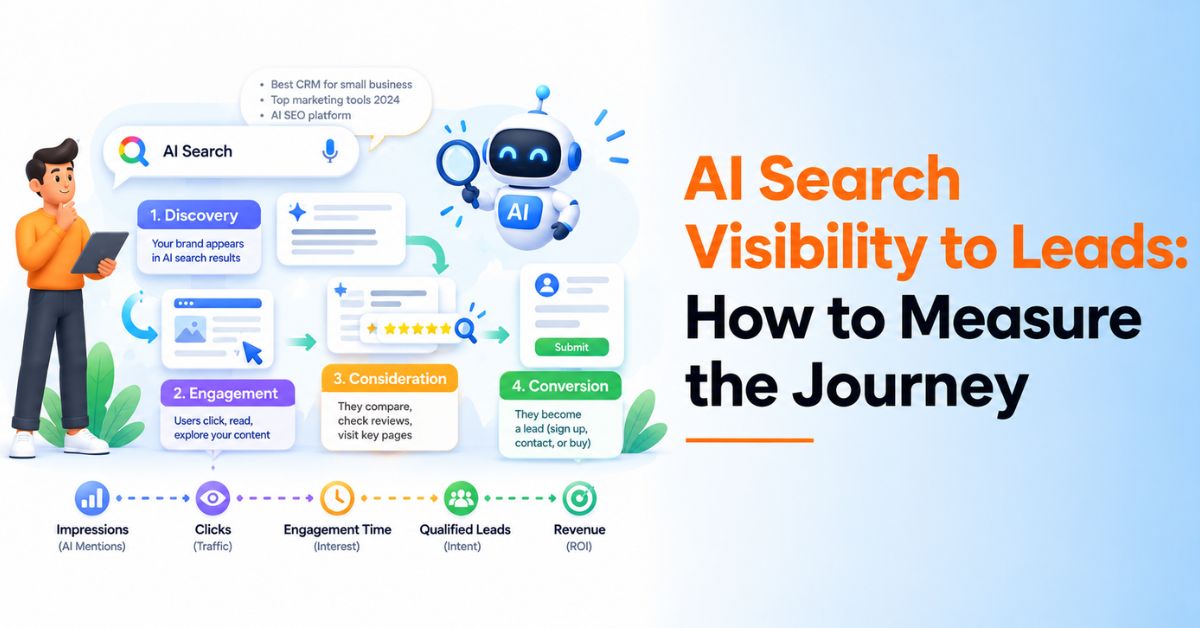
Getting mentioned in an AI-generated answer is useful. But a mention by itself is not a business outcome.
The harder question is what happens next.
Does the person search for your brand? Do they visit your website? Do they land on a service page? Do they compare your offer with competitors? Do they eventually become a lead?
As AI search becomes part of the research process, businesses need to look beyond citation counts. AI visibility should be connected to the wider customer journey, from discovery and brand recognition to website visits and conversions.
This does not mean replacing traditional SEO reporting. Rankings, impressions, clicks and organic conversions still matter. AI search adds another layer to the journey.
What Does AI Search Visibility Actually Mean?
AI search visibility is your brand's presence when people ask questions through AI-powered search experiences such as Google AI Overviews, AI Mode, ChatGPT, Perplexity and similar platforms.
Visibility can take several forms:
- Your website is cited as a source.
- Your brand is mentioned in an answer.
- Your product or service is included in a recommendation.
- A third-party website associated with your brand is cited.
- Your competitors appear alongside your brand.
- Your brand is surfaced for questions you were not directly targeting.
These are useful signals, but they do not automatically translate into leads.
A brand can receive AI citations and still have weak conversion paths. Another brand may receive fewer visible citations but generate more branded searches and qualified visitors.
That is why the next step is connecting visibility with user behavior.
The AI Search Journey Does Not Start With a Click
Traditional SEO often gives you a relatively clear path:
Search → SERP → Click → Website → Conversion
AI search can introduce several additional steps:
Question → AI answer → Brand discovery → Further research → Branded search → Website visit → Conversion
Sometimes the website is never visited during the initial discovery.
A potential customer might ask:
“What are the best ways to build backlinks for a SaaS company?”
The AI response may mention several brands, tools or service providers.
The user may then remember one of those names and search for it later in Google.
That second search can look like a branded search rather than an AI referral. Standard analytics may therefore capture the final website visit without clearly showing what influenced the initial discovery.
This is one reason AI search should be treated as part of the full search journey, rather than as another referral channel.
Start With the Questions That Can Create Demand
One of the most useful ways to measure AI visibility is to build a prompt library around real customer questions.
Do not limit this to prompts containing your company name.
Create groups based on the problems your customers are trying to solve.
1. Problem-based questions
These describe the problem before the customer knows which solution to choose.
Examples:
- How can I improve my website's backlink profile?
- How do I find relevant guest posting websites?
- How can a small business improve its search visibility?
- What should I check before buying a backlink?
2. Solution-based questions
These show that the user understands the type of solution they need.
Examples:
- What are the best link building methods?
- How does guest posting work for SEO?
- What tools can help find guest post opportunities?
- How can I build links from relevant websites?
3. Comparison questions
These often indicate stronger commercial intent.
Examples:
- Which guest post marketplaces are worth considering?
- How do backlink marketplaces compare with manual outreach?
- What should I compare when choosing a link building service?
4. Brand and category questions
These help determine whether your brand has become associated with the category.
Examples:
- What is Vefogix?
- What services are available on Vefogix?
- What are alternatives to traditional guest post outreach?
- Where can businesses find guest posting websites?
The goal is not to manufacture positive mentions.
The goal is to understand where your brand appears, where competitors appear, what sources AI uses and which questions remain visibility gaps.
Track More Than AI Citations
A citation is an important visibility signal, but it should not be the only metric.
A useful AI search measurement framework can include five layers.
1. AI visibility
Track:
- Percentage of target prompts where your brand appears
- Number of citations
- Number of brand mentions
- Which URLs are cited
- Which third-party sources are cited
- Competitors appearing in the same answers
This tells you whether AI systems are discovering your brand.
2. Brand demand
Next, look for evidence that visibility is creating recognition.
Monitor:
- Branded search impressions
- Branded search clicks
- Direct traffic
- Brand-name queries
- New branded keywords
- Searches combining your brand with a service or product
This is particularly useful when AI discovery does not result in an immediate referral.
3. Website engagement
Once people reach your website, measure what they do.
Look at:
- Landing pages
- Engaged sessions
- Pages per session
- Service or product page visits
- Returning visitors
- Contact page visits
- Signup activity
For Vefogix, for example, a visitor who discovers the marketplace and then moves from an informational article to a commercial page represents a more meaningful signal than a pageview alone.
Relevant commercial pages can include the link building services and marketplace sections, depending on the visitor's intent.
4. Lead activity
The final step is connecting visibility with business actions.
Depending on the business, this could include:
- Contact form submissions
- Demo requests
- Account registrations
- Calls
- Quote requests
- Purchases
- Marketplace orders
- Newsletter signups
Not every AI search interaction will be directly attributable to one of these actions.
That is normal.
The objective is to identify patterns rather than claim that every conversion came from an AI citation.
5. Assisted influence
This is the hardest layer to measure.
Someone might discover your brand through an AI answer, search your company name two days later, read three pages and then convert.
The final analytics session may be attributed to organic search, direct traffic or another channel.
That does not make the earlier AI interaction irrelevant.
Use assisted indicators such as:
- Growth in branded searches after visibility improvements
- New visitors landing on commercial pages
- AI-referred sessions where identifiable
- Survey responses mentioning AI tools
- CRM notes showing AI-assisted discovery
- Changes in conversion behavior after expanding AI visibility
The goal is to build a more complete picture rather than force every interaction into a single attribution bucket.
Create a Path From AI Discovery to the Right Page
AI visibility and website conversion should not be treated as separate projects.
Your website needs to support the questions people are asking.
For example, suppose a company becomes visible for:
“How do I evaluate a backlink before purchasing it?”
The cited content should lead naturally to a deeper resource, tool or commercial page.
For Vefogix, this can include internal paths such as:
Educational article → DA/PA Checker → relevant backlink or guest post marketplace page
The Bulk DA PA Checker Tool can support users who have moved from learning about link quality to evaluating actual websites.
Similarly:
AI search question → guest posting information → marketplace
can move a user from informational research toward relevant guest posting services.
This is where internal linking becomes more than an SEO technique.
It creates a logical route between different stages of intent.
Build Content Around the Questions AI Users Ask
Traditional keyword research often starts with search volume.
AI search requires another layer of research: conversation patterns.
Look at the questions customers ask sales teams, support teams and account managers.
Collect phrases from:
- Customer emails
- Sales calls
- Support tickets
- Product reviews
- Community discussions
- Search Console queries
- Site search
- AI-generated questions
- Competitor comparisons
Then group those questions by intent.
For example:
|
Customer stage |
Example question |
Useful content |
|
Problem |
Why are my rankings dropping? |
Diagnostic guide |
|
Research |
How do backlinks help SEO? |
Educational guide |
|
Evaluation |
What makes a good backlink? |
Comparison/checklist |
|
Commercial |
Where can I find relevant websites? |
Marketplace/service page |
|
Action |
How do I check a website before buying a link? |
Tool or workflow |
This creates a content system where informational pages support commercial pages instead of existing as isolated blog posts.
Third-Party Visibility Still Matters
Your own website is only one part of AI search visibility.
AI systems can encounter information about a business through publishers, industry websites, reviews, directories, forums, social platforms and other third-party sources.
That makes off-site visibility important.
Relevant editorial backlinks, expert contributions, digital PR and brand mentions can increase the number of independent sources discussing a business.
But the objective should not be to create hundreds of artificial mentions.
Focus on:
- Topical relevance
- Consistent brand information
- Useful editorial context
- Credible referring websites
- Real audience relevance
- Natural references to your products or expertise
Vefogix's existing guidance on AI search link building covers how backlinks, digital PR and brand mentions can work together. This article takes the next step by connecting that visibility to the customer journey.
Local Businesses Need an Extra Layer
For local businesses, AI visibility can connect directly with high-intent actions.
A customer might ask:
“Who provides emergency plumbing services near me?”
The answer may include several businesses.
The next action could be:
- Opening a business profile
- Calling a business
- Requesting directions
- Visiting the website
- Searching the business name
- Reading reviews
- Comparing several providers
That means local AI visibility needs to be measured against actions, not just mentions.
Businesses should keep important information consistent across their website and external profiles, including:
- Business name
- Address
- Phone number
- Services
- Opening hours
- Locations served
- Reviews
- Business categories
For multi-location businesses, each location also needs a useful, genuinely localized page rather than a collection of pages with only the city name changed.
Why Traffic Alone Can Mislead You
AI search creates a measurement problem because visibility can influence people without producing an obvious referral.
Imagine this sequence:
Monday: A user asks an AI assistant about SEO marketplaces.
Tuesday: They search your brand name on Google.
Wednesday: They return directly to your website.
Thursday: They sign up.
Analytics may record the conversion as organic or direct traffic.
If you only look for an AI referral, you may conclude that AI search produced nothing.
That is why AI visibility should be analyzed alongside branded search, direct traffic, engagement and conversion data.
The reverse is also important.
A sudden increase in AI citations does not automatically mean revenue increased.
The business outcome still needs to be measured.
Use AI Visibility Data to Find Content Gaps
The most useful AI visibility reports should answer questions such as:
- Which customer questions trigger our brand?
- Which questions trigger competitors instead?
- Which sources are being cited?
- Are we being cited for commercial or informational topics?
- Which pages are appearing?
- Are third-party pages describing our brand accurately?
- Which important topics have no brand presence?
- Are users reaching a relevant page after discovering us?
These questions turn AI visibility from a vanity metric into an SEO research process.
For example, if competitors consistently appear when users ask about a particular SEO problem, investigate what evidence supports their visibility.
Perhaps they have:
- Better topical coverage
- Stronger third-party references
- More relevant editorial mentions
- Original research
- Better structured content
- Stronger brand recognition
That gives you a much clearer action plan than simply trying to increase the number of AI citations.
What Should You Do First?
A practical process can be kept simple.
Step 1: Build a prompt library
Collect 50 to 100 questions covering problems, solutions, comparisons and commercial intent.
Step 2: Establish a baseline
Record your current visibility across the AI platforms and prompts you care about.
Step 3: Identify citation gaps
Find questions where competitors or other sources appear but your brand does not.
Step 4: Improve the source material
Create or update content that directly answers those questions.
Make important information easy to understand, verify and reference.
Step 5: Strengthen relevant third-party presence
Build genuine visibility through useful content, editorial outreach, digital PR, expert contributions and relevant publications.
Step 6: Connect content to commercial intent
Use internal links to move visitors from informational resources toward relevant tools, services and marketplace pages.
Step 7: Track downstream behavior
Monitor branded searches, website engagement, signups, leads and conversions alongside AI visibility.
Step 8: Repeat the process
AI search visibility changes as sources, competitors, content and user questions change.
A monthly or quarterly comparison can reveal which topics are gaining visibility and where new gaps are appearing.
AI Visibility Should Support SEO, Not Replace It
AI search does not eliminate traditional SEO.
A strong strategy still requires:
- Search-intent research
- Useful content
- Technical SEO
- Internal linking
- Strong site architecture
- Relevant backlinks
- Brand visibility
- Conversion-focused landing pages
AI search adds another discovery layer.
The businesses that benefit from it will not necessarily be the ones with the highest citation count. They will be the ones that connect visibility with useful content, credible sources and a clear path toward the next customer action.
The real question is no longer only:
“Does AI mention my brand?”
It is:
“What happens after someone discovers my brand through AI search?”
That is where AI search visibility starts becoming a measurable part of SEO and business growth.
Frequently Asked Questions
AI search visibility is the extent to which a brand, website, product, or service appears in answers generated by AI-powered search tools. Visibility can include brand mentions, website citations, product recommendations, and references from third-party sources.
AI search visibility can contribute to lead generation, but a citation or mention does not guarantee a conversion. Users may discover a brand through an AI answer, search for the brand later, visit its website, and then submit a form, sign up, or make a purchase. Tracking these downstream actions helps measure its business impact.
You can measure AI search visibility by tracking how often your brand appears for a defined set of prompts, which URLs and third-party sources are cited, and how competitors appear in the same answers. Combine this data with branded searches, website engagement, leads, signups, and conversions to understand the wider impact.
Some AI-generated referrals can appear as identifiable referral traffic in analytics, but not every AI-assisted visit will be attributed to an AI platform. A person may discover your brand through AI and later return through Google, direct traffic, or another channel. This is why AI visibility should be analyzed alongside branded search and conversion data.
Businesses can create clear paths from informational content to relevant commercial pages, tools, contact forms, or other conversion points. Strong internal linking, useful landing pages, clear calls to action, and content that matches the user's search intent can help turn brand discovery into further engagement.
Relevant backlinks can contribute to AI search visibility by helping establish connections between a brand, its website, and trusted third-party sources. However, backlinks alone do not guarantee inclusion in AI-generated answers. Relevance, useful content, brand information, and the quality of supporting sources also matter.