E-E-A-T in SEO: How to Build Trust, Experience, and Authority Online
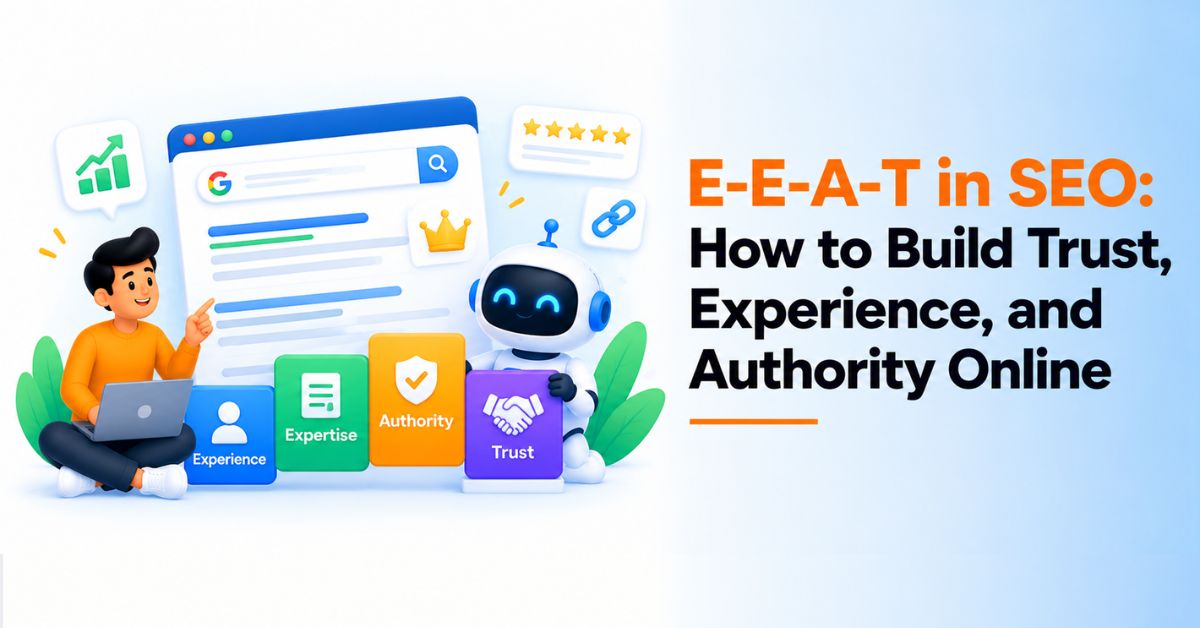
Publishing content regularly does not automatically make a website trustworthy. Search engines need to understand whether the information is useful, reliable, and supported by credible experience or expertise. This is where E-E-A-T becomes important.
What Is E-E-A-T in SEO?
E-E-A-T stands for Experience, Expertise, Authoritativeness, and Trustworthiness. Google uses these concepts in its Search Quality Rater Guidelines to help human evaluators assess the quality of search results.
E-E-A-T is not a direct ranking factor or a score that websites can increase through a single optimisation. Instead, it provides a useful framework for understanding the signals that help establish content quality and credibility.
For businesses, this means focusing on more than keywords and technical SEO. Content should demonstrate genuine knowledge, answer user questions, and give visitors clear reasons to trust the website.
Why Does E-E-A-T Matter for SEO?
Search engines aim to provide information that users can rely on. A page may include the right keywords and follow basic optimisation practices, but that does not necessarily make its content useful or credible.
E-E-A-T encourages website owners to consider the quality behind their content.
It is particularly important for topics that can affect a person's health, financial decisions, safety, or well-being. However, experience, expertise, authority, and trust are useful considerations for websites across different industries.
Businesses investing in SEO services should consider these elements alongside technical improvements, content quality, and search intent.
A website that consistently publishes accurate information, demonstrates relevant experience, and maintains a credible online presence gives users stronger reasons to engage with its content.
The Four Elements of E-E-A-T
1. Experience: Show First-Hand Knowledge
Experience refers to whether the content demonstrates first-hand involvement with the subject.
For example, a product review based on actually using the product can provide more useful information than a description rewritten from its sales page.
Businesses can demonstrate experience through:
- Original case studies based on real projects.
- Product demonstrations and practical examples.
- Customer experiences and genuine testimonials.
- Screenshots, research findings, and original observations.
- Lessons learned from completed projects.
A good example is a detailed case study explaining the business challenge, the work completed, and the outcomes observed. It gives readers something more valuable than general statements about a service.
Avoid publishing claims that cannot be supported. Real examples and transparent explanations make content more useful.
2. Expertise: Publish Accurate and Useful Information
Expertise relates to the knowledge and skill demonstrated in the content.
A website should provide information that answers the reader's question accurately and at an appropriate level of detail. Simply adding technical terms or lengthy explanations does not establish expertise.
To demonstrate expertise:
- Research topics before publishing.
- Explain technical concepts in clear language.
- Support factual claims with reliable sources.
- Review content regularly for outdated information.
- Include relevant qualifications or professional experience where appropriate.
- Address common questions and practical challenges.
For example, an article about link building should explain how relevance, publisher quality, and placement context affect a campaign. It should not simply suggest that acquiring more backlinks will improve rankings.
Businesses planning a campaign can explore link building services to compare available approaches and opportunities.
3. Authoritativeness: Build Recognition in Your Industry
Authoritativeness is about how a website, business, or content creator is recognised within a particular subject area.
A website can publish useful content, but its authority also depends on how it is recognised across the wider online environment.
Relevant mentions, references, citations, and links from credible websites can contribute to a business's online reputation.
Some practical ways to build authority include:
- Publishing original research and industry insights.
- Contributing useful information to relevant publications.
- Earning mentions from credible websites.
- Building relationships with publishers and industry professionals.
- Creating detailed resources that others may reference.
- Maintaining consistent information about the business across online platforms.
Backlinks can support authority when they come from relevant and credible sources. However, the number of links alone does not establish expertise or trustworthiness.
Businesses can compare available backlink packages based on publisher relevance, website quality, niche, and pricing.
Another option is to explore guest post packages for publishing useful, original content on websites relevant to their industry.
The focus should remain on relevance and editorial value rather than acquiring links simply to increase a metric.
4. Trustworthiness: Give Visitors Reasons to Trust Your Website
Trust is a central part of E-E-A-T. Even informative content can lose credibility if the website provides unclear business details, makes unsupported claims, or hides important information.
Visitors should be able to understand who operates the website, what the business does, and how to contact it.
To improve website trust:
- Display accurate business and contact information.
- Publish clear privacy and refund policies where applicable.
- Use HTTPS to secure website connections.
- Keep service descriptions and pricing transparent.
- Correct outdated or misleading information.
- Display genuine customer reviews and testimonials.
- Explain how information, research, or recommendations were produced.
Trust should be consistent across the website. A professional homepage cannot compensate for misleading service pages or outdated information elsewhere.
How Backlinks and Brand Mentions Support E-E-A-T
Backlinks are an important part of off-page SEO, but their value depends on quality and context.
A link from a relevant industry publication can help users discover a business and provide a reference to its website. On the other hand, links from unrelated or low-quality websites may offer little value.
When evaluating link-building opportunities, consider:
- Relevance: Does the website cover topics related to your business?
- Editorial quality: Does it publish useful and original content?
- Audience: Are its readers relevant to your target market?
- Website quality: Does the site maintain a credible publishing standard?
- Placement: Does the link fit naturally within the content?
Brand mentions also matter for reputation. A business may be discussed in industry articles, directories, reviews, and other online publications even when those mentions do not include a backlink.
Press releases can help communicate genuine business developments to relevant audiences. Businesses can explore press release distribution when sharing product launches, company announcements, or significant updates.
The goal is to build a credible presence across relevant sources, not to create artificial signals of popularity.
Does E-E-A-T Matter for AI Search?
AI-powered search platforms are changing how users discover information. Instead of only presenting a list of links, some platforms generate answers using information gathered from multiple sources.
This makes clear, accurate, and well-structured content increasingly important.
Businesses should focus on:
- Creating content that directly answers specific questions.
- Publishing original insights and practical examples.
- Keeping company information consistent across the web.
- Supporting factual statements with credible references.
- Building recognition through relevant industry publications.
- Organising website content around clear topics and entities.
There is no guaranteed method to make a website appear in AI-generated answers. However, useful content, clear brand information, and a credible online presence can help make information easier to understand and reference.
Businesses working on visibility across traditional search and AI-powered platforms can explore AI SEO packages as part of a broader optimisation strategy.
Common E-E-A-T Mistakes to Avoid
Many websites focus on adding more content without reviewing whether it actually helps readers. This can create pages that look optimised but offer little original value.
Some common mistakes include:
- Publishing content without first-hand insight: Rewriting information already available elsewhere does not add much value.
- Making unsupported claims: Statements about results, experience, or expertise should be backed by evidence.
- Focusing only on backlink numbers: A large backlink profile does not automatically make a website authoritative.
- Using generic author information: Author profiles should accurately reflect relevant knowledge and experience.
- Ignoring outdated content: Old statistics, broken links, and incorrect information can reduce content usefulness.
- Creating content only for search engines: Pages should satisfy real user needs rather than simply target keywords.
Avoid treating E-E-A-T as a checklist that can be completed once. It requires consistent attention to content quality, reputation, and website transparency.
A Practical E-E-A-T Strategy for Businesses
Improving E-E-A-T does not require a separate campaign for every element. Businesses can work on these areas as part of their regular SEO activities.
A practical approach includes:
- Review existing content: Identify pages with outdated information, weak explanations, or unsupported claims.
- Add first-hand insights: Include real examples, project experiences, original research, and useful observations.
- Improve content accuracy: Review facts, update references, and make technical explanations easier to understand.
- Strengthen website transparency: Make business details, contact information, policies, and service descriptions easy to find.
- Build relevant authority: Pursue editorial mentions, useful industry contributions, and relevant link-building opportunities.
- Maintain brand consistency: Ensure that business information and messaging remain accurate across important online platforms.
- Measure progress: Monitor organic visibility, engagement, referral traffic, branded searches, and the quality of incoming links.
Businesses looking for broader campaign support can compare full SEO packages covering different aspects of search optimisation.
The right priorities will depend on the website, industry, competition, and current SEO performance.
vefogix
Frequently Asked Questions
E-E-A-T is not a single direct Google ranking factor or a numerical score. It is a framework used in Google's Search Quality Rater Guidelines to assess content quality. Google's ranking systems use multiple signals to identify helpful and reliable information.
E-E-A-T stands for Experience, Expertise, Authoritativeness, and Trustworthiness. These four concepts help explain the qualities associated with useful and credible website content.
A new website can focus on publishing accurate and useful content, demonstrating first-hand knowledge, providing transparent business information, and earning relevant industry recognition. Building credibility takes time and requires consistent effort.
Backlinks are not a direct E-E-A-T score or guarantee of better rankings. Relevant links from credible websites can contribute to online recognition and authority, but link quality, context, and editorial value matter more than quantity.
Experience, expertise, authority, and trust are useful principles for creating reliable content. AI-powered search platforms may use information from multiple online sources, so clear, accurate, and well-supported content can help establish a credible online presence. However, E-E-A-T does not guarantee visibility in AI-generated answers.
Content should be reviewed whenever information becomes outdated, inaccurate, or less useful. Important pages should be checked regularly, especially when they cover changing topics such as technology, finance, regulations, or industry developments.