2026 Guide to Hiring a Link Building Agency in the AI Search Era
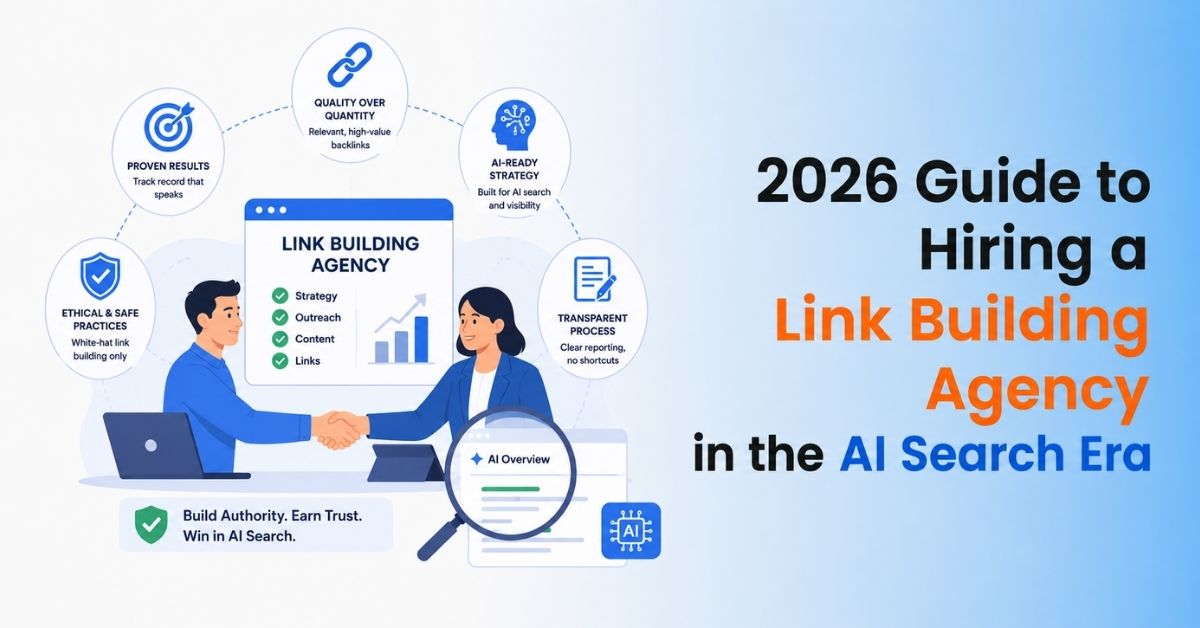
Hiring a link building agency in 2026 requires more than comparing Domain Rating, Domain Authority, or the number of backlinks included in a package.
A website can have a high DR and thousands of monthly visitors and still be a poor backlink opportunity. The traffic may be unrelated to your market, the site may publish hundreds of commercial articles, or the actual page containing your link may have little search visibility.
At the same time, AI-powered search is changing how people discover businesses. Google AI Overviews, ChatGPT, Perplexity, and other answer engines increasingly rely on information from across the web when generating responses.
That makes relevance, authority, trustworthy third-party mentions, useful content, and brand visibility increasingly important.
So how do you choose the right link building agency in 2026?
This guide gives you a practical framework for evaluating agencies, comparing pricing, identifying red flags, asking the right questions, and deciding whether a traditional agency or a transparent marketplace is a better fit.
Quick Answer: What Makes a Good Link Building Agency?
A good link building agency should be able to clearly explain:
- How it finds and vets publishers
- Why a publisher is relevant to your business
- How it evaluates organic traffic and search visibility
- How it selects target pages
- How it manages anchor text
- How content is researched and edited
- How placements are monitored
- What happens when a link disappears
- What reporting you receive
- How link building fits into your broader SEO and AI-search strategy
Warning sign: an agency that focuses almost entirely on "high DA backlinks," link volume, and guaranteed rankings without asking about your website, audience, competitors, or SEO goals.
What Has Changed About Link Building in 2026?
The traditional link-building model was often:
Find high-DA websites → buy links → increase backlink count → improve rankings.
That approach is too simplistic. Modern campaigns need to evaluate the quality and context of each opportunity.
A backlink should ideally come from a website that:
- Covers topics relevant to your business
- Has genuine organic visibility
- Publishes useful content
- Has a legitimate audience
- Maintains a natural publishing pattern
- Provides a logical context for your link
AI search adds another layer.
Your goal is no longer only to rank a URL in traditional search. You also want your company to become a recognizable and credible source within your industry.
That does not mean there is a special type of "AI backlink" that guarantees ChatGPT or Perplexity visibility. Instead, link acquisition should contribute to a broader authority strategy involving useful content, relevant publications, brand mentions, digital PR, and credible third-party references.
Vefogix's guide on link building in the age of AI search explores this shift in more detail.
1. Define What You Actually Want From Link Building
Before comparing agencies, establish your objective. Different goals require different campaigns.
This matters because an agency promising 100 backlinks may not actually be addressing your primary problem. For example, a SaaS company trying to establish authority in cybersecurity may benefit more from 10 highly relevant cybersecurity publications than from 100 unrelated websites.
| Your Goal | What the Campaign Should Prioritize |
|---|---|
| Improve rankings | Relevant publishers, target pages, natural anchors |
| Increase organic traffic | Publishers with relevant search visibility and audiences |
| Build topical authority | Industry-specific and closely related websites |
| Increase brand visibility | Publications, mentions, PR, expert content |
| Support AI-search visibility | Authority, citations, brand mentions, useful content |
| Generate referral traffic | Publishers with a genuine audience matching your market |
| Support new service pages | Relevant editorial placements pointing to commercial pages |
2. Evaluate Publishers Using a Modern Criteria Framework
DA and DR can be useful, but they should never be the only filters. Use a broader evaluation model.
The rule to remember
Don't reverse that process and start with the cheapest high-DR website.
| Evaluation Factor | What to Check | Why It Matters |
|---|---|---|
| Topical relevance | Does the site cover your industry? | Establishes contextual relevance |
| Organic traffic | Is traffic genuine and search-driven? | Indicates real search visibility |
| Traffic trend | Stable, growing, or declining? | Helps identify weak or deteriorating sites |
| Ranking keywords | Are keywords relevant to your market? | Reveals topical strength |
| Audience | Does the readership match your customers? | Creates potential referral value |
| Content quality | Is content useful and editorially maintained? | Distinguishes real publications from link farms |
| Outbound links | Are commercial links excessive? | Excessive selling can indicate risk |
| Publishing pattern | Is content published naturally? | Unnatural volume can be a warning sign |
| Linking page | Is the actual page valuable and indexable? | Domain metrics don't guarantee page value |
| Authority | DA, DR, referring domains | Useful supporting metrics |
| Price | Is cost reasonable for the opportunity? | Helps evaluate overall ROI |
3. Red Flags vs. Green Flags When Evaluating an Agency
Instead of reading through dozens of warning signs, use this quick comparison. One warning sign by itself doesn't necessarily mean an agency is bad. Several warning signs together should make you investigate further.
| Red Flag | Green Flag |
|---|---|
| Guarantees #1 Google rankings | Explains realistic campaign outcomes |
| Talks only about DA/DR | Evaluates relevance, traffic, authority, and context |
| Promises hundreds of links extremely cheaply | Explains exactly what each placement includes |
| Won't explain publisher-vetting criteria | Has a defined publisher-vetting process |
| Uses the same anchors repeatedly | Builds a natural anchor strategy |
| Every link points to the homepage | Selects target pages based on SEO objectives |
| Doesn't disclose delivered URLs | Provides transparent placement reporting |
| No replacement policy | Has a clear lost-link policy |
| Focuses only on backlinks | Connects link building to SEO and brand goals |
| Uses "AI SEO" as a vague sales pitch | Explains how AI-search visibility fits into the strategy |
| Publishes generic content everywhere | Creates content appropriate for each publisher |
| No post-publication monitoring | Tracks link status and indexing |
4. Why Relevance Can Matter More Than Raw DR
Consider two hypothetical publishers.
| Publisher A | Publisher B | |
|---|---|---|
| DR | 78 | 46 |
| Monthly organic traffic | 90K | 19K |
| Industry relevance | Low | High |
| Relevant ranking keywords | Few | Many |
| Audience match | Poor | Strong |
| Publishing quality | Mixed | Strong |
| Commercial outbound links | High | Moderate |
If you're a cybersecurity SaaS company, Publisher B may be the more strategically useful opportunity. Why? Because the value of a backlink isn't determined by one number.
A relevant publisher can provide:
- Topical context
- Industry credibility
- Potential referral traffic
- Relevant surrounding content
- A stronger association between your brand and the subject
This is why "highest DR wins" is not a reliable link-building strategy. Vefogix's backlink evaluation framework provides a more detailed way to assess individual backlink opportunities.
5. How Much Does Link Building Cost in 2026?
Pricing is one of the most difficult parts of comparing link building agencies because providers use very different pricing models. You may encounter:
- Per-link pricing
- Monthly retainers
- Bulk packages
- Managed campaigns
- Digital PR campaigns
- Marketplace pricing
- Content-plus-placement pricing
Instead of relying on generic "average backlink" figures, look at real transaction and marketplace data where available. Vefogix published a 2026 link-building pricing report based on data from more than 90,000 publishers, examining pricing by factors such as DR, niche, geography, and the difference between asking and actual transaction prices. That is a more useful benchmark than assuming every genuine editorial placement should cost a fixed amount. You can browse live pricing in the Vefogix marketplace.
What affects the price of a backlink?
| Factor | Why Price Can Increase |
|---|---|
| Publisher authority | Stronger publishers may charge more |
| Organic traffic | Genuine search visibility increases demand |
| Topical relevance | Specialized publishers can be harder to secure |
| Geography | Local or country-specific publications may command different rates |
| Industry | Competitive niches can cost more |
| Content | Research-heavy or expert content requires more work |
| Outreach difficulty | Difficult publishers require more effort |
| Placement type | Editorial placements and niche edits have different economics |
| Campaign management | Managed services include strategy and execution costs |
Don't automatically choose the cheapest link
A $20 placement isn't necessarily better value than a $150 placement. Likewise, a $500 placement isn't automatically worth five times as much as a $100 placement. The correct question is:
What am I getting for the price?
Evaluate the publisher, page, relevance, traffic, content, placement, and risk before comparing the final cost.
6. Ask How the Agency Vets Its Publishers
This is one of the most important questions to ask during an agency sales call. Don't ask only:
"How many websites are in your network?"
Ask:
"What criteria must a website meet before you allow it into your network?"
A serious provider should be able to explain whether it checks:
- Organic traffic
- Traffic history
- Ranking keywords
- Topical relevance
- Domain history
- Content quality
- Existing backlinks
- Outbound commercial links
- Publishing patterns
- Country and audience
- Indexing
- Spam indicators
A large database isn't automatically valuable. A well-vetted database is.
7. Review the Actual Linking Page
Another common mistake is evaluating only the domain. A website can look excellent at the domain level while the individual article containing your backlink provides little value. Before approving a placement, examine:
- Is the page indexed?
- Does it belong to the relevant section of the site?
- Is the content useful?
- Does the page receive organic visibility?
- Is the article surrounded by unrelated commercial links?
- Does your link fit naturally into the content?
- Is the page likely to remain useful over time?
This is particularly important for large websites where domain-level metrics can hide significant differences between individual pages.
8. Check the Content Process
The content surrounding your backlink matters. Ask:
- Who writes the article?
- Is it researched?
- Is it edited by a human?
- Does it match the publisher's editorial style?
- Can you approve the article?
- How many external links are included?
- Are commercial anchors forced into the copy?
- Is AI-assisted content reviewed before publication?
AI can make content production faster, but speed should not replace editorial quality. A good article should make sense even if the backlink is removed. That is a useful test. If the article has no reason to exist except to insert your link, the placement deserves more scrutiny.
9. Ask About Anchor Text Strategy
Avoid agencies that treat exact-match anchor text as a formula. If your target keyword is link building services, your entire backlink profile shouldn't consist of links using that exact phrase.
A natural profile can include:
- Brand anchors
- Naked URLs
- Generic anchors
- Partial-match anchors
- Contextual phrases
- Some exact-match anchors where appropriate
The correct mix depends on your existing backlink profile, competitors, target pages, and overall SEO strategy. Ask the agency:
"How will you decide which anchor text to use?"
A good answer should involve your existing backlink profile rather than a fixed percentage template applied to every client.
10. Ask Which Pages the Agency Will Promote
Don't allow an agency to automatically point every backlink to your homepage. Depending on your SEO goals, links may be directed toward:
- Service pages
- Product pages
- Category pages
- Research studies
- Tools
- Guides
- Supporting content
- Brand pages
Commercial pages require particular care because forcing promotional anchors into unrelated editorial content can look unnatural. A strong agency should explain why a particular page is being promoted and why the publisher is appropriate for it.
For more detail, see Vefogix's guide on building backlinks to service pages without looking spammy.
11. What Should a Link Building Report Include?
Before signing a contract, ask for a sample report. A useful report should make the campaign easy to audit. A report that simply says:
"20 backlinks delivered"
isn't enough. You should be able to see where the links are and what was actually delivered.
| Report Item | What You Should See |
|---|---|
| Publisher | Exact website |
| Published URL | Live placement |
| Target URL | Your promoted page |
| Anchor text | Exact anchor used |
| Publication date | When it went live |
| Link status | Live, removed, changed, etc. |
| Publisher metrics | Relevant authority/traffic data |
| Indexing | Whether the page is indexed |
| Content title | Article containing the link |
| Notes | Relevant campaign information |
12. What Happens If a Link Disappears?
Backlinks are not necessarily permanent. Pages can be:
- Deleted
- Updated
- Redirected
- De-indexed
- Moved
- Changed from followed to nofollow
- Removed by the publisher
Ask about the agency's replacement policy before purchasing. For example, Vefogix currently advertises a 90-day link replacement guarantee for qualifying placements.
| Question | Why It Matters |
|---|---|
| How long is the placement covered? | Defines your protection period |
| What counts as a lost link? | Avoids disputes |
| How quickly are replacements made? | Minimizes campaign disruption |
| Is the replacement equivalent? | Prevents quality downgrade |
| Is there an additional fee? | Clarifies your real cost |
13. AI Search: What Should a Link Building Agency Actually Do?
Be cautious when an agency starts selling "AI backlinks." There isn't a magic backlink that guarantees visibility in ChatGPT, Perplexity, Google AI Overviews, or another AI search system.
Instead, ask how the agency contributes to the signals that can make a brand more discoverable and credible. AI search should be treated as part of your broader search strategy, not as a separate shortcut. Vefogix's existing AI search link-building guide covers this topic in greater depth.
| Weak AI-SEO Pitch | Stronger Strategy |
|---|---|
| "Buy AI backlinks" | Build relevant authority |
| "Guaranteed ChatGPT rankings" | Track brand and citation visibility |
| "AI will rank your links" | Create useful, reference-worthy content |
| "100 AI mentions guaranteed" | Build legitimate third-party mentions |
| "Special AI-only placements" | Combine SEO, PR, content, and authority |
14. Look for Linkable Assets and Digital PR
The strongest backlink strategy isn't always about manually requesting placements. Sometimes the better question is:
"What can we create that other websites genuinely want to reference?"
Potential linkable assets include:
- Original research
- Industry surveys
- Statistics
- Free tools
- Calculators
- Original datasets
- Expert studies
- Industry reports
- Benchmarks
- Interactive resources
For example, a SaaS company could publish an annual industry benchmark. A marketing company could publish original search data. A finance company could produce a consumer research report. These assets give journalists, bloggers, and industry publications a reason to mention the brand.
15. Agency Red Flags You Shouldn't Ignore
16. The 10 Questions to Ask Before Hiring an Agency
Use this checklist during your next agency call. If an agency gives vague answers to most of these questions, don't rush into a long-term contract.
| Question | What a Good Answer Should Explain |
|---|---|
| How do you vet publishers? | Traffic, relevance, quality, risk |
| Do you check traffic trends? | Historical organic visibility |
| How do you select target pages? | Strategy based on SEO objectives |
| How do you choose anchors? | Natural, profile-aware approach |
| Who writes the content? | Research, writing, editing process |
| Can I approve placements? | Level of client control |
| Can I see a sample report? | Reporting transparency |
| What happens if a link disappears? | Replacement/guarantee policy |
| How do you measure success? | Rankings, traffic, links, business outcomes |
| How does AI search affect your strategy? | Authority, mentions, content, citations |
17. How to Compare Two Link Building Agencies
Don't compare agencies based only on their monthly price. Use a weighted scorecard. Score each provider from 1–10. This gives you a more useful comparison than simply asking:
"Who gives me more backlinks for less money?"
| Evaluation Area | Suggested Weight |
|---|---|
| Publisher relevance | 20% |
| Publisher quality | 15% |
| Organic visibility | 15% |
| Content quality | 10% |
| Publisher-vetting process | 10% |
| Reporting transparency | 10% |
| Strategic expertise | 10% |
| Link replacement policy | 5% |
| AI-search understanding | 5% |
| Total | 100% |
18. Agency vs. Vefogix: Which Approach Fits You?
You don't necessarily need a traditional agency for every link-building campaign. The right option depends on how much control you want.
Vefogix currently offers both a managed link-building service and a self-service marketplace, allowing businesses to choose between outsourcing campaign execution and selecting individual publishers themselves.
When to Use Vefogix Managed Services
Choose managed services when you want:
- SEO strategy
- Publisher selection
- Outreach
- Content
- Campaign management
- Reporting
- Ongoing execution
When to Use the Vefogix Marketplace
Use the marketplace when you want:
- Individual placements
- More publisher control
- Transparent publisher information
- Flexible budgets
- Specific niches or countries
- The ability to compare opportunities yourself
| Choose a Traditional Agency If… | Choose Vefogix If… |
|---|---|
| You want the agency to handle strategy and execution | You want more control over publisher selection |
| You prefer a managed monthly campaign | You want to choose individual placements |
| You don't want to evaluate publishers yourself | You want publisher metrics and pricing upfront |
| You need an ongoing SEO partner | You need flexible campaign sizes |
| You want strategy + outreach + reporting handled together | You want transparent marketplace pricing |
| You prefer a retainer model | You want to buy individual links or packages |
19. What Should a 90-Day Link Building Campaign Look Like?
A good campaign shouldn't begin with:
"We need 100 backlinks."
It should begin with research. The exact pace depends on the website, niche, competition, geography, and campaign budget. The important point is that link building should be treated as an ongoing SEO process, not a one-time purchase.
| Period | Main Activities | Output |
|---|---|---|
| Days 1–30 | Backlink audit, competitor research, target-page analysis, publisher criteria | Campaign strategy |
| Days 31–60 | Outreach, content creation, publisher approvals, placements | Initial links |
| Days 61–90 | Performance analysis, publisher refinement, anchor review, replacements | Optimized campaign |
20. How Should You Measure Link Building Success?
Backlink count alone isn't enough. Use several layers of measurement. The important distinction is: a backlink is a deliverable. Business growth is the outcome.
| Metric | Strategic Purpose |
|---|---|
| Referring domains | Measures breadth of external authority |
| Publisher relevance | Measures topical alignment |
| Organic publisher traffic | Indicates genuine search visibility |
| Ranking changes | Shows potential SEO impact |
| Organic traffic | Measures search growth |
| Referral traffic | Measures direct audience value |
| Target-page performance | Shows whether promoted URLs improve |
| Anchor distribution | Helps maintain a natural profile |
| Link retention | Measures long-term placement value |
| Brand mentions | Measures broader authority |
| AI-search visibility | Tracks visibility in emerging answer engines |
| Leads/conversions | Connects SEO activity to business outcomes |
21. A Simple Link Building Agency Hiring Scorecard
If you want a quick decision framework, score each agency out of 100.
| Category | Points |
|---|---|
| Publisher relevance | 20 |
| Organic traffic quality | 15 |
| Publisher vetting | 15 |
| Content quality | 10 |
| Link placement quality | 10 |
| Reporting | 10 |
| Pricing transparency | 5 |
| Replacement policy | 5 |
| Strategy | 5 |
| AI-search understanding | 5 |
| Total | 100 |
90–100: The provider demonstrates strong processes, transparency, and strategic thinking.
75–89: The agency may be suitable, but investigate the weaker areas.
60–74: Ask additional questions and request examples before committing.
Below 60: The provider may be relying too heavily on volume, vanity metrics, or aggressive promises.
This is a decision-making framework, not a Google ranking formula.
Final Takeaway
Hiring a link building agency in 2026 shouldn't be a race to find the highest DR or the cheapest price.
The better approach is to evaluate: Relevance + Organic Visibility + Publisher Quality + Content + Placement + Strategy + Transparency
AI search makes this even more important. Your goal shouldn't be to manufacture the largest possible backlink count. Your goal should be to build a credible web presence around your brand that supports:
- Search visibility
- Topical authority
- Referral traffic
- Brand discovery
- Third-party credibility
- Long-term SEO growth
Before signing with an agency, ask one simple question: "Can you explain why the links you're building should be valuable for my business?"
If the answer goes beyond DA, DR, and backlink volume, you're probably having the right conversation. If the entire pitch comes down to "100 high-DR backlinks for $X," keep asking questions.
The best link building provider isn't necessarily the one that sells the most links. It's the one that can explain the strategy behind every link.
Frequently Asked Questions
There is no universal price because costs vary by publisher quality, relevance, niche, geography, content requirements, outreach difficulty, and campaign management. The best way to evaluate pricing is to compare the actual quality and scope of placements rather than relying on a single industry-wide "average backlink price." Vefogix's 2026 pricing report analyzes pricing across more than 90,000 publishers and provides a data-backed view of how link costs vary.
Backlinks are not a guaranteed ranking or citation mechanism for AI search engines. However, links can contribute to a broader web presence by helping establish relationships between your brand, relevant topics, authoritative publications, and third-party sources. For AI search, think beyond backlinks alone — useful content, brand mentions, authoritative references, and credible third-party sources can all contribute to discoverability and perceived authority.
No. DR is a useful comparative metric, but it doesn't tell you everything about topical relevance, traffic quality, the linking page, editorial standards, or risk. A lower-DR website with genuine relevance and strong organic visibility may be more strategically useful than a high-DR website with unrelated traffic.
Not necessarily. Quality, relevance, and campaign strategy are more important than raw link volume. A smaller number of strong, relevant placements can be more useful than a large number of low-quality links.
Exact-match anchors can be appropriate in some situations, but they shouldn't dominate a backlink profile. Anchor selection should consider your existing backlink profile, target page, competitors, and the context of the linking content.
Ask how it vets publishers, evaluates organic traffic, selects target pages, handles anchors, creates content, reports placements, replaces lost links, and measures campaign performance. Also ask the agency to explain how its strategy addresses AI-powered search and broader brand visibility.
Neither is universally better. An agency is generally more suitable when you want strategy and execution handled for you. A marketplace can be better when you want more control over publisher selection, pricing, and individual placements. Vefogix provides both managed services and marketplace-based purchasing options.