Is AI Killing Your Website Traffic? How to Rank in AI Overviews Instead
The analytics pattern is consistent enough now that most content teams have seen it: rankings stable or improving, impressions holding steady, clicks dropping. Sometimes significantly. It's disorienting because the traditional signal — position in search results — suggests everything is fine. But the traffic data says otherwise.
What's happening is structural, not algorithmic in the traditional sense. Google AI Overviews are answering queries directly on the results page, and a meaningful portion of users who would previously have clicked through to read an article are getting what they need without leaving Google. The click never happens. The page never loads. The visit never registers.
This isn't a temporary fluctuation or a penalty you can reverse. It's a fundamental shift in how a significant portion of search queries resolve. The question isn't whether to respond to it — it's how.
What AI Overviews Actually Are and How They Select Sources
Google AI Overviews are LLM-generated summaries that appear at the top of search results for a growing range of queries. Google's systems analyze content from multiple web sources, synthesize the most relevant information, and present a summary directly on the results page — often with citations linking back to the sources used.
The citation mechanic is what creates the strategic opportunity. Pages cited in AI Overviews receive a different kind of visibility than a standard ranking — they appear as endorsed sources within the answer itself, which tends to attract higher-intent clicks from users who want to go deeper on the topic. The traffic volume may be lower than what a traditional top-three ranking produced, but the visitor quality is typically higher.
Understanding how Google selects those cited sources is the foundation of any strategy to appear in them.
AI Overviews don't select sources based purely on traditional ranking signals. The selection process weights several factors that overlap with but aren't identical to conventional SEO:
Topical authority. Sites that consistently cover a specific subject area in depth are treated as more reliable sources for queries within that area than generalist sites with occasional coverage of the same topic. This is the same directional shift visible in traditional SEO over the past two years — the difference is that AI Overview selection amplifies it.
Content that answers the specific sub-questions within a query. AI systems break complex queries into component questions and look for sources that address specific components clearly. A page that answers the main question well but ignores related sub-questions is less useful for synthesis than a page that addresses the full scope of what the query implies.
Structural accessibility. Content organized with clear headings, defined answer blocks, and logical section hierarchy is easier for AI systems to parse and extract from. This isn't about gaming the system — it's about whether the content is structured to communicate clearly, which benefits both AI extraction and human readers.
Factual specificity. AI systems weight content that makes specific, verifiable claims over content that makes general observations. A sentence like "pages updated within the past 13 weeks show measurably higher AI citation rates than older content" carries more weight than "keeping content fresh is important." Specificity is a proxy for genuine knowledge.
Freshness. AI systems weight recency for topics where information changes over time. Pages that haven't been updated in six months or more face a meaningful disadvantage in AI Overview citation relative to recently updated content on the same topic.
Why Generic Content Is Getting Bypassed
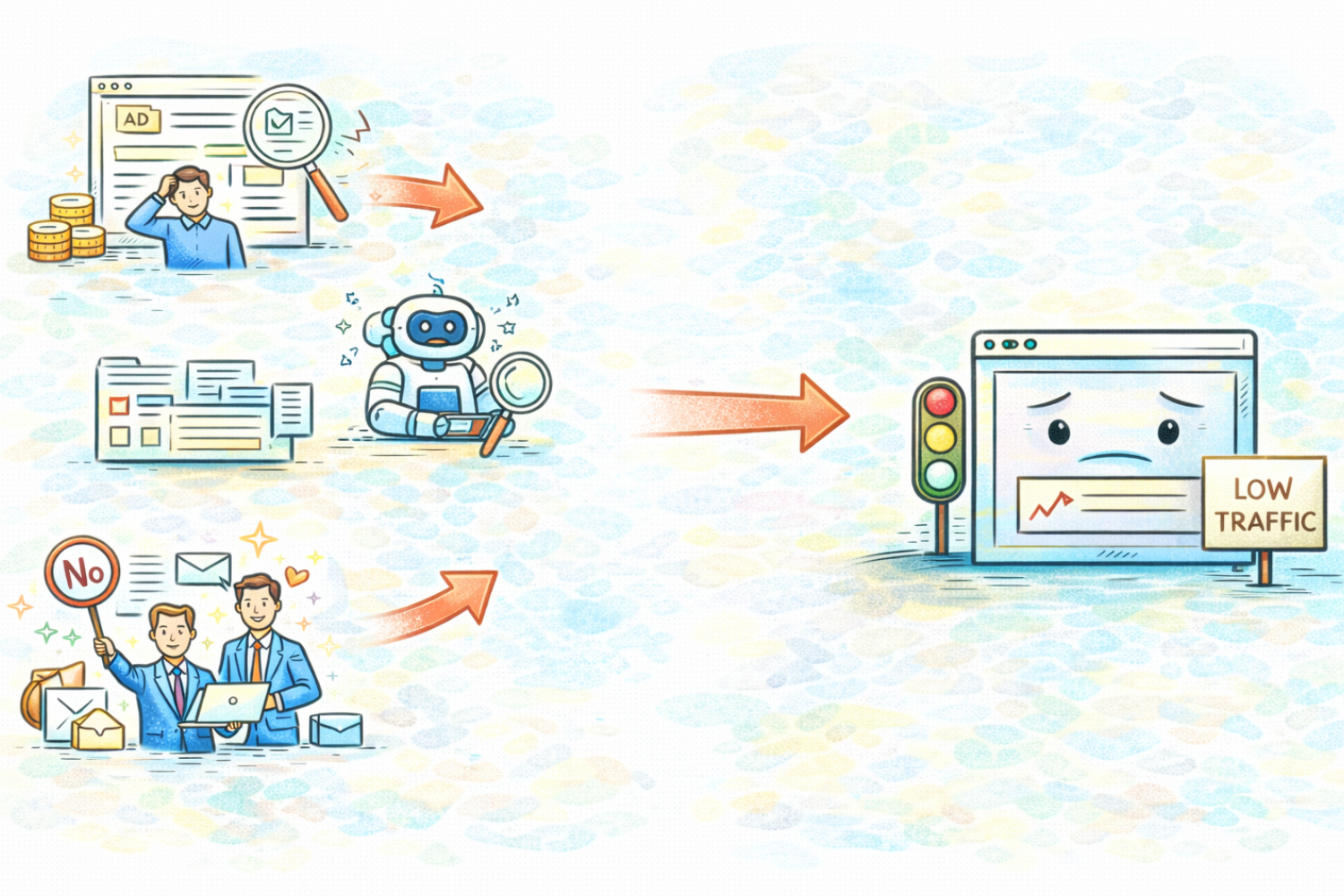
The core dynamic driving traffic loss for most affected sites is simpler than it might appear: AI systems don't need multiple sources saying the same thing. When several pages cover the same topic at the same level of depth with the same general conclusions, the AI selects the most credible-seeming version and ignores the rest.
This is the problem with content that was built for traditional keyword SEO — articles optimized to rank for a term by covering it comprehensively, but without adding anything that isn't already covered by competitor articles. This content ranked because it was well-optimized. It gets bypassed in AI Overview selection because it offers no differentiated information value.
The practical implication is that content strategy needs to shift from "what does this keyword require?" to "what does our genuine knowledge, experience, or data add to this topic that isn't available from other sources?" That's a harder question to answer, but it's the right one.
Content that consistently gets cited in AI Overviews shares one characteristic: it contains information the AI system couldn't have assembled by synthesizing what's already widely available. Original data, documented experience with specific outcomes, analysis that reaches non-obvious conclusions, coverage of edge cases and exceptions that surface only through real-world work — these are the content elements that create genuine differentiation.
The Traffic Pattern Worth Understanding
The drop in organic clicks isn't uniform across all query types, and understanding where it's hitting hardest helps prioritize where to focus optimization effort.
Informational queries — how-to questions, definitions, explanations of concepts — are the category most affected. These are the queries where AI Overviews appear most frequently and where users are most likely to accept an on-page summary rather than clicking through. If your traffic base is heavily weighted toward informational content, this is where you'll have seen the sharpest decline.
Commercial investigation queries — comparison pages, "best X for Y" content, evaluation guides — are partially affected. AI Overviews appear for some of these, but users making purchasing decisions tend to want more depth than a summary provides, which preserves some click-through behavior.
Transactional queries — high-intent searches where the user is ready to act — are least affected, because the answer to "buy X" or "hire a [specialist]" isn't something a summary resolves. These queries still produce clicks.
This means the right response to AI Overview-driven traffic loss is different for different types of content. Informational content needs to compete for citation rather than clicks. Commercial and transactional content needs to focus on the depth and specificity that drives click-through even when a summary is present.
How to Optimize Content for AI Overview Citation
Make your content's answer to the core question explicit and early
AI systems give disproportionate weight to the first 150–200 words of a page and to content that appears directly under a relevant heading. If your page's clearest, most direct answer to the query it targets is buried three paragraphs into a section, it's less likely to be extracted.
Restructure key sections so the direct answer comes first, followed by supporting detail, context, and nuance. This isn't about oversimplifying — it's about making the answer accessible before making it comprehensive.
Build content around specific sub-questions, not just the primary keyword
Use tools like AlsoAsked, Google's "People Also Ask" data, and Search Console query reports to identify the related questions users are asking alongside your primary target. Structure your content to address each of these explicitly, with clear heading demarcation. AI systems synthesizing an answer to a complex query will prefer sources that address the full question space over sources that address only the primary term.
Add content only your site can provide
This is the highest-leverage change most sites can make. Review each piece of content and identify what's present that couldn't be found in competitor articles — original data, specific results from real campaigns, documented mistakes and their consequences, frameworks developed through iteration. If the honest answer is "nothing," that's where to focus revision effort.
The types of content that consistently get cited: specific statistics with clear sourcing, case study results with enough detail to be verifiable, named examples with outcomes, first-person accounts of decisions and what they produced.
Implement schema markup relevant to your content format
FAQ schema, HowTo schema, and Article schema all help Google's systems understand your content's structure and context. FAQ schema is particularly useful for content that addresses multiple related questions, because it maps directly to the question-answer format AI systems use when constructing summaries.
Apply structured data to pages that address high-volume informational queries — these are the pages most likely to appear in AI Overviews and most in need of the structural clarity schema provides.
Update content on a regular cycle
Given the evidence that AI citation rates decline measurably for content not updated within roughly 13 weeks, high-value pages targeting competitive informational queries need a refresh cadence, not just a one-time update. This doesn't mean rewriting from scratch — it means adding new data, updating examples, revising claims that have become outdated, and ensuring the content reflects current conditions.
Build a content maintenance calendar that prioritizes your highest-traffic informational pages and cycles through them regularly. This is a different workflow than most content teams have operated with historically, but it's increasingly necessary for sustained AI Overview visibility.
The Role of Link Building in AI Citation
Traditional link building and AI Overview citation are more connected than they might appear. Google's AI systems don't operate in isolation from its broader trust and authority evaluation — domains with strong backlink profiles from credible, topically relevant sources start with a higher baseline of trust in AI source selection.
This means a site that has invested in editorial link building and genuine topical authority through guest posting on relevant publications has a structural advantage in AI Overview citation relative to a site with similar content quality but weaker authority signals. The two disciplines are not competing priorities — they compound.
The specific link building work that most directly supports AI Overview citation is the kind that builds topical authority: editorial placements on sites with genuine readership in your niche, brand mentions across relevant publications, and digital PR that generates coverage with named citations. These activities build the authority signals that make Google's systems more likely to treat your domain as a credible source.
Measuring AI Overview Performance
Standard analytics don't capture AI Overview visibility directly, which creates a measurement gap most teams haven't solved. Clicks and impressions in Google Search Console reflect traditional ranking performance — they don't tell you whether your content is being cited in AI summaries.
The metrics worth tracking alongside traditional SEO data:
AI citation rate — systematically testing 15–25 of your most important target queries across Google, Perplexity, and ChatGPT Search, and recording whether your domain is cited. Do this monthly to track trend.
Branded search volume — measured in Search Console over rolling 90-day windows. AI Overview citations that reach real users tend to drive incremental branded searches from people who encountered your site as a cited source and want to explore further.
Referral traffic from AI platforms — as AI search tools generate more traffic, sessions referred from ChatGPT.com, Perplexity.ai, and similar sources are increasingly trackable in analytics. Monitor these referral sources separately to understand how AI-referred visitors behave relative to organic search visitors.
Click-through rate on AI-present SERPs — compare CTR on queries where AI Overviews appear versus queries where they don't. This helps quantify the traffic impact and prioritize which queries most need citation optimization versus which still behave like traditional search.
Frequently Asked Questions
The trend has been consistent expansion since their broad rollout. Google has pulled back AI Overviews for some query categories where they produced unreliable answers, but the overall direction is toward more coverage, not less. Planning for an environment where AI Overviews are present for most informational queries is more defensible than planning for a reversal.
Smaller sites with genuine topical expertise do get cited — sometimes over larger generalist sites with more overall authority. The selection is weighted toward topical relevance and content specificity, which means a smaller site that covers a niche deeply and accurately can outperform a high-authority generalist on queries within that niche. The barrier is demonstrating expertise through content quality, not just domain authority.
Yes, but context matters more now. Using relevant terms like seo marketplace, professional seo services, and seo monthly packages naturally within helpful content works better than repeating a single keyword.
No — but the goal of informational content needs to shift. Content that gets cited in AI Overviews still drives meaningful traffic, brand visibility, and authority signals. The failure mode is producing informational content that neither ranks well in traditional search nor gets cited in AI Overviews because it doesn't differentiate. Informational content worth creating in 2026 is content that adds something genuinely distinctive to the topic — which is a higher bar than it used to be, but not an impossible one.
Yes. Structured data formats like FAQ, HowTo, and Organization schema help search engines understand your content better and improve the chances of it being cited in AI-generated summaries.
AI systems can begin citing updated content within days of re-indexing on some platforms. Perplexity in particular indexes and updates frequently. Google AI Overviews tend to update more slowly. Meaningful, consistent citation on competitive queries typically takes weeks to months of sustained effort — it's not a one-time fix.