Meta Descriptions for SEO: How to Write Better Search Snippets
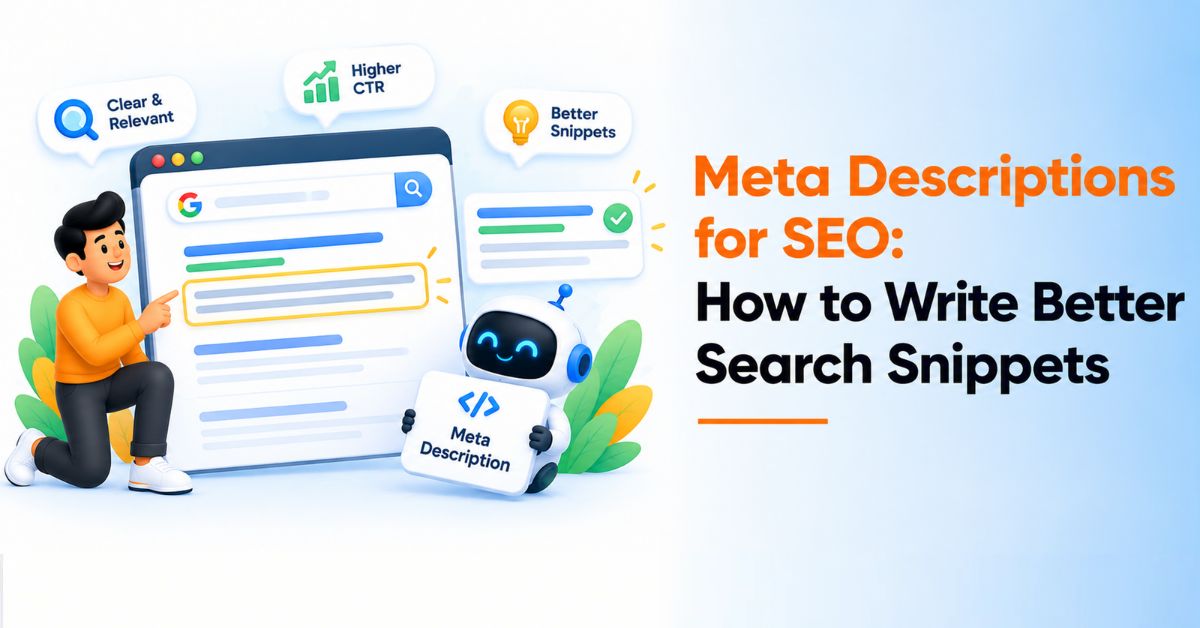
A meta description is a short HTML description that summarizes a webpage. It can appear below the page title in Google search results and helps searchers decide whether a result matches what they are looking for.
But there is an important detail many SEO guides miss: Google does not always use the meta description you write.
Google primarily creates search snippets from the content on the page. It may use your meta description when it believes that description provides a better summary for the search query. This means writing a good meta description is still useful, but it should not be treated as a direct ranking factor or a guarantee that Google will display your exact text.
So what makes a good meta description today?
It should accurately explain the page, match the search intent, give users a reason to click, and work alongside the content rather than trying to manipulate search engines.
What Is a Meta Description?
A meta description is an HTML element placed in the <head> section of a webpage.
A basic example looks like this:
<meta name="description" content="Learn how to write effective meta descriptions that accurately summarize your pages and improve the quality of your search snippets.">
Users normally do not see this text when they visit the webpage. Its main purpose is to provide search engines with a concise description of the page.
Google may use that description as the search-result snippet when it considers it useful for the user's query. However, Google can also generate a different snippet from visible page content.
This is why a meta description should not be written only for search engines. It should be written for the person deciding whether to click your result.
Do Meta Descriptions Affect SEO Rankings?
No. Meta descriptions are not a direct Google ranking factor.
Adding a keyword to your meta description does not automatically improve the ranking position of your page.
However, that does not make meta descriptions useless.
A well-written description can make a search result more relevant and appealing when Google uses it. That can influence whether a searcher chooses your result over another listing.
Think of the difference this way:
Ranking: Your page needs to satisfy Google's broader systems for relevance, quality, usability, authority, and other signals.
Search snippet: Your title and description help communicate what the page offers once it appears in search.
A good meta description cannot rescue a page that does not satisfy the search intent. But a poor or generic description can make a useful page look less relevant than it actually is.
This is also why meta descriptions should be considered part of a broader on-page SEO process, rather than an isolated optimization task.
If a page has problems with content structure, keyword targeting, internal links, technical SEO, and other on-page elements, changing the description alone is unlikely to produce a significant improvement. For websites that need broader optimization, Vefogix's Full SEO Packages cover complete on-page, technical, and off-page SEO work.
Why Does Google Rewrite Meta Descriptions?
This is one of the most important things to understand about meta descriptions.
You can write a carefully optimized description and still see completely different text in Google.
That is normal.
Google generates snippets dynamically based on the search query and the content it believes is most useful to the searcher. It may use the meta description when that description provides a better summary, but it can also select text directly from the page.
For example, suppose your page has this meta description:
Learn how to build high-quality backlinks with practical link building strategies, examples, and SEO tips.
Someone searches:
how to choose backlinks for SaaS websites
Google may decide that a paragraph on your page specifically discussing SaaS backlink relevance is more useful than the generic meta description.
The displayed snippet can therefore change based on the query.
What Should You Do About Rewrites?
Do not try to write a description that covers every possible keyword variation.
Instead:
- Write a clear summary of the actual page.
- Match the primary search intent.
- Make the page content itself highly relevant.
- Make important information easy for search engines to understand.
- Check your actual search-result snippets.
If Google repeatedly generates a different snippet, examine what text it is selecting.
That can provide a useful SEO clue.
The section of your page being selected may contain information that better matches the query. Rather than constantly rewriting the meta description, consider whether that information should be clearer or more prominent on the page.
How Long Should a Meta Description Be?
There is no fixed character limit that guarantees your description will display completely.
Google does not specify a strict maximum length for meta descriptions. Search-result snippets can be truncated depending on the available display space and device.
So instead of obsessing over an exact character count, focus on putting the most useful information near the beginning.
Weak Example
We provide the best SEO solutions for businesses looking to improve their online presence and achieve better rankings through professional digital marketing strategies.
Better Example
Compare backlink building packages by niche, country, traffic, and SEO metrics. Choose relevant publishers and find a package that fits your campaign.
The second version tells the searcher exactly what the page is about.
This approach is particularly important for commercial pages such as Vefogix backlink building packages, where users need to understand what they can compare before visiting the marketplace.
7 Meta Description Best Practices
1. Write a Unique Description for Important Pages
Do not copy the same meta description across dozens or hundreds of URLs.
A description for a link building service should explain the link building service.
A description for a guest posting marketplace page should explain the marketplace.
A description for a blog post should summarize the specific article.
Google recommends creating unique descriptions for individual pages because repeated descriptions provide little value when different pages appear in search results.
For large websites, prioritize important commercial pages first, followed by high-value informational pages.
If you are working on a website with many service or marketplace URLs, this becomes especially important because each page may target a different combination of search intent, service, niche, or location.
2. Describe What the Page Actually Provides
The description should answer one simple question:
"If I click this result, what will I find?"
For example:
Learn how to evaluate backlink quality using relevance, traffic, authority, placement, and other practical SEO factors.
This is stronger than:
Best SEO backlink services and solutions for businesses. Improve rankings, traffic, authority, and online visibility.
The second version sounds promotional but does not tell the searcher much about the page.
The same principle applies to SEO tools. If a page helps users check multiple website metrics, the description should explain what the tool does rather than simply repeating generic SEO terms. For example, a page such as Vefogix's Bulk DA PA Checker Tool should make the tool's purpose clear.
3. Match the Search Intent
The same keyword can have different types of intent.
Someone searching for:
"what is a meta description"
probably wants an explanation.
Someone searching for:
"meta description generator"
probably wants a tool.
Someone searching for:
"SEO meta description service"
may be looking for a provider.
Your meta description should reflect the actual purpose of the page.
Do not write a commercial description for an informational article simply because you want to target a commercial keyword.
The same principle applies to link building. A user researching link building strategies needs educational information, while someone searching for link building packages may be ready to compare services.
Matching the description to that intent helps set the right expectation before the click.
4. Use Keywords Naturally
Including the main keyword can make the description more closely match the searcher's query, but keyword stuffing is unnecessary.
Instead of:
Meta descriptions, SEO meta descriptions, SEO meta description best practices, meta description SEO, meta descriptions for SEO...
write something naturally descriptive:
Learn how meta descriptions work in SEO, when Google rewrites them, and how to create better search snippets that match user intent.
The page itself should provide the depth. The meta description only needs to communicate the value clearly.
5. Put Important Information Early
Search snippets can be truncated.
Place the core value proposition near the beginning rather than hiding it at the end.
For example:
Compare backlink building packages by niche, country, traffic, and SEO metrics...
is more useful than:
Vefogix provides several SEO solutions for businesses and marketers. If you are looking for different options based on your campaign requirements, you can compare backlink building packages by niche...
The important information should come first.
6. Give the Searcher a Reason to Click
A meta description should not simply repeat the page title.
Use it to add information that the title cannot communicate.
For example:
Title:
Backlink Building Packages | Vefogix
Description:
Compare backlink building packages by niche, country, traffic, and SEO metrics. Review publisher details and choose placements that fit your campaign.
The title identifies the page.
The description explains why the page is useful.
This distinction is particularly important for competitive commercial queries. If several search results have similar titles, a more specific description can help communicate what makes your page useful.
7. Keep It Accurate
Do not promise something that the page does not provide.
If your description says:
Download a free SEO audit
the page should actually provide a free SEO audit.
If the description says:
Compare 1,000+ publishers
the page should contain that option.
Misleading snippets may generate clicks, but they create a poor user experience when the visitor cannot find what was promised.
Meta Description Mistakes to Avoid
Using the Same Description Everywhere
A generic description such as:
Vefogix provides SEO services and digital marketing solutions to help businesses grow online.
does not tell users what an individual page offers.
It may be acceptable as a broad brand description, but it is weak for specific service, marketplace, and content pages.
Stuffing Keywords
A description packed with repeated keywords can look unnatural and does not provide a useful summary.
Write for the person reading the search result.
Writing a Description That Does Not Match the Page
If the page answers "how to build backlinks," the description should not mainly promote a backlink package.
Keep the description aligned with the page's actual purpose.
Likewise, a page targeting backlink building packages should explain the available packages rather than using a generic description about SEO services.
Treating the Character Count as a Hard Rule
There is no universal number of characters that guarantees a complete display.
Focus on clarity and front-load the most important information.
Writing Every Description With the Same Template
Templates can help large websites, but they should use page-specific information.
Google recommends that programmatically generated descriptions remain human-readable, diverse, and relevant to the individual page.
For websites with thousands of URLs, the goal should not be to manually write every description at any cost. The goal should be to create a system that produces useful, page-specific descriptions and then manually review important pages.
Should You Use AI to Write Meta Descriptions?
Yes, but use it as a drafting tool rather than a reason to publish hundreds of identical descriptions.
AI can quickly create first drafts for large websites, especially when descriptions are based on structured page information.
For example, an ecommerce website could generate descriptions from:
- Product name
- Product type
- Brand
- Key feature
- Price
- Availability
A marketplace could use:
- Service category
- Package type
- Niche
- Country
- Main deliverable
- Pricing information
The important part is the input.
If every page receives the same generic AI-written description, the result is simply automated duplication.
For large websites, programmatic descriptions can be useful when they are accurate, page-specific, and written in natural language.
The same rule applies to AI-generated SEO content. Automation should make optimization more efficient, not make every page sound the same.
Meta Descriptions and AI Search
Meta descriptions are also worth discussing in the context of AEO and AI search.
But there is a common misconception:
Writing a perfect meta description does not make ChatGPT, Google AI Overviews, or another AI system cite your website.
AI search systems need useful information from the underlying webpage and other available sources.
That means your priority should be the complete information architecture:
Useful content → clear page structure → strong topical relevance → supporting internal links → credible external signals
The meta description supports the search-result presentation, but it should not become the center of an AI-search strategy.
For example, if you publish an article about backlink evaluation, the article should clearly explain:
- What makes a backlink valuable
- How relevance affects link quality
- How to evaluate a publisher
- What metrics can and cannot tell you
- How to compare potential placements
The meta description can summarize that value, but the actual answers need to exist on the page.
This is also where internal linking becomes useful. A page about SEO should not exist as an isolated article. Relevant supporting pages can help users move from learning to evaluation and eventually to action.
How Meta Descriptions Fit Into On-Page SEO
A meta description is only one part of on-page optimization.
A stronger workflow looks at the entire page:
- Search intent
- Title tag
- H1
- Content structure
- Keyword and topic coverage
- Internal links
- Images and alt text
- Structured data where appropriate
- Meta description
- Page experience and technical SEO
This is why changing a meta description should not be the first response to every ranking problem.
If a page has weak content, poor internal linking, unclear search intent, or technical problems, rewriting the description alone is unlikely to solve the underlying issue.
For example, if an important commercial page is struggling to gain visibility, review its content depth, internal linking, technical accessibility, search intent, and authority before assuming the meta description is responsible.
How to Audit Meta Descriptions Across a Website
If you manage a large website, do not review pages randomly.
Start with pages that matter most to organic traffic and revenue.
Step 1: Export Your Important URLs
Start with:
- Homepage
- Main service pages
- Commercial landing pages
- Marketplace/category pages
- High-traffic blog posts
- Pages losing organic traffic
- Pages with high impressions but low CTR
Step 2: Check for Common Problems
Look for:
- Missing descriptions
- Duplicate descriptions
- Very generic descriptions
- Descriptions unrelated to the page
- Keyword stuffing
- Old offers or outdated information
- Descriptions that do not match search intent
Step 3: Compare Impressions and Clicks
A page receiving many impressions but relatively few clicks deserves closer attention.
That does not automatically mean the meta description is the problem.
The title, ranking position, SERP features, search intent, competition, and actual page relevance can all affect CTR.
But the snippet is one of the elements worth reviewing.
Step 4: Check What Google Actually Displays
Do not stop after checking the HTML source.
Search important queries and compare the description you wrote with the snippet Google displays.
If Google repeatedly selects text from another section of the page, ask why.
That text may be more closely aligned with the query.
Step 5: Improve the Page When Necessary
If the generated snippet repeatedly pulls a paragraph that better answers the query, consider whether that information should be made more prominent on the page.
This turns snippet analysis into an actual SEO insight rather than a metadata exercise.
Internal Linking and Meta Descriptions
Meta descriptions and internal links solve different problems, but they work together as part of a broader SEO strategy.
A meta description helps communicate the value of a page in search results.
An internal link helps users and search engines discover related pages once they are on your website.
For example, someone reading about meta descriptions may also be researching complete on-page SEO. A contextual link to Vefogix Full SEO Packages makes sense because the service covers broader on-page and technical work.
Someone reading about backlink-related SEO metrics may need a way to evaluate potential websites. In that context, the Bulk DA PA Checker Tool is a more relevant next step than another generic SEO article.
Likewise, when a reader moves from understanding backlinks to comparing actual placements, the Backlink Building Packages page provides a commercial next step.
The important point is context.
Do not add an internal link simply because the destination page exists. Add it when the reader would reasonably benefit from visiting that page.
A useful internal linking path might look like:
SEO information → related SEO concept → evaluation tool → service/package
This creates a stronger connection between informational content and commercial pages without turning the article into a list of promotional links.
A Simple Meta Description Formula
If you need a starting point, use this structure:
[What the page covers] + [specific benefit/information] + [useful differentiator or action]
For example:
Learn how meta descriptions work, why Google rewrites them, and how to create useful search snippets that match user intent.
For a commercial page:
Compare backlink building packages by niche, country, traffic, and SEO metrics. Review publisher details and choose placements for your SEO campaign.
The formula is only a starting point.
The final description should reflect the actual page.
Meta Description Checklist
Before publishing a page, ask:
- Is the description unique?
- Does it accurately summarize the page?
- Does it match the search intent?
- Is the main topic clear?
- Does it provide useful information beyond the title?
- Is the important information near the beginning?
- Does it avoid keyword stuffing?
- Does it avoid misleading claims?
- Does it give users a reason to visit?
- Does the page itself support what the description promises?
- Have you checked whether Google is generating a different snippet?
- Does the page have relevant internal links?
If the answer is yes to most of these questions, your meta description is doing its job.
Final Takeaway
Meta descriptions are not a magic SEO ranking lever.
They do not directly move a page from position 20 to position 5. Google can also rewrite them whenever it believes another section of the page provides a better answer for a particular search.
Their real value is more practical: they help communicate what a page offers when Google chooses to use them as part of the search snippet.
The best approach is therefore not to chase an exact character count or stuff keywords into every description.
Write unique, useful descriptions that match search intent. Make the underlying page strong enough to support the description. Monitor the snippets Google actually displays. Then improve the page based on what users and search engines are telling you.
And remember: meta descriptions are only one part of SEO. Strong content, clear page structure, useful internal links, technical accessibility, and relevant authority all contribute to how well a page performs in organic and AI-powered search.
Frequently Asked Questions
No. Meta descriptions are not a direct Google ranking factor. However, a useful description can help communicate the relevance of a search result and may influence whether users choose to click it.
There is no fixed ideal character limit. Google can truncate snippets based on available space and may generate the snippet from different parts of the page. Focus on making the description clear and putting the most important information first.
Google may generate a different snippet when it believes another section of your page better matches the user's search query. This is normal and does not necessarily indicate that your meta description is incorrect.
Important indexable pages should generally have unique, useful descriptions. This is especially important for commercial, category, service, and high-value informational pages where users may encounter several similar URLs in search results.
You can include relevant keywords naturally, but do not stuff keywords into the description. The priority should be accurately describing the page and matching the searcher's intent.
Yes. AI can be useful for creating first drafts, especially for large websites. However, descriptions should be reviewed for accuracy, uniqueness, search intent, and natural language before publishing.
They can help describe a page in traditional search, but they are not a direct method for getting cited by AI search systems. The underlying content, structure, relevance, authority, and accessibility of the webpage are more important.
Not automatically. First check what text Google is displaying and why it may be more relevant to the query. If the generated snippet consistently highlights an important section of the page, consider improving that page content rather than repeatedly changing the meta description.
It can help make a search result clearer and more compelling, but CTR depends on many factors, including ranking position, search intent, competition, the title, SERP features, and the actual relevance of the page.
There is no fixed schedule. Review them when a page's search intent, content, offer, target keyword, or business information changes. You can also review pages with high impressions but unexpectedly low clicks.