The Complete Guide to Evaluating Backlinks in 2026
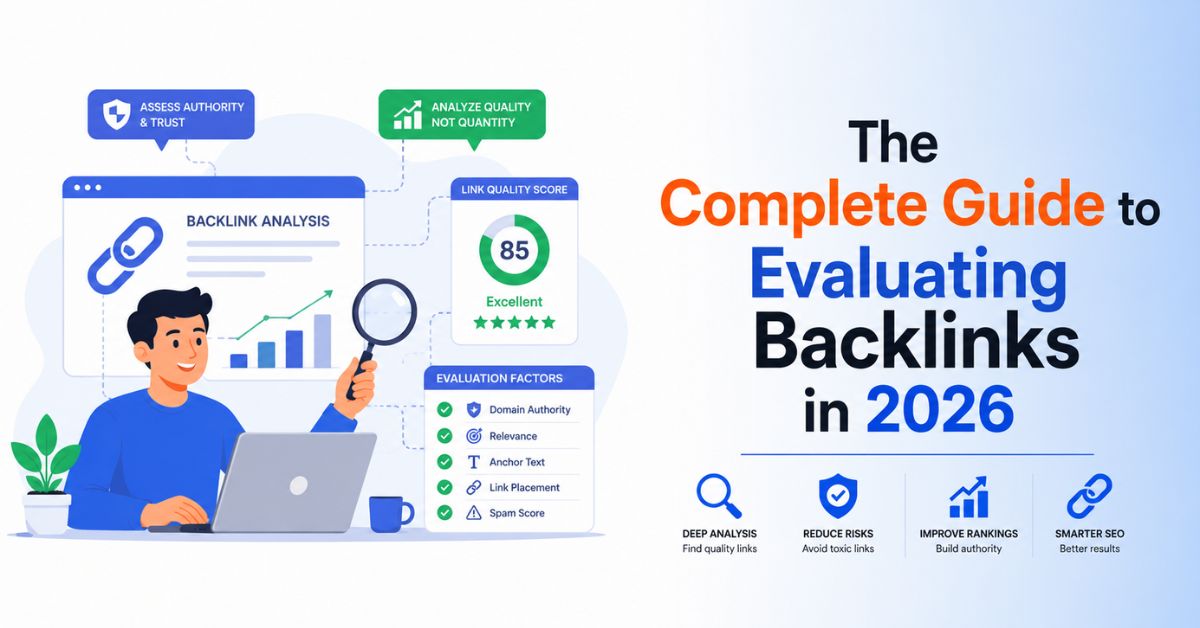
A backlink can look impressive on a spreadsheet and still provide very little value.
A publisher might have a high Domain Rating, thousands of monthly visitors, and a reasonable price. But when you look closer, the traffic may come from unrelated countries, the ranking keywords may have little connection to your niche, the linking page may not be indexed, or the website may publish large volumes of content primarily to sell links.
That is why evaluating backlinks in 2026 requires more than checking DA, DR, or traffic.
A proper backlink evaluation considers the publisher, linking page, topical relevance, organic visibility, placement, anchor text, indexing, editorial quality, risk signals, and price together.
Quick answer: A high-quality backlink generally comes from a relevant and credible website with genuine organic visibility, quality content, and a natural link placement on an indexable page. No single metric determines backlink quality.
The most useful evaluation sequence is:
What Is Backlink Evaluation?
Backlink evaluation is the process of determining whether a backlink is likely to provide meaningful SEO value, referral traffic, brand exposure, or other strategic benefits.
Instead of asking:
"Does this website have a high DR?"
ask:
"Is this a relevant, credible page on a legitimate website, and does the proposed link make sense in that context?"
That distinction matters.
A DR 70 website with declining organic traffic and thousands of unrelated commercial articles may be a weaker opportunity than a DR 40 website that consistently publishes useful content for your exact audience.
This doesn't mean authority metrics are useless. They are useful supporting signals. They simply shouldn't be the entire decision.
Why Backlink Evaluation Matters in 2026
The SEO market has become increasingly competitive, and impressive-looking metrics don't always tell the full story.
A publisher can have a strong authority score, large traffic numbers, or an attractive price while still offering a weak placement. At the same time, search has become increasingly focused on relevance, quality, context, and trust. That makes the evaluation process more important.
The goal shouldn't be to collect as many backlinks as possible. The goal should be to identify backlinks that make sense for your website, audience, and SEO strategy.
For a broader understanding of how modern link acquisition works, see Vefogix's link building services.
The 10 Factors That Determine Backlink Quality
| Factor | Importance | What to Check |
|---|---|---|
| Topical relevance | Very High | Does the site and page relate to your topic? |
| Organic traffic | Very High | Is traffic genuine and consistent? |
| Linking-page quality | Very High | Is the actual page useful and visible? |
| Editorial quality | High | Does the site publish genuine content? |
| Authority | High | DA, DR and referring-domain strength |
| Link placement | High | Is the link naturally placed in the main content? |
| Anchor text | Medium-High | Does it fit naturally? |
| Indexing | High | Is the host page accessible and indexed? |
| Publisher risk | Very High | Are there spam or manipulation signals? |
| Price/value | High | Does the opportunity justify its cost? |
Let's examine each factor in detail.
1. Check Topical Relevance First
If you remember only one thing from this guide, remember this:
Start with relevance, not DR.
Suppose you're promoting an SEO software product. You have two possible publishers.
Website A
- DR 75
- General lifestyle website
- Mostly travel, entertainment, and celebrity content
- Very little SEO coverage
Website B
- DR 45
- Marketing publication
- Regular SEO and digital marketing content
- Audience includes marketers and agencies
Website A has the bigger number. Website B may be the better contextual opportunity. Why? Because the relationship between the linking website, linking page, target page, and surrounding topic makes sense.
What to Check
Ask:
- Does the publisher cover your industry?
- Does the specific article relate to your topic?
- Does the target page solve a problem relevant to that audience?
- Does the link make sense to a reader?
- Does the publisher have genuine topical depth?
A Simple Relevance Hierarchy
Think about relevance in this order:
↓
Closely related topic
↓
Same broader industry
↓
General authority publication
↓
Completely unrelated website
The more relevant the relationship, the easier it is to justify the backlink naturally.
For more context on selecting suitable publishers, see 66 guest posting sites by niche, with DA/DR data.
2. Check Organic Traffic — But Don't Stop at the Number
Traffic is one of the most useful backlink evaluation signals, but the traffic number alone isn't enough.
A website showing 100,000 monthly organic visitors sounds attractive. But where do those visitors come from?
Check:
- Traffic trend
- Countries
- Ranking keywords
- Traffic-driving pages
- Branded vs. non-branded traffic
- Traffic concentration
- Historical changes
Publisher A
- 100,000 monthly organic visits
- 92% of traffic comes from one country
- 70% comes from two unrelated pages
- Traffic appeared suddenly
- Ranking keywords have little connection to your niche
Publisher B
- 18,000 monthly organic visits
- Consistent growth
- Hundreds of relevant keywords
- Traffic spread across the site
- Audience matches your target market
Publisher B may be considerably more useful.
Look for Consistency
A healthy traffic trend generally matters more than one impressive traffic snapshot. Look for:
- Stable traffic
- Gradual growth
- Multiple ranking pages
- Relevant keywords
- No unexplained massive spikes
- No sudden collapse
💡 Traffic quality matters more than traffic quantity.
3. Evaluate the Actual Linking Page
This is where many backlink evaluations go wrong. People evaluate the domain and forget the page.
Your backlink isn't placed on "DR 60." It is placed on a specific URL. That page has its own:
- Topic
- Content quality
- Indexing status
- Organic visibility
- Internal links
- External links
- Relevance
- Search visibility
A strong domain may have thousands of pages, while the proposed placement could be:
- Newly published
- Poorly written
- Not indexed
- Receiving no organic traffic
- Completely unrelated to your target page
That is very different from a relevant article that already has search visibility.
Page-Level Questions
Before approving a placement, ask:
- Is the page indexed?
- Does it receive organic traffic?
- Does it rank for relevant keywords?
- Is the content useful?
- Does the page have topical relevance?
- Does the link fit naturally?
- Is the page accessible to search engines?
For existing-content link insertions, page-level evaluation becomes especially important. See Vefogix's link insertion services for a deeper look at evaluating existing pages.
4. Evaluate Domain Authority and Domain Rating Correctly
DA and DR are useful metrics. But they are not quality scores.
Domain Authority
Domain Authority is a Moz metric designed to estimate a website's ability to rank.
Domain Rating
Domain Rating is an Ahrefs metric that evaluates the strength of a site's backlink profile.
Neither metric tells you:
- Whether the website is relevant
- Whether the traffic is genuine
- Whether the specific page is useful
- Whether the publisher has editorial standards
- Whether your link can generate referral traffic
- Whether the website sells excessive numbers of links
That's why authority metrics should be treated as one layer of evaluation.
For a more detailed look at authority-based link opportunities, see Vefogix's purchase backlinks marketplace.
Instead of:
DR 70 = good backlink
think:
Relevant site + real traffic + quality page + legitimate editorial environment + appropriate authority = stronger backlink opportunity
5. Compare Authority With Organic Visibility
One of the fastest ways to identify publishers that need further investigation is to compare authority with organic visibility.
| Publisher | DR | Organic Traffic | Initial Impression |
|---|---|---|---|
| A | 72 | 400 | Investigate |
| B | 48 | 18,000 | Strong candidate |
| C | 65 | 24,000 | Strong candidate |
| D | 80 | 1,200 | Investigate |
A high DR doesn't automatically mean a website is bad. However, high authority combined with extremely low organic visibility deserves investigation.
The reason could be completely legitimate. For example:
- The website is primarily brand-driven
- The niche has low search volume
- Most visitors come from referral sources
- The site is a respected publication that doesn't rely heavily on organic search
But it could also indicate:
- Expired-domain history
- Artificial link acquisition
- Deindexed content
- Manipulated metrics
- A website built primarily for selling links
The metric tells you where to investigate, not what the final answer should be.
6. Examine the Publisher's Content Quality
Open several recent articles. Don't inspect only the page being offered to you. Look at the overall publication.
Check for:
- Original content
- Useful information
- Author information
- Clear editorial structure
- Consistent publishing
- Good writing quality
- Relevant topics
- Expert contributions
- Useful internal linking
- Genuine audience focus
Now look for warning signs.
🚨 Red flags: Hundreds of unrelated niches, repetitive article templates, thin or generic content, obvious filler, large numbers of unrelated commercial articles, every article containing commercial outbound links, articles that appear created specifically to host backlinks, and extremely high guest-post publishing volume.
A publisher doesn't need to be perfect. But the website should look like a real publication first and a link-selling platform second.
7. Inspect the Link Placement
Not all placements on the same website are equal.
A backlink placed naturally inside the main body of relevant content is generally more useful than a link placed in:
- Footer
- Sidebar
- Author bio
- Sitewide widget
- Navigation
- Generic sections with little context
Strong Contextual Placement
Imagine an article explaining how SaaS companies can improve organic visibility. A sentence naturally references your SEO platform as a useful resource. That's a logical link.
Weak Placement
A completely unrelated article suddenly says:
"For more information about affordable SEO services, visit..."
The link might technically exist, but the context is weak.
Ask yourself:
Would a real reader expect this link to be here?
If the answer is yes, the placement is probably more natural.
8. Evaluate Anchor Text
Anchor text provides additional context about the linked page. But repeatedly forcing commercial exact-match keywords can make a backlink profile look unnatural.
A healthy anchor profile can contain a mixture of:
- Branded anchors
- Naked URLs
- Generic anchors
- Partial-match anchors
- Natural descriptive phrases
- Some exact-match anchors
For a deeper discussion of anchor distribution, see Vefogix's guide on how to score a backlink before buying it.
Example
Instead of forcing:
best link building services
into every placement, natural anchors could include:
- Vefogix
- this link building platform
- backlink marketplace
- SEO link building options
- learn more about link building
- Vefogix's platform
The correct anchor depends on the surrounding sentence and the broader backlink profile.
💡 Don't evaluate anchor text in isolation.
9. Verify Indexing
A backlink can't provide much search value if the host page isn't accessible to search engines.
Before purchasing a placement, check whether the relevant page is indexed. Check:
- Is the page indexed?
- Is the URL canonicalized correctly?
- Is the page accessible to crawlers?
- Does it appear in search results?
- Is it blocked by robots directives?
- Is the content substantially unique?
After publication, verify it again. A live link is not necessarily an indexed backlink.
For more detail on post-publication indexing, see Vefogix's audit of 100 backlinks and which metrics actually predicted their value.
10. Look for Publisher Risk Signals
Before buying a backlink, actively search for reasons not to buy it. This is one of the most important changes you can make to your backlink evaluation process.
Don't ask:
"Can I justify buying this?"
Ask:
"What evidence would make me reject this?"
Common Warning Signs
Extreme Niche Diversity
One website covers SEO, gambling, plumbing, CBD, fashion, cryptocurrency, medical products, and essay writing — with no obvious editorial connection.
Excessive Outbound Commercial Links
Almost every article contains links to another business.
Unnatural Publishing Volume
Dozens of generic guest posts appear every day.
Suspicious Traffic
Large traffic numbers don't match the site's content, geography, or keyword footprint.
Manipulated Metrics
Authority scores are high while other indicators are unusually weak.
Poor Content
Articles are obviously produced for search engines rather than readers.
Network Footprints
Multiple domains appear to share similar designs, similar authors, similar content, similar outbound links, and similar structures.
One signal isn't necessarily enough to reject a site. Several signals together are much more meaningful.
For a broader guide to purchasing links more carefully, see Vefogix's guide to telling a manual action apart from an algorithmic ranking drop.
Backlink Quality: A Practical 100-Point Scoring Framework
If you're evaluating dozens or hundreds of publishers, subjective judgment becomes difficult. A scoring model makes the process more consistent.
| Evaluation Factor | Points |
|---|---|
| Topical relevance | 20 |
| Organic traffic quality | 20 |
| Linking-page quality | 15 |
| Editorial quality | 10 |
| Authority | 10 |
| Link placement | 10 |
| Indexing/search visibility | 5 |
| Anchor-text suitability | 5 |
| Risk assessment | 5 |
| Total | 100 |
How to Interpret the Score
This is not a Google formula. It's a decision-making framework designed to help you compare opportunities consistently. A publisher scoring 85 isn't automatically better than one scoring 82. The purpose is to ensure that you don't get distracted by one attractive metric.
For an even more detailed scoring approach, see Vefogix's guide on how to score a backlink before buying it.
How to Compare Two Backlinks
Suppose you're choosing between two placements.
Publisher A
- DR: 70
- Organic traffic: 4,000
- Relevance: Medium
- Host page traffic: Low
- Editorial quality: Medium
- Price: $300
Publisher B
- DR: 45
- Organic traffic: 25,000
- Relevance: Very high
- Host page traffic: Strong
- Editorial quality: High
- Price: $150
If you only compare DR, Publisher A wins. If you evaluate the complete opportunity, Publisher B may be the better investment.
This is why backlink selection should be treated as a value assessment rather than a metric-shopping exercise.
How Much Should You Pay for a Backlink?
There is no universal backlink price. Cost can depend on:
- Publisher authority
- Organic traffic
- Niche
- Geography
- Editorial quality
- Placement type
- Existing page vs. new article
- Audience
- Publisher demand
- Link attributes
A $30 backlink isn't necessarily a bargain if it provides little value. Likewise, a $200 placement isn't necessarily expensive if it provides strong relevance, visibility, and editorial quality.
For a broader look at current link-building costs, see Vefogix's SEO marketplace, where pricing is shown alongside each publisher's metrics.
The Right Question
Don't ask:
"How cheap is this backlink?"
Ask:
"What am I getting for the price?"
Price should be evaluated after quality, not before it.
How to Evaluate a Backlink Before Buying It
Use this simple process before approving a placement.
| 1 | Check the niche. Does the website genuinely relate to your industry? |
| 2 | Check organic visibility. Review traffic, keywords, countries, and historical trends. |
| 3 | Check authority. Look at DA, DR, and referring-domain strength. |
| 4 | Check the actual page. Evaluate the host page rather than relying only on domain-level metrics. |
| 5 | Check indexing. Make sure the page is accessible and indexed. |
| 6 | Review recent content. Look for editorial quality and unnatural publishing patterns. |
| 7 | Inspect outbound links. Are commercial links naturally incorporated, or are they everywhere? |
| 8 | Review placement. Will your backlink appear naturally within useful content? |
| 9 | Review anchor text. Make sure it fits the sentence and your overall anchor distribution. |
| 10 | Check risk. Reject publishers with multiple suspicious signals. |
| 11 | Compare price. Only after the opportunity passes the previous checks. |
| 12 | Record the decision. For larger campaigns, keep a log of publisher, URL, niche, DA, DR, traffic, target page, placement type, anchor, price, risk score, and final decision. |
This turns backlink acquisition into a repeatable SEO process.
What About Dofollow vs. Nofollow Backlinks?
The rel attribute is another factor to record, but it shouldn't become the only quality test.
A dofollow link can come from a poor-quality website. A nofollow link can come from an authoritative publication and generate referral traffic, visibility, and brand exposure.
So don't use:
dofollow = good, nofollow = bad
as your entire evaluation framework. Instead, evaluate:
For more context, see Vefogix's guest posting services, where link attributes are reviewed as part of every placement.
Guest Posts, Niche Edits, and Other Backlinks
The evaluation principles remain similar, but the emphasis changes depending on the placement type.
Guest Posts
Evaluate: publisher, topic, article quality, placement, anchor, indexing, and editorial standards.
Niche Edits / Link Insertions
Pay particular attention to: existing page quality, page age, indexing, existing organic traffic, existing rankings, and context around the link.
Digital PR
Pay more attention to: publication reputation, audience, editorial legitimacy, brand exposure, referral potential, and citation context.
Resource-Page Links
Evaluate: whether the page is genuinely curated, relevance, existing links, page authority, search visibility, and whether your resource genuinely belongs there.
The format changes. The evaluation principle doesn't:
Does this link make sense on this page for this audience?
Common Backlink Evaluation Mistakes
Mistake 1: Choosing the Highest DR
DR is useful, but it doesn't replace relevance, traffic, or page-level evaluation.
Mistake 2: Looking at Traffic Without Checking Its Source
A large traffic number can hide poor relevance or suspicious traffic patterns.
Mistake 3: Evaluating Only the Homepage
Your backlink will usually appear somewhere else. Evaluate the actual page.
Mistake 4: Ignoring Topical Relevance
A high-authority unrelated website isn't automatically the best choice.
Mistake 5: Ignoring Outbound-Link Patterns
A publisher that links to everyone may provide less meaningful value than a selective publisher.
Mistake 6: Checking the Site Only Once
Publisher quality changes. Traffic changes. Content changes. Review important publishers periodically.
Mistake 7: Buying Based on Price
Cheap isn't automatically good. Expensive isn't automatically good.
Mistake 8: Treating Every Backlink as Permanent
Links can disappear, pages can be removed, domains can expire, and publishers can change their policies. Track your placements after publication.
How to Evaluate Backlinks After They Go Live
Backlink evaluation shouldn't end when the article is published. Create a post-publication checklist. Verify:
- Live URL
- Correct target URL
- Correct anchor
- Link attribute
- Placement location
- Page indexability
- Page indexing
- Content availability
- Publisher availability
- Traffic and ranking changes
Then monitor the link over time. A backlink that looked excellent on day one can become less useful if the article is removed, the page loses visibility, the domain loses traffic, the link is changed, the page becomes inaccessible, or the publisher changes its editorial practices.
This is why backlink management is an ongoing process rather than a one-time purchase.
A 5-Minute Backlink Evaluation Checklist
If you don't have time for a full 100-point analysis, use this quick version.
Publisher
- Relevant niche
- Genuine website
- Consistent organic traffic
- Reasonable authority
- Quality recent content
Page
- Relevant topic
- Indexed
- Organic visibility
- Useful content
- Natural place for your link
Link
- Contextually relevant
- Natural anchor
- Appropriate link attribute
- Main-content placement
- Correct target URL
Risk
- No obvious PBN footprint
- No excessive unrelated niches
- No suspicious traffic
- No excessive commercial outbound links
- No obvious link-farm behavior
Value
- Price matches quality
- Publisher fits campaign goals
- Potential referral value
- Reasonable long-term opportunity
If a publisher fails several of these checks, don't let one impressive DR number convince you otherwise.
The 2026 Backlink Evaluation Framework
Ultimately, evaluating backlinks comes down to five questions.
1. Is the Website Relevant?
Does the publisher belong in the same topical ecosystem as your brand?
2. Is the Website Real?
Does it have genuine content, audience signals, organic visibility, and editorial activity?
3. Is the Page Valuable?
Does the actual page have quality, relevance, and search visibility?
4. Does the Link Make Sense?
Would a real reader understand why the link exists?
5. Is the Opportunity Worth the Price?
Does the total value justify what you're paying?
If the answer to all five is yes, you probably have a strong backlink opportunity.
If the only answer is:
"It has DR 70."
keep looking.
Final Takeaway
Backlink evaluation in 2026 is no longer about finding the website with the biggest number. It's about understanding the relationship between authority, relevance, organic visibility, page quality, placement, context, and risk.
A strong backlink usually has several things working together: relevant publisher + genuine visibility + quality page + natural placement + appropriate anchor + legitimate editorial environment.
That's a much better definition of backlink quality than simply saying "get high-DA backlinks."
The goal isn't to collect as many backlinks as possible. The goal is to identify backlinks that are actually worth acquiring.
So before spending your link-building budget, don't start by asking "how many backlinks can I buy?" Start by asking: "Which backlinks are actually worth buying?"
Frequently Asked Questions
Topical relevance and genuine organic visibility are two of the most important factors. A backlink from a relevant site with real search visibility can be more useful than a link from a higher-authority but unrelated website.
Neither should be treated as the definitive quality metric. DA and DR are useful authority indicators, but they should be evaluated alongside relevance, organic traffic, page quality, indexing, placement, and editorial standards.
Check the publisher's niche, organic traffic, traffic trend, authority, content quality, linking page, indexing status, link placement, anchor text, and risk signals. Then compare the total quality against the price.
No. A high DR doesn't guarantee relevance, traffic, or editorial quality. A lower-DR publisher with strong topical relevance and genuine organic visibility may be a better opportunity.
Check both, but don't ignore the linking page. The domain gives you a broader picture of the publisher; the specific page tells you more about the actual environment where your backlink will appear.
Look for combinations of warning signs such as extremely low organic traffic relative to authority, unrelated niches, excessive commercial outbound links, poor content, unusual traffic patterns, mass guest-post publishing, and obvious network footprints.
No. Price is a commercial variable, not a quality score. A cheap backlink can be excellent, and an expensive backlink can be poor. Evaluate the publisher and placement first, then decide whether the price makes sense.
Yes. Verify that the link remains live, points to the correct page, has the expected attribute, and that the host page remains accessible and indexed. Ongoing monitoring helps identify removed or changed placements.