Is SEO Still Worth It in 2026? Stats, ROI & Why Link Building Still Matters
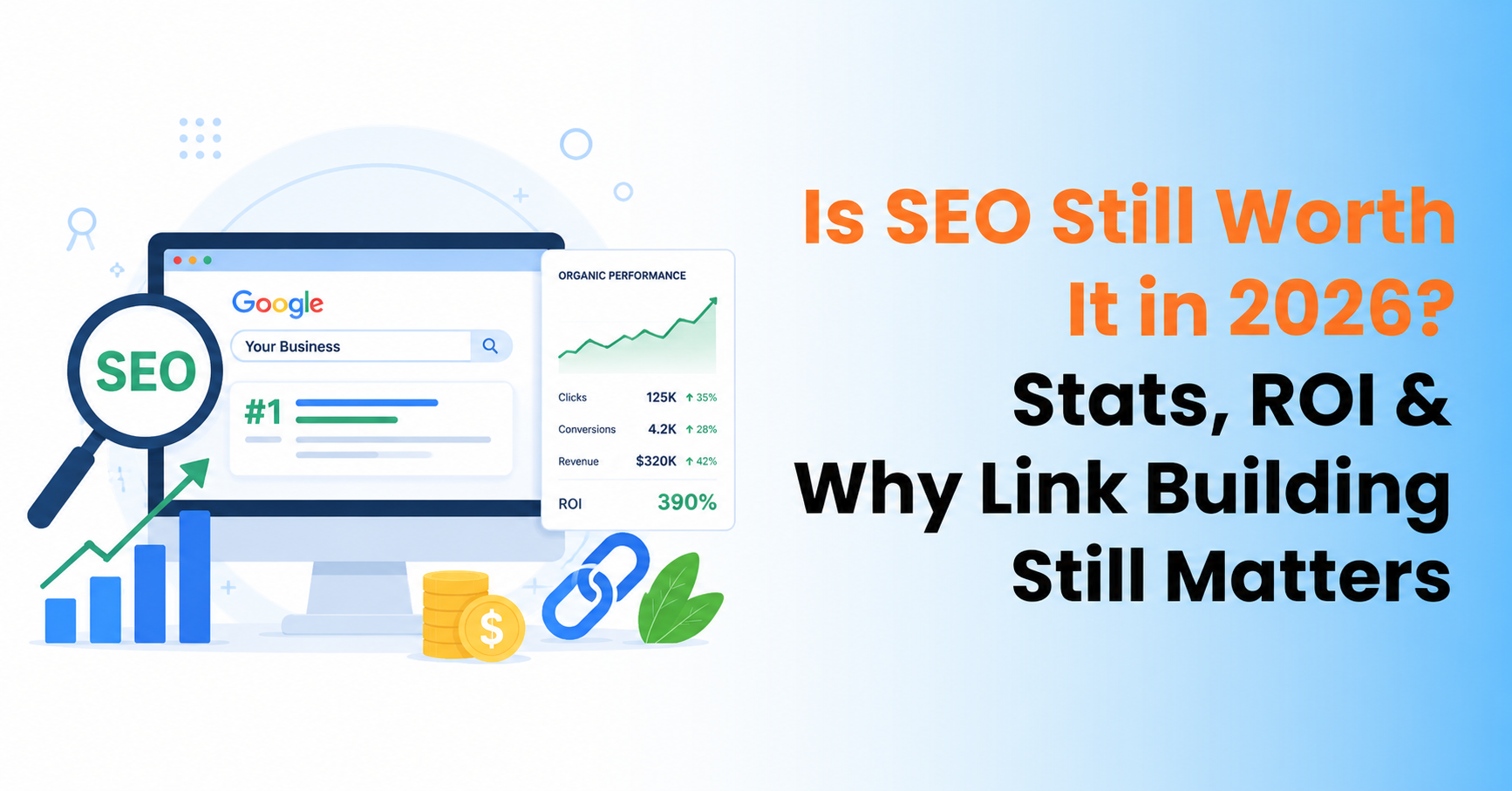
The short answer is yes, with sharper conditions than before.
SEO is still worth it in 2026. The global SEO services market is on track to exceed $83 billion this year. Organic search still accounts for over 50% of average website traffic. And 49% of marketers rank it as the highest-ROI channel they use.
What has changed is the cost of doing it poorly. AI-generated content has flooded the web. Editorial standards for link placements have tightened. Google's algorithm evaluates signals that mediocre content simply can't satisfy. The businesses winning at SEO in 2026 are not doing more, they're doing it with more precision.
Here is what the data actually says.
SEO ROI: What the Numbers Show in 2026
SEO delivers strong, compounding returns but not quickly.
SEO generates an estimated 8x return on investment, roughly twice that of paid search advertising, according to SeoProfy's 2026 industry analysis. The performance varies heavily by sector, but the baseline efficiency over paid media remains undisputed:
|
Industry Sector |
Average SEO ROI |
Key Timeline Benchmark |
|
B2B SaaS / Tech |
702% |
Highest long-term yield; drives 44.6% of all B2B revenue |
|
317% |
9-month average break-even window; accounts for 43% of traffic |
|
|
General B2B Services |
8x (800%) |
Generates roughly double the ROI of PPC/Paid Search |
The catch is the timeline. SEO compounds rather than spikes. A business that starts today should expect meaningful traction in months 4–6, measurable ROI by month 9–12, and sustained growth that outperforms paid channels from year two onward. Anyone promising results faster than that is either selling you something or running tactics that Google will penalize.
Organic Search Traffic in 2026: Still the Dominant Channel
Despite years of predictions about SEO's death, organic search remains the largest source of traffic for most websites.
Organic traffic accounts for approximately 53% of all web traffic on average. The first-position result on Google captures 39.8% of all clicks for a given query. The number-one result is ten times more likely to receive a click than the page in position ten.
AI-generated search results have introduced some nuance. Google AI Overviews do reduce click-through rates for the queries they appear in dropping average CTR from 1.41% to 0.64% in affected searches, per Charle Agency data. But 63% of marketers report that AI Overviews have actually had a positive net effect on their overall organic visibility and rankings, because the content that gets featured in AI Overviews and the content that ranks on page one are largely the same content.
The data point that matters most: 76.1% of URLs cited in Google AI Overviews also rank in Google's top 10 organic results. Ranking well in traditional SEO is still the clearest path to appearing in AI-driven answers.
Why Link Building Still Matters A Lot
Backlinks remain a top-3 Google ranking factor in 2026. Google has confirmed this publicly and the correlation data backs it up.
Pages ranking in Google's top 10 have 3.8 times more backlinks than pages ranked below them. The top organic results average 2,418 backlinks. Among the top 100 ranking websites in any given category, 92.3% have at least one backlink. Pages with 30 to 35 backlinks generate more than 10,500 visits per month on average, according to uSERP research.
The less discussed stat: 95% of all web pages have zero backlinks. That is not a warning sign it is a competitive opening. The majority of published content earns nothing because its creators do not pursue links systematically.
Eight out of ten SEO professionals predict links will remain a ranking factor a decade from now. The signal has proven durable across every major algorithm update since PageRank's introduction.
How Link Quality Has Shifted
Volume-based link building is a liability in 2026. Quality has always mattered, but the gap between high-quality and low-quality links has widened considerably.
Among SEO professionals, 93.8% now prioritize link quality over quantity. A survey of 518 SEO experts by Editorial.link found that in-house SEO teams allocate 36% of their total SEO budget specifically to link building a signal of how seriously practitioners treat it.
The most effective link building method in 2026 is digital PR, used by 67.3% of marketers and rated the most effective tactic by 48.6% of SEO professionals. Guest posting comes second at 16%. Creating linkable assets original research, data studies, free tools, and calculators comes third at 12%.
The number of unique referring domains correlates with rankings more strongly than the total number of backlinks. Domain diversity links from many different sites, not many links from one site is a stronger positive signal. Content exceeding 3,000 words attracts 3.5 times more backlinks than shorter articles. Posts with more than three embedded videos draw 55% more backlinks.
What Link Building Costs in 2026
Link building costs have risen significantly and are still climbing.
The average cost per quality backlink is now $508.95, according to Editorial.link's 2026 survey. Niche edits and link insertions average $361.44. Link building costs overall have increased 20 to 35% since 2022. The primary driver is AI content saturation: more content is competing for fewer editorial slots, pushing up the price per placement.
Editorial rejection rates have risen 33% since 2023. Editors are receiving more AI-generated pitches and are responding with more skepticism which means human-quality, differentiated content now earns a premium.
The budget framework that emerges from the data: companies spending more than $4,000 per published post are 2.6 times more likely to rate their content strategy as "very successful." The investment required to compete in link acquisition has gone up, but so has the value of the links earned, because fewer competitors can afford to do it consistently.
Domain Authority, Backlink Services, and What to Look for
Domain Authority (DA) and Domain Rating (DR) are not direct Google ranking factors but they are useful proxies for a site's link profile strength. Among SEO professionals, 64.1% use Ahrefs' DR metric as their preferred domain authority measure, with SEMrush’s Authority Score a distant second at 15.4%.
When evaluating professional SEO services or link building agencies, three signals matter:
1. They focus on relevance, not just authority.
A link from a DR 40 site in your exact industry beats a DR 70 link from an unrelated domain every time. Any agency that leads with volume or domain authority scores without discussing topical relevance is selling you the wrong thing.
2. They use white hat link building methods exclusively.
White hat link building means earning links through legitimate content placement, digital PR, and genuine editorial relationships not link farms, private blog networks (PBNs), or paid-link schemes that Google's Spam Brain detects and penalizes. The distinction between white hat link building services and black hat alternatives is not subtle: one builds lasting authority, the other builds risk.
3. They measure results in traffic and rankings, not just links.
Any SEO link building package worth buying will tie deliverables to measurable outcomes. A high-quality backlink service should be able to show which placements moved the needle on target keywords, not just deliver a report of URLs.
SEO Content Marketing: The Link and the Traffic Work Together
Content marketing and link building are not separate strategies in 2026 they are the same strategy executed at two levels.
Content earns links. Links boost content's rankings. Rankings drive traffic. Traffic generates leads and revenue. The flywheel only works when both sides are funded. Businesses that invest in SEO content marketing but ignore link building plateau. Businesses that build links without investing in content quality earn links that decay in value because the destination pages do not convert or retain rankings.
B2B companies publishing nine or more blog posts per month increase organic traffic year-over-year by 35.8%, compared to 16.5% for companies publishing one to four posts monthly, per StrataBeat data. Companies offering original research on their websites grow organic traffic by 29.7% on average versus 9.3% for those that do not.
The content marketing services investment that outperforms in 2026 is long-form original research combined with a targeted digital PR outreach campaign. This combination earns editorially placed backlinks from authoritative domains, generates AI citation visibility, and builds topical authority over time.
Is SEO Worth It for Small Businesses?
The data is consistent: yes, with realistic expectations on timeline and investment.
74% of small businesses invest in SEO, with average monthly service costs of $497. That budget is on the lower end of what produces measurable results agencies typically show meaningful progress starting at $1,500 to $3,000 per month for competitive niches. SEO-generated leads close at a 14.6% rate, compared to 1.7% for outbound channels like print or cold outreach. The quality of inbound organic traffic is categorically different from paid traffic.
For small businesses, the most efficient path is a focused content and link strategy aimed at a specific niche rather than trying to compete against high-DA incumbents across broad keywords. Owning 15 long-tail keywords in a niche with clear purchase intent delivers more revenue than chasing two head terms dominated by national competitors.
The Bottom Line
SEO is worth it in 2026 but only when done with precision. The market has self-selected against low-effort execution. AI content saturation has driven up editorial standards and link costs. Google's algorithm is better than it has ever been at rewarding genuine authority and penalizing shortcuts.
The businesses compounding organic growth right now are investing in professional SEO services that combine technical optimization, high-quality content, and systematic white hat link building. They treat SEO as infrastructure, not advertising something that appreciates in value rather than goes dark the moment spend stops.
Is SEO still worth it in 2026? The $83 billion industry, the 53% traffic share, and an 8x ROI say the same thing: it is the most durable growth channel in digital marketing. The question is not whether to invest it is whether you are investing with enough precision to compete.
vefogix
Frequently Asked Questions
Yes. SEO delivers an estimated 8x ROI twice that of paid search. Organic traffic accounts for over 50% of average website traffic, and 49% of marketers rank it the highest-ROI digital marketing channel.
Yes. Google has confirmed backlinks remain a top-3 ranking signal. Top-ranking pages have 3.8x more backlinks than pages ranked 2–10. Quality and relevance matter far more than raw link count.
Most businesses reach positive ROI within 6 to 12 months of a sustained SEO campaign. Ecommerce SEO shows a 317% ROI with a nine-month average break-even window, according to First Page Sage.
The average cost per quality backlink is $508.95, according to a 2026 survey of 518 SEO professionals by Editorial.link. Costs are up 20–35% since 2022, driven by AI content saturation increasing editorial competition.
Digital PR is the top method used by 67.3% of marketers and rated most effective by 48.6% of SEO professionals, well ahead of guest posting at 16%.
Yes. 76.1% of URLs cited in Google AI Overviews also rank in Google's top 10. Strong SEO particularly authoritative backlinks and E-E-A-T-aligned content drives visibility in both traditional and AI-generated results.