How to Build Local SEO Pages That AI Search Can Understand
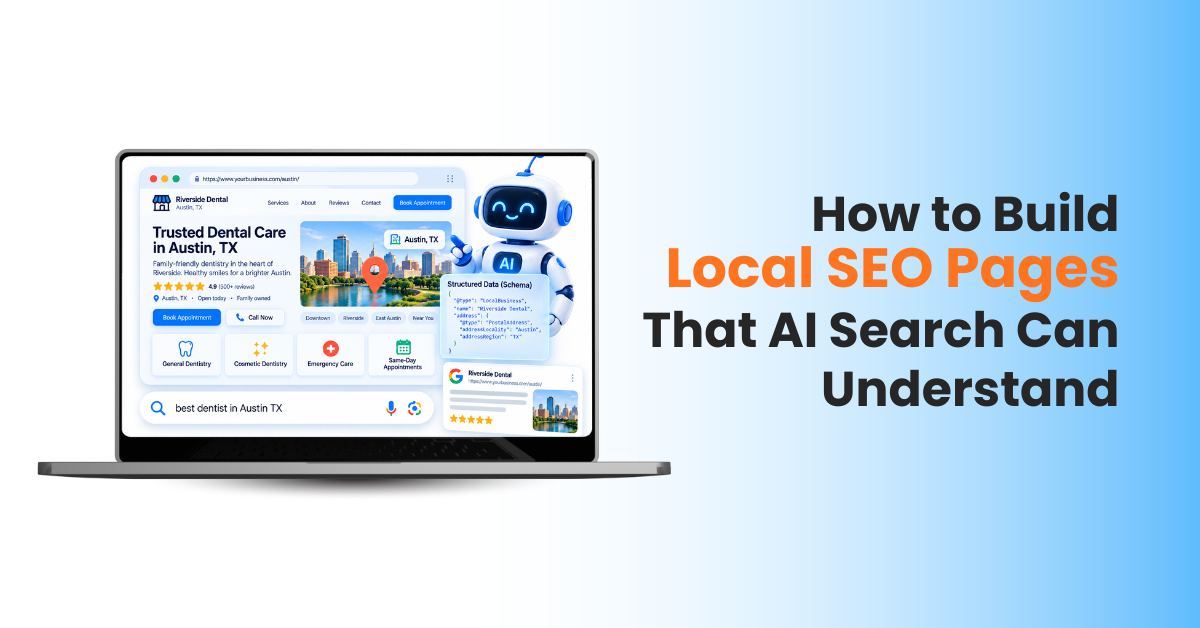
Local search is no longer limited to ranking a business in Google's local results.
People now ask AI-powered search tools questions such as:
- Which SEO company serves businesses in my city?
- Who provides local SEO for small businesses?
- Which provider offers SEO services in Jaipur?
- What local SEO services are available for a new business?
- Which provider has experience with businesses in my industry?
The challenge is that AI systems need more than a page containing a city name and a list of services. They need clear, accessible, and consistent information that helps them understand who the business is, what it does, where it operates, and why it is relevant to a particular search.
This makes the quality and structure of local SEO pages increasingly important for both traditional search and AI-driven discovery.
What Is an AI-Ready Local SEO Page?
An AI-ready local SEO page is a location-focused page that clearly explains a business's services, geographic coverage, expertise, customer needs, and supporting evidence in a format that both people and search systems can understand.
A strong page should make these questions easy to answer:
- What business is this?
- What service does it provide?
- Which locations does it serve?
- Which customers does it serve?
- What makes the service relevant to this location?
- What evidence supports the claims?
- What questions do local customers commonly ask?
The goal is not to write pages specifically for AI systems. Instead, create useful local content that is easy for search engines, AI systems, and users to interpret.
1. Make Sure Search Crawlers Can Access the Page
Before improving the copy, make sure the page can actually be discovered and processed.
Check:
- robots.txt rules
- noindex directives
- canonical tags
- XML sitemaps
- internal links
- server responses
- security or firewall rules
- JavaScript-dependent content
- Cloudflare or other crawler controls
A well-written location page cannot contribute to search visibility if important content is blocked from crawlers.
The same principle applies to AI search. If relevant information is unavailable in the page's accessible HTML, an AI system may have little usable information to extract. Understanding how AI crawlers access and process website content is therefore an important part of building search visibility.
2. Give Every Location Page a Real Purpose
Creating 100 pages by changing only the city name is not a local SEO strategy.
For example, these pages are unlikely to provide much additional value if their content is almost identical:
- Local SEO Services in Delhi
- Local SEO Services in Mumbai
- Local SEO Services in Jaipur
- Local SEO Services in Pune
A useful location page should contain information that is genuinely relevant to that market.
You can include:
- services available in the location
- industries commonly served
- local customer requirements
- areas or regions covered
- location-specific FAQs
- relevant case studies
- local testimonials
- service availability
- pricing or package information where appropriate
- relevant local business or industry context
The city name should not be the only thing that changes.
3. Clearly Connect the Business With the Location
AI systems need to understand entities and relationships.
Instead of repeatedly writing:
We provide SEO services and help businesses grow.
Use clearer language where it matters:
Vefogix connects businesses with freelancers offering local SEO services, citation building, link building, and other digital marketing services.
The business or marketplace should be explicitly named when discussing important facts such as:
- services
- locations
- pricing
- specialties
- marketplace categories
- customer types
This creates clearer relationships between the brand, service, and location.
You do not need to repeat the brand name in every paragraph. Use it naturally in the sections where entity identification matters most.
4. Add Information Customers Actually Ask
Local pages should answer real questions, not just target keywords.
Think beyond:
“local SEO services in Delhi”
A potential customer may actually ask:
- Do you provide local SEO for small businesses?
- Can I hire a freelancer for Google Business Profile optimization?
- Do you offer citation building?
- Can I target multiple cities?
- How long does local SEO take?
- Can local SEO improve Google Maps visibility?
- What information is needed to optimize a local business listing?
- Can I hire someone for a single location?
- Do you support businesses with multiple locations?
These questions are useful for traditional search and conversational AI search queries.
They also give you opportunities to explain the service clearly instead of filling a page with location-based keyword variations.
5. Put Important Information in the HTML
Do not hide critical business information inside elements that require additional JavaScript rendering.
Important information should be present as readable page content, including:
- business name
- service description
- location
- service areas
- pricing
- opening hours where relevant
- reviews or ratings
- credentials
- FAQs
- contact information
- customer evidence
For example, if reviews are displayed only through a third-party widget, the information may not be as accessible as text written directly on the page.
The same applies to service descriptions, location coverage, and important business claims.
Making important information accessible as text can also support broader brand visibility in AI search, because search systems need usable information to understand a business and its services.
6. Keep Business Information Consistent
Local SEO depends heavily on consistency.
Check that important information matches across your website and external business profiles:
|
Information |
Website |
Business Profile |
Directories |
Schema |
|
Business name |
✓ |
✓ |
✓ |
✓ |
|
Address |
✓ |
✓ |
✓ |
✓ |
|
Phone number |
✓ |
✓ |
✓ |
✓ |
|
Website |
✓ |
✓ |
✓ |
✓ |
|
Services |
✓ |
✓ |
✓ |
✓ |
|
Business hours |
✓ |
✓ |
✓ |
✓ |
|
Locations served |
✓ |
✓ |
✓ |
✓ |
An old phone number on an archived page or outdated address inside structured data can create conflicting signals.
This is particularly important for businesses that have moved, changed phone numbers, expanded their service areas, or redesigned their websites.
Local SEO also depends on the accuracy of information published outside your own website. Keeping local citations consistent can help maintain a clearer picture of the business across different sources.
7. Use Structured Data as a Consistency Layer
Structured data can help search systems understand what information on a page represents.
For local businesses, relevant schema can include details such as:
- business name
- address
- telephone
- URL
- opening hours
- service area
- business type
The important part is maintenance.
If the visible page says one phone number while the structured data contains an old number, the markup becomes another source of conflicting information.
Treat schema as part of the website's business information management process rather than something that is added once and forgotten.
8. Use Reviews as Content Research
Reviews can reveal questions and concerns that generic keyword research misses.
Look at positive and negative reviews for businesses competing in the same market.
You may discover recurring concerns such as:
- slow response times
- unclear pricing
- poor communication
- limited service areas
- appointment delays
- lack of industry experience
- difficulty contacting support
If your business genuinely addresses one of these concerns, explain that clearly on the relevant page.
For example:
Local SEO specialists can review your existing business listings, identify inconsistent information, and provide a report of the changes required.
Specific statements are more useful than vague claims such as “we provide the best local SEO services.”
9. Build Local Authority Beyond the Location Page
A local landing page should not exist in isolation.
Support it with relevant content and external references.
For example, a local SEO section can connect to:
- local citation building
- Google Business Profile optimization
- link building services
- guest posting
- AI search visibility
- local SEO marketplace services
Internal links help users move from educational content to relevant services. They also help search engines understand how related pages fit within the site's overall topic structure.
For businesses looking to strengthen authority beyond local landing pages, link building services can provide another way to build relevant references to important pages.
Relevant guest posting can also support broader content and authority-building strategies when placements are genuinely relevant to the business and audience.
10. Avoid Thin City Pages
One of the biggest risks with local SEO at scale is creating dozens or hundreds of pages that provide little unique value.
A useful test is:
If the city name were removed, would this page still contain meaningful information about the location?
If the answer is no, the page probably needs more work.
A good local page should demonstrate why the business is relevant to that market.
That could come from:
- local customer questions
- actual service availability
- location-specific examples
- local industry knowledge
- unique testimonials
- market-specific FAQs
- genuinely different service information
Do not create a page for every city simply because a keyword tool shows search volume.
11. Connect Local SEO With AI Search Visibility
Traditional local SEO and AI search optimization should not be treated as separate strategies.
The same fundamentals support both:
Clear entity information → accessible pages → consistent business data → useful local content → customer evidence → structured information → relevant external references
AI search adds another reason to make this information explicit.
A person may understand that “we” refers to the company. A search system has to determine what entity “we” represents.
That is why clear wording matters.
Instead of:
We help businesses improve their local visibility.
Use:
Vefogix connects businesses with local SEO freelancers who can help improve business listings, citation consistency, link building, and local search visibility.
The second statement gives the reader and search systems more context.
Local SEO Page Checklist
Before publishing a location page, check the following:
Technical
- Is the page indexable?
- Is it included in the appropriate sitemap?
- Can important content be read without client-side JavaScript?
- Is the canonical URL correct?
- Are there duplicate or outdated versions of the page?
Content
- Does the page provide genuinely local information?
- Is the service clearly explained?
- Does the page answer real customer questions?
- Are important claims supported by evidence?
- Is the business name used where entity clarity matters?
- Does the page avoid unnecessary keyword repetition?
Local signals
- Is the business information accurate?
- Are service areas clearly stated?
- Are address and phone details consistent?
- Are relevant reviews or testimonials included?
- Are local citations accurate?
AI and AEO
- Can an AI system easily identify the business?
- Can it understand the service?
- Can it identify the location served?
- Are pricing and service details stated clearly?
- Are FAQs written around genuine customer questions?
- Is important information available as text?
Final Takeaway
Local SEO is becoming less about creating a page that simply contains a city name and more about building a reliable source of information about a business and its service area.
The strongest local pages make the relationship between business, service, location, customer need, and supporting evidence easy to understand.
That approach also creates a better foundation for AI search.
Instead of asking only, “How can this page rank for a local keyword?”, ask a broader question:
“If an AI system had to describe this business and recommend its service in this location, does this page give it enough accurate information to do that?”
If the answer is yes, the page is doing more than targeting a local keyword. It is becoming a useful, structured source that can support both traditional search and AI-driven discovery.
Frequently Asked Questions
An AI-ready local SEO page clearly explains a business, its services, locations, customers, and relevant local information. It uses accessible content, consistent business details, structured data, and useful answers so both search engines and AI systems can understand the page.
AI search systems need clear information to identify businesses and connect them with specific services and locations. A well-structured local page gives these systems more context when processing location-based searches and recommendations.
Start with accurate business information, clear service and location details, useful local content, relevant FAQs, internal links, structured data, and consistent information across your website and business listings. Avoid creating pages that only replace the city name while keeping the rest of the content unchanged.
Not necessarily. Create separate location pages when there is a genuine reason to target that location and you can provide useful, location-specific information. Creating large numbers of nearly identical city pages can result in thin or repetitive content.
A useful local page can include the service offered, location or service area, customer needs, relevant industries, local FAQs, testimonials, pricing information where appropriate, contact details, and supporting evidence. The exact information should depend on the business and search intent.
Structured data can help search systems understand information such as a business's name, address, phone number, website, business type, and other relevant details. It should match the visible information on the page and be kept up to date.
Reviews can reveal the questions, concerns, and experiences customers associate with a business or service. Businesses can use these insights to create more useful local content and address genuine customer concerns, provided they do not manufacture or misrepresent customer experiences.
A local landing page provides useful information about a service and its relevance to a specific location. A doorway-style page generally provides little unique value and exists mainly to capture searches for different locations. The focus should be on creating pages that serve a genuine user need rather than producing pages solely for keyword coverage.