Why Smart Agencies Outsource Link Building and PR Instead of Hiring In-House
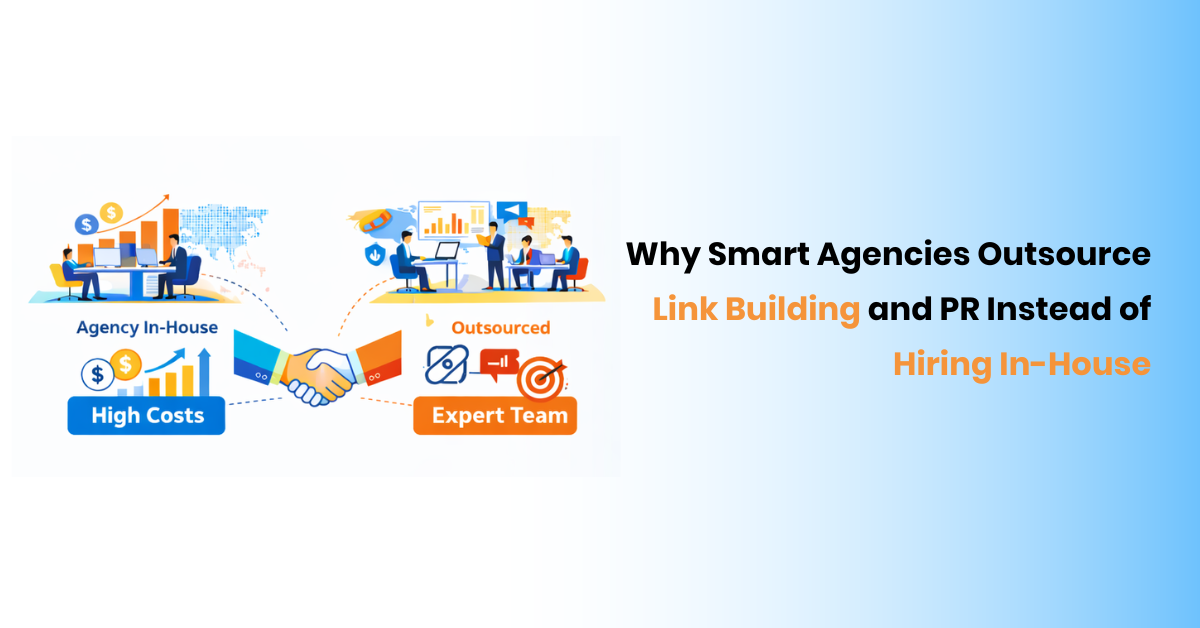
Hiring for link building and PR sounds like the right move. You want control. You want standards. You want someone accountable in the building.
Until you're three months in, burning payroll, chasing writers, retraining outreach reps after the last one left, and still explaining to clients why rankings haven't moved.
We've watched this play out across dozens of agencies at different growth stages. The failure mode is consistent: agencies don't collapse because they lacked talent. They fail because they scaled the wrong function the wrong way at the wrong time.
Here's what the data from our own reseller network shows: agencies that outsource link building and PR through structured white-label arrangements consistently deliver client results faster, at lower cost-per-outcome, and with significantly less internal management overhead than those who hire in-house — especially when client demand fluctuates month to month, which it almost always does.
This guide breaks down why that's true, where the traps are, and how to set up an outsourced link building arrangement that actually holds up.
The Real Cost of Building an In-House Link Team
On paper, an in-house hire feels like control. You own the process, you set the standards, you can course-correct in real time. The logic is sound.
The math usually isn't.
You're not just paying a salary. You're paying for Ahrefs or Semrush seats, prospecting databases, outreach software like Pitchbox or Mailshake, training time, and the 60–90 day ramp-up period before a new link builder produces at a level that actually serves your clients. That's if you hired correctly on the first attempt.
We've watched agencies hire two outreach executives, lose one within six months to a better offer, restart the hiring process, and absorb three months of deliverable gaps while clients escalated. The clients didn't pause. The Google algorithm didn't pause. The internal churn was invisible to everyone except the agency owner absorbing it.
The real numbers for a mid-sized agency:
|
Cost Category |
Estimated Annual Cost |
|
Link builder salary (mid-level) |
$45,000–$65,000 |
|
SEO tooling (Ahrefs, Semrush, etc.) |
$3,000–$6,000 |
|
Outreach software |
$2,000–$4,000 |
|
Training and onboarding |
$3,000–$8,000 |
|
Management overhead (% of a senior hire) |
$10,000–$20,000 |
|
Turnover cost if hire leaves within 12 months |
$15,000–$25,000 |
|
Total range |
$78,000–$128,000/year |
A structured white-label link building arrangement through a vetted provider typically costs $1,500–$6,000 per month depending on volume — with zero tooling overhead, zero training cost, and zero management requirement beyond reviewing deliverables.
The in-house model only becomes cost-competitive when link building volume is high enough, consistent enough, and specialist enough to justify full-time dedicated headcount. Most agencies aren't there — and the ones that are usually already have hybrid models with outsourced components handling overflow.
Why Link Building Specialization Is Harder Than It Looks
Link building in 2026 is not mass email outreach and guest post swaps. It's relationship-driven, niche-aware, quality-focused work that changes continuously as Google's quality systems evolve.
The March 2026 core update specifically targeted low-relevance placements and sites with manipulative link patterns — outreach strategies that passed quality checks 18 months ago now produce links that actively harm the profiles they're placed on. Teams that do link building full-time stay ahead of spam filter changes, evolving editorial standards, and publisher fatigue. Teams that split their attention between link building and five other deliverables don't.
The specific skills that make link building work at a high level — publisher relationship management, anchor text strategy, topical relevance judgment, profile-level risk assessment — take years to develop. And they're skills that compound through volume: a specialist running 50+ campaigns a year develops pattern recognition that an in-house generalist running 3–5 campaigns a year simply doesn't accumulate at the same rate.
This is the same reason most agencies already use specialized platforms for reporting, analytics, and technical SEO tooling. Outsourcing link building execution to specialists who do nothing else follows the same logic — you're accessing expertise that would take years and significant resource investment to develop internally. For a full breakdown of what specialist-level link building evaluation looks like, see our guide to choosing a link building service.
Why Outsourcing Actually Gives You More Control (Not Less)
This is counterintuitive, but it holds up in practice.
With a structured link building service package, every deliverable is defined before work begins: number of placements, site quality thresholds, DR and traffic minimums, turnaround windows, reporting format, and escalation process when something doesn't meet spec. That specificity is often more defined than internal processes where standards exist in people's heads rather than documented agreements.
The control you lose with outsourcing is physical presence — someone in your building who you can tap on the shoulder. The control you gain is contractual clarity: defined outputs, defined quality standards, and a provider who is accountable to those outputs in a way that an employee isn't.
You also gain the flexibility that in-house staffing structurally cannot provide. When a client account scales from 10 links per month to 35 because of a competitive push, you adjust an order. You don't post a job listing, interview candidates, negotiate an offer, and wait 60 days. That flexibility is worth significantly more than the physical proximity of an in-house hire when client demand is variable — which it always is.
Speed to Client Results Matters More Than Internal Ownership
Clients don't pay agencies to build internal departments. They pay for ranking movement, traffic growth, and lead volume. The mechanism by which those outcomes are achieved is largely invisible to them — and rightly so.
Outsourced link building teams are already trained, already publishing, already managing publisher relationships, already pitching. There's no ramp-up period charged to a client's timeline. For agencies where a new contract depends on demonstrable progress in the first 60–90 days, that speed differential is the difference between a renewed contract and a churned one.
A concrete example from our reseller network: a regional marketing agency brought on a home services client competing against a national brand with an 8-year domain authority advantage. Instead of hiring internally and absorbing a 90-day ramp-up, they plugged into a specialist outsourced link building arrangement and began placements in week two. Four months later the client outranked the national competitor on three high-intent local keywords — while the national brand was outspending them on paid by a factor of five.
That outcome required speed. Speed required specialist execution already in motion. Internal hiring would have cost the client the first quarter of results and likely the contract.
Why PR and Link Building Need to Work Together — and Why That's Hard In-House
Modern PR is authority building, not just brand coverage. A well-executed press release that gets picked up by three relevant trade publications earns three editorial backlinks from sources that Google treats as genuine endorsements — not links placed in exchange for content.
But PR outreach and SEO link building require genuinely different skills. Journalists don't respond to the same outreach that works with blog editors. They respond to relevance, timing, a news angle that serves their audience, and a pitch that demonstrates the author has read their publication. Templated SEO outreach sent to journalists produces silence or, worse, public mockery from journalists who share bad pitches on social media.
Trying to hire one person to "do SEO and PR" produces mediocre results in both directions. The skills required are different, the relationships are different, the timing considerations are different, and the measurement frameworks are different. Specialist teams — those who do press release distribution and media outreach full-time — have the journalist relationships, editorial calendar awareness, and pitch craft that can't be replicated by an SEO specialist asked to stretch into earned media.
The agencies that do this well run coordinated campaigns where link building builds foundational authority and PR earns high-authority editorial links from publications their target audience already reads. Both feed into the same goal — topical authority and a backlink profile that demonstrates genuine third-party credibility — but they require different execution specialists.
In-House vs. Outsourced: Full Comparison
|
Factor |
In-House Link Building & PR |
Outsourced / White-Label |
|
Cost structure |
Fixed salaries + tools + training + overhead |
Variable, scales with client volume |
|
Time to first results |
60–90 day ramp-up after hire |
Typically 2–3 weeks to first placements |
|
Scalability |
Requires hiring or layoffs to adjust |
Scales up or down per order |
|
Specialist depth |
Limited to hired staff's experience |
Access to full-time specialists across niches |
|
Staff dependency risk |
High — one departure disrupts delivery |
Distributed — redundancy built in |
|
Adaptability to Google updates |
Slower — training required after each update |
Specialists update continuously as core function |
|
PR and media access |
Limited journalist relationships |
Established editorial relationships at scale |
|
Management overhead |
Daily supervision, process management |
Defined deliverables, minimal oversight |
|
Reporting and transparency |
Dependent on internal process quality |
Structured reports with live URLs and metrics |
|
Best fit |
Agencies with high, predictable, stable volume |
Growth agencies with variable client demand |
How Marketplaces Changed the Freelance and Agency Model
A decade ago, outsourcing link building felt risky in ways that were hard to articulate. You were taking a chance on someone's claim of quality with limited ability to verify it before committing.
That model has been replaced by structured marketplace environments where publishers are vetted before listing, traffic and DR thresholds are verified at intake, editorial standards are enforced through ongoing quality review, and agencies can review actual live placements in their niche before committing to volume.
The Vefogix marketplace operates with 90,000+ vetted publishers across categories, with traffic data and editorial standards verified at listing and reviewed on an ongoing basis. Agencies browsing for placements in a specific niche can review publisher metrics, see live example posts, and check topical relevance before placing a single order. That transparency eliminates most of the risk that made outsourcing feel uncertain a decade ago.
The redundancy benefit is also structurally significant. If one freelancer or publisher relationship becomes unavailable, the campaign doesn't stall — the marketplace provides alternative publishers in the same niche with equivalent or better metrics. Building that level of redundancy internally requires over-hiring, which few agencies have the margin to sustain.
How to Set Up Outsourced Link Building That Doesn't Create New Problems
Outsourcing only works when it's set up intentionally. A poorly structured outsourcing arrangement creates the same accountability gaps as a poorly managed internal team — just with less visibility into what's going wrong.
Define link quality standards before any work begins. Set specific thresholds: minimum DR, minimum organic traffic on the linking page (not just the domain), niche relevance requirement, maximum outbound links on the placement page, anchor text guidelines tied to your client's existing profile. These should be written, agreed on, and referenced in every campaign brief. Vague quality descriptions produce vague results.
Start with a test batch on one client before scaling agency-wide. Run 5–8 placements on a single client account over 30–45 days. Set up rank tracking before the links go live. Evaluate at the 60-day mark: did rankings move on target pages? Did referral traffic arrive from the placed links? Those two data points tell you more about provider quality than any pre-sale conversation. For the evaluation framework, see our link building service guide.
Insist on page-level traffic data, not just domain-level metrics. A link on a high-DA domain buried in an orphaned page with zero organic traffic passes almost nothing. Any quality provider should be able to share organic traffic data on the specific pages where links will be placed before you commit. If they can't or won't, that tells you what you need to know.
Build anchor text management into every brief. Anchor text distribution across a client's backlink profile is a penalty trigger when it looks manipulative in aggregate. A provider that asks about existing anchor distribution before proposing anchors is doing the work correctly. A provider that accepts whatever anchor text you supply without reviewing the existing profile is not managing risk — they're processing orders.
Require structured reporting tied to outcomes. Live URLs, DR and traffic metrics at time of placement, target page ranking position before and after, and referral traffic from each placed link. This is the reporting format that connects link activity to client outcomes — and the format you need to make the case for continued investment to both clients and internal stakeholders.
For agencies specifically offering link building as a resellable service, see how Vefogix structures SEO reseller arrangements with white-label reporting that carries your agency's branding.
What Agency Owners Actually Say When They're Being Honest
The conversation agency owners rarely have publicly goes like this: they don't want to manage another department. They want leverage — the ability to deliver premium services to more clients without proportionally increasing internal complexity.
Hiring feels like progress because it's visible. A new person on the team, a new role on the org chart. Outsourcing feels like letting go, which conflicts with the instinct to own every part of the process.
But the agencies growing most effectively in 2026 aren't the ones with the largest internal teams. They're the ones that have identified where their internal expertise actually compounds — client strategy, account management, business development — and outsourced the specialist execution functions to people who do those functions at higher volume and quality than any in-house generalist could.
Internal strategists. Outsourced executors. That's the model that keeps margins healthy, prevents single points of failure, and lets agency owners focus on the parts of the business that actually require their judgment. Understanding where AI fits into this execution model — and where it categorically doesn't — is part of the same strategic clarity. See our analysis of AI's real role in digital marketing for how this plays out in practice.
The E-E-A-T compliance question is also relevant here: when agencies outsource guest posting as part of link building campaigns, the quality of the content being placed determines whether those links produce ranking value. Generic guest posts on link farm sites produce links that look fine in a report and do nothing in search — or actively hurt profiles after a core update. See our E-E-A-T guest post guide for what compliant content actually looks like and why it matters for agency client outcomes.
Running an agency and evaluating outsourced link building options? See how Vefogix's reseller program works or browse publisher options to review placements in your clients' niches before committing to any volume.
Frequently Asked Questions
For agencies with variable client demand — which describes most growing agencies — yes. Outsourcing removes the fixed cost of a salary during low-volume months, eliminates the 60–90 day ramp-up period that delays client results, and provides access to specialist depth that generalist in-house hires rarely develop at the same level. The in-house model makes sense when link building volume is high, consistent, and stable enough to justify dedicated headcount without over-hiring. Most agencies aren't there, and the ones that are typically use hybrid models with outsourced overflow capacity.
Only if you choose the wrong partner and don't specify quality standards clearly before work begins. Specialists who do link building full-time — managing publisher relationships across hundreds of campaigns — develop quality judgment that generalists don't accumulate at the same rate. The key is specifying minimum thresholds in writing before any work starts: DR minimums, page-level traffic requirements, niche relevance criteria, and anchor text guidelines. Providers who push back on detailed specifications are telling you something important about their actual standards.
Control in outsourced arrangements comes from contractual clarity, not proximity. Define outputs, quality thresholds, reporting format, and escalation process before work begins. Review live placements before approving volume. Require page-level ranking data and referral traffic metrics in every report. An outsourced provider accountable to specific, measurable standards is often more controllable than an in-house team where quality lives in undocumented individual judgment.
It's particularly suited to them. Small agencies rarely have consistent enough demand to justify full-time specialist hires without over-staffing during low-volume periods. Outsourcing through structured packages lets smaller agencies offer premium link building services to clients without the overhead that makes those services economically impractical internally. The flexibility to scale volume per client without restructuring internal headcount is the specific advantage that matters most at the growth stage.
PR that earns genuine editorial coverage produces backlinks from publications with real authority, real audiences, and strong trust signals — the kind of links that are hardest to build through standard outreach methods and most valuable for moving competitive keyword rankings. Press release distribution through specialist teams with established journalist relationships produces different link types than guest posting — higher authority, harder to replicate, and more resistant to the link spam pattern detection that Google's 2025–2026 updates have targeted. A balanced backlink profile includes both.
The cleanest approach is positioning it as specialist partner network rather than vendor dependency. Agencies credibly present this as: "we manage your link building through a vetted network of specialist publishers and outreach professionals rather than limiting you to what one in-house person can manage." Most clients care about outcomes, timeline, and reporting clarity — not whether the person placing links sits in your office. White-label reporting through Vefogix's reseller program means all deliverables carry your agency branding, which maintains client perception of a seamless service.
Five things that actually matter: publisher vetting standards with specific removal triggers (not just intake filters), ability to share page-level traffic data before placements are confirmed, anchor text management that starts with reviewing existing profiles rather than accepting whatever you submit, structured reporting tied to ranking outcomes rather than just link counts, and a clear replacement or refund process for placements that don't hold or go dark. Partners who answer all five specifically are operating with real standards. Partners who give vague answers about quality are telling you something about what those standards actually look like in practice.