3 GEO Pillars: LLM Readability, Brand Context, and Agentic Commerce
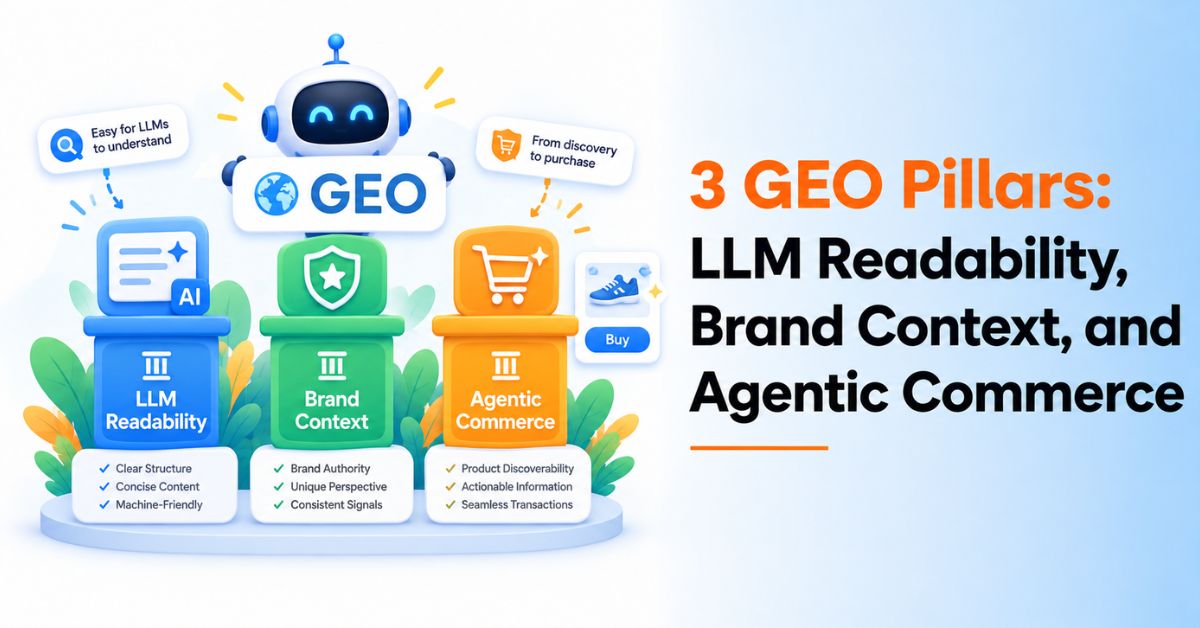
Generative Engine Optimization (GEO) is often described as the process of making content more visible in AI-generated search results. That definition is useful, but incomplete.
AI search does more than retrieve pages and generate summaries. Depending on the query, an AI system may need to understand a source, identify a brand, compare different options, or help a user decide what to buy.
That creates three related but different GEO goals:
- Make content easy for AI systems to understand and cite.
- Build enough brand context for AI systems to understand and recommend the brand.
- Make products and offers easy for AI agents to evaluate and select.
Search Engine Land recently described these as three GEO pillars: LLM readability, brand context, and agentic commerce.
The distinction matters because improving one area does not automatically solve the others.
A well-structured article may be easy for an AI system to cite, but that does not mean the system understands what a company does. A brand may have strong recognition across the web, but its product information may still be difficult for an automated agent to process.
A practical GEO strategy therefore needs to look beyond content optimization.
What are the three GEO pillars?
The three pillars address different stages of AI-assisted search:
|
GEO pillar |
Main objective |
What needs to improve |
|
LLM readability |
Help AI systems understand and cite content |
Content structure, clarity, semantics, technical SEO |
|
Brand context |
Help AI systems understand and recommend a brand |
Brand mentions, entity consistency, third-party sources, topical authority |
|
Agentic commerce |
Help AI agents evaluate and select products or offers |
Product data, structured information, availability, pricing and transaction signals |
The first two are relevant to almost every business with an online presence.
The third becomes especially important when AI systems move from answering questions to helping users complete commercial tasks.
Let's look at each pillar separately.
1. LLM readability: Make your content easy to retrieve and understand
LLM readability is not simply about making an article easier for people to read.
It is about presenting information in a structure that language models can interpret accurately, extract from, and use when generating an answer.
Modern AI search systems can retrieve information from multiple sources and combine relevant passages into a response. That means an article does not always need to be selected as one complete document. Individual sections or passages can become useful sources for specific questions.
This makes information structure increasingly important.
Write around clear information units
A useful section should answer a specific question or explain one concept without forcing the reader or AI system to search through several unrelated paragraphs.
For example, instead of writing a long section about link building that mixes definitions, benefits, pricing and tactics, separate those ideas into focused sections:
- What is link building?
- Why are relevant backlinks important?
- How do editorial backlinks differ from paid placements?
- How should businesses evaluate a backlink opportunity?
Each section creates a clearer information unit.
This also improves traditional SEO because search engines can understand the page's topical structure more easily.
Use direct answers before detailed explanations
AI-generated answers often need concise information that can be extracted from a larger page.
A useful structure is:
Question → direct answer → supporting explanation → example
For example:
What is GEO?
GEO is the process of optimizing content, brand information and digital assets so they can be discovered, understood, cited or recommended in AI-powered search experiences.
The following paragraphs can then explain how GEO differs from traditional SEO.
This does not mean every paragraph should be written for a machine. The content still needs to be useful and natural for people.
Remove semantic ambiguity
AI systems need to understand what a sentence actually means.
Consider a sentence such as:
"It provides better results for businesses."
What does "it" refer to?
What type of results?
For which businesses?
Clearer writing would specify the subject:
"Relevant editorial backlinks can help a website strengthen its authority and improve its visibility for related search topics."
The second version provides more context without relying on surrounding sentences.
This is particularly important for technical subjects, products, services and brands with similar names.
Don't forget traditional SEO
GEO does not remove the need for technical SEO.
A page still needs to be discoverable, crawlable and indexable before it has a realistic opportunity to become part of an AI system's source set.
Important foundations include:
- Indexable pages
- Descriptive titles and headings
- Clean HTML structure
- Internal links
- Fast page performance
- Mobile usability
- XML sitemaps
- Canonical URLs
- Structured data where appropriate
Search Engine Land also makes this distinction: retrieval comes before LLM readability. If a document is not available to the retrieval system, improving its wording cannot make it a source.
For a broader look at how AI visibility can be measured across mentions, citations and rankings, see how to measure AI search visibility.
2. Brand context: Help AI understand what your brand represents
Being cited is only one part of AI search visibility.
Suppose an AI system sees a company mentioned on its own website. That tells the system what the company says about itself.
Now imagine the same company is also mentioned by industry publications, relevant websites, directories, reviews, communities and other independent sources.
The second situation provides a broader information environment around the brand.
That is where brand context becomes important.
Brand mentions are more useful when they carry context
A brand name appearing on a page is not necessarily meaningful.
Compare:
"Company X is mentioned here."
with:
"Company X is a marketplace where businesses can find guest posting websites and digital marketing services."
The second statement connects the brand with:
- A category
- A business model
- Specific services
- A target audience
- A use case
That context gives AI systems more information about how the brand relates to a topic.
Build consistent entity information
Your website should make basic brand information easy to understand.
For example, important pages should consistently explain:
- What the company is
- What category it belongs to
- What products or services it provides
- Who it serves
- Which problems it solves
- Which markets or industries it covers
The same information should not contradict itself across major external sources.
If one website describes a company as an SEO agency, another calls it a software company, and the company's own website describes it as a marketplace, an AI system has more ambiguity to resolve.
Consistency does not mean copying the same description everywhere. It means maintaining the same underlying facts while adapting the wording to each publication.
Third-party sources matter
AI systems can encounter a brand outside its own website.
Relevant sources may include:
- Industry publications
- Editorial articles
- Digital PR coverage
- Reviews
- Business directories
- Expert contributions
- Industry communities
- Social profiles
- Partner websites
- Relevant backlinks
This is one reason digital PR and link building can contribute to GEO, even though a backlink does not guarantee an AI citation.
The goal is not to manufacture hundreds of brand mentions.
The goal is to build a network of relevant sources that provides useful context around the brand.
Vefogix's guide on AI search link building covers the relationship between backlinks, digital PR and brand mentions in more detail.
Think beyond your own website
Your website tells AI systems what you claim about your business.
The wider web can provide evidence of how your business is discussed by other sources.
That makes off-site SEO increasingly relevant to AI visibility.
For example, a company selling SEO software could publish a detailed product page. But if independent industry publications, comparison pages and relevant experts also discuss the company in the context of SEO software, the brand has a broader digital footprint around that category.
This does not mean every external mention is equally valuable.
Relevance and context matter more than simply increasing the number of mentions.
3. Agentic commerce: Prepare for AI-assisted buying decisions
The third GEO pillar is different from the first two.
LLM readability focuses on whether AI can understand content.
Brand context focuses on whether AI understands and recognizes a brand.
Agentic commerce focuses on whether an AI agent can evaluate and act on commercial information.
This becomes important as AI systems move beyond answering questions and increasingly assist with product discovery, comparison and purchasing workflows.
Imagine a user asking:
"Find me a laptop under $1,000 with 16GB RAM, at least 1TB storage and next-day delivery."
An agent needs more than an article explaining laptops.
It needs structured and current information about individual products.
That can include:
- Product name
- Price
- Availability
- Specifications
- Product identifiers
- Reviews
- Ratings
- Shipping information
- Return policies
- Seller information
- Purchase options
The quality of that underlying data can affect whether an automated system can confidently evaluate an offer.
Structured product data becomes more important
For ecommerce businesses, product information should be machine-readable as well as human-readable.
Relevant implementation can include:
- Product structured data
- Accurate prices
- Current availability
- Product identifiers
- Reviews and ratings where applicable
- Clear product variants
- Consistent product feeds
- Updated inventory information
The exact requirements depend on the platform and type of business.
The larger principle is simple:
If an AI agent cannot reliably understand an offer, it has less information with which to evaluate that offer.
Agentic commerce is broader than product pages
The same concept applies to the rest of the buying journey.
An AI agent may need to understand:
- What the product or service is.
- Who it is suitable for.
- How much it costs.
- Whether it is available.
- How it compares with alternatives.
- What restrictions apply.
- How the transaction can be completed.
For traditional ecommerce, much of this information exists in product catalogs and merchant feeds.
For service businesses and marketplaces, the equivalent information may be distributed across service pages, packages, profiles, pricing information, reviews and marketplace listings.
That makes clear commercial information useful even outside traditional ecommerce.
How the three GEO pillars work together
These pillars should not be treated as three completely separate SEO projects.
They form a progression.
LLM readability → Brand context → Commercial selection
First, AI needs to understand the information.
Then it needs to understand what the brand represents.
For commercial searches, it may then need enough structured information to compare available options.
Consider a company that sells an SEO product.
Stage 1: LLM readability
The company's website clearly explains:
- What the product does
- Who it is for
- How it works
- Which problems it solves
- How its features differ
The content is structured and technically accessible.
Stage 2: Brand context
Independent publications and relevant websites discuss the product in the context of its category.
The brand is consistently associated with its product and audience.
Stage 3: Agentic commerce
The product information includes accurate:
- Pricing
- Availability
- Specifications
- Reviews
- Product identifiers
- Purchase information
Now an AI system has more of the information required to move from understanding to recommendation or selection.
This is why GEO should not be treated as simply "writing content that ChatGPT can read."
It is becoming a broader discipline covering content, technical SEO, brand visibility and commercial data.
Where backlinks fit into the three-pillar model
Backlinks do not belong to only one GEO activity.
Their value depends on the context around the link.
A relevant editorial backlink can help search engines discover and evaluate a page. It can also place a brand within a relevant topical environment.
For example, a backlink from a respected marketing publication to an SEO marketplace page provides more context than an unrelated link from a generic website.
This does not mean the backlink automatically causes an AI system to cite the destination page.
Instead, think of backlinks as one component of a broader visibility system involving:
- Discoverability
- Topical relevance
- Content authority
- Brand mentions
- Third-party context
- Traditional rankings
Vefogix's link building services can be considered within this wider SEO and authority-building framework rather than as a standalone GEO shortcut.
A practical GEO framework for businesses
Businesses can use the three pillars as an audit framework.
Step 1: Check LLM readability
Review important pages and ask:
- Can the main topic be understood quickly?
- Does each section answer a clear question?
- Are definitions precise?
- Are important facts easy to extract?
- Are headings descriptive?
- Can search engines crawl and index the page?
- Are internal links helping establish topic relationships?
Step 2: Check brand context
Search for your brand across relevant sources.
Look for:
- How other websites describe the company
- Which category the brand is associated with
- Which products or services are mentioned
- Whether descriptions are consistent
- Which third-party sources are being cited
- Whether competitors have stronger topical coverage
You can also monitor AI answers for brand mentions and citations.
Vefogix's AI search visibility metrics guide explains why tracking mentions alone is not enough and why citations, rankings and other signals should be considered together.
Step 3: Check commercial data
If you sell products or services, review the information an AI-assisted buyer would need.
For products, this may include:
- Price
- Availability
- Specifications
- Reviews
- Product data
- Shipping and returns
- Purchase options
For services, it may include:
- Service description
- Pricing or packages
- Deliverables
- Target audience
- Locations served
- Experience or credentials
- Availability
- Clear next steps
The goal is to reduce ambiguity between what the business offers and what an automated system can understand.
GEO does not replace SEO
It is tempting to treat GEO as the next version of SEO.
A better way to think about it is that GEO extends search optimization into environments where the final result may be an AI-generated answer, recommendation or action rather than a conventional list of links.
Traditional SEO still provides important foundations:
Crawlability → Indexing → Retrieval → Relevance → Authority
GEO adds additional considerations:
Understandability → Brand context → AI visibility → Recommendation → Commercial selection
The two systems overlap heavily.
Technical SEO helps content become discoverable.
Good content makes information easier to understand.
Digital PR and relevant backlinks can expand a brand's presence across independent sources.
Structured commercial information can make products and offers easier for automated systems to evaluate.
The future of GEO is not just about being cited
Citations remain an important part of AI search visibility, but they represent only one possible outcome.
A business may want its:
- Content cited
- Brand mentioned
- Brand recommended
- Product compared
- Product selected
- Service discovered
- Offer considered
These are different outcomes and require different optimization work.
That is the key idea behind the three GEO pillars.
LLM readability helps AI understand your information.
Brand context helps AI understand what your brand represents.
Agentic commerce helps AI evaluate products and offers when users are ready to make a decision.
Businesses that treat GEO only as a content-writing exercise may miss the broader changes taking place in AI-powered search.
The stronger approach is to connect technical SEO, useful content, brand authority, third-party visibility and structured commercial information into one search strategy.
Frequently Asked Questions
The three pillars of Generative Engine Optimization (GEO) are LLM readability, brand context, and agentic commerce. LLM readability focuses on making information easy for AI systems to understand and retrieve. Brand context helps AI systems understand what a company represents and how it relates to a topic. Agentic commerce focuses on making products and commercial information easier for AI agents to evaluate and act on.
LLM readability refers to how easily AI systems can understand, extract, and use information from a webpage. Clear headings, direct answers, structured content, precise language, internal links, and accessible page architecture can make important information easier to interpret.
Brand context helps AI systems connect a company with its products, services, industry, audience, and areas of expertise. Consistent information across a company's website and relevant third-party sources can help establish clearer associations between the brand and the topics it wants to be known for.
Agentic commerce refers to optimizing product and commercial information for AI systems that can help users compare options or complete purchasing tasks. Accurate pricing, availability, product specifications, reviews, identifiers, shipping information, and clear purchase options can make commercial information easier for AI agents to evaluate.
Backlinks can contribute most directly to LLM discoverability and brand context, particularly when they come from relevant sources and place a brand within a meaningful topical context. They do not guarantee AI citations or recommendations. Agentic commerce relies more heavily on accurate, structured, and current product or offer information.
No. GEO builds on many of the same foundations as SEO, including crawlability, indexing, content quality, internal linking, and relevance. The difference is that GEO also considers how AI systems understand information, associate brands with topics, generate answers, and evaluate commercial options.